Translated with AI from the Russian original.
Teachers and cadets of the Volsk branch of the Military Academy of Logistics (VA MTO) named after A.V. Khrulev have developed the "Volchanin" ground drone. The radio channel of the device has high noise immunity.
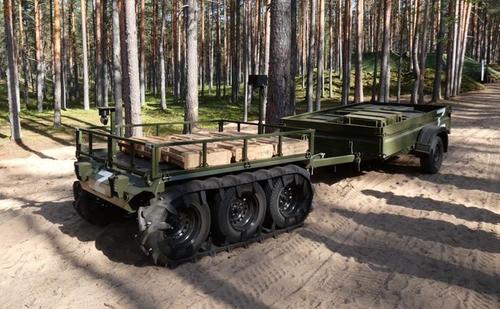
The drone can be controlled remotely via a remote antenna or a drone repeater located at a distance of up to 10 km.
This range of the complex is limited by the radio path - at a greater distance, there is a chance of losing control of the drone.
The press service of VA MTO explained that the developers paid special attention to the transmission of the ground drone. Thanks to this, the product can be operated in off-road conditions. "Volchanin" overcomes barriers with an angle of inclination of 30 degrees.
Characteristics of the ground platform:
- "Korshun" control system
- Drone weight - 600 kg
- Range - 30 km
- 2 silent 5.5-kilowatt asynchronous electric motors
- Load capacity when using a trolley - 950 kg
- Automatic cargo release
Now we have to solve several more technical problems, for example, to increase the autonomy of the platform.
The first four "Volchanin" drones were created in cooperation with the Ufa Tram and Trolleybus Plant. Now they are being tested in real combat conditions.
Read also on the topic:
Vysokotochka Manufactures Irbis Robotic Chassis Prototype
Laboratory for Assembling and Repairing Ground Drones Created by "Zapad" Military Groups
Terrible Gun: The Latest Ground Robots with Large-Caliber "Utes" Have Entered the Russian Military
Never miss our newsAdd this site to your preferred sources to see us more oftenAdd on Google

















