Developers from the St. Petersburg State Marine Technical University (SPbGMTU) have patented flexible fins for an underwater robot, modeled after a stingray's pectoral fins. Unlike conventional rigid propulsion elements, this design should provide up and down movement and wave-like bending and twisting, helping the robot maneuver more precisely underwater.
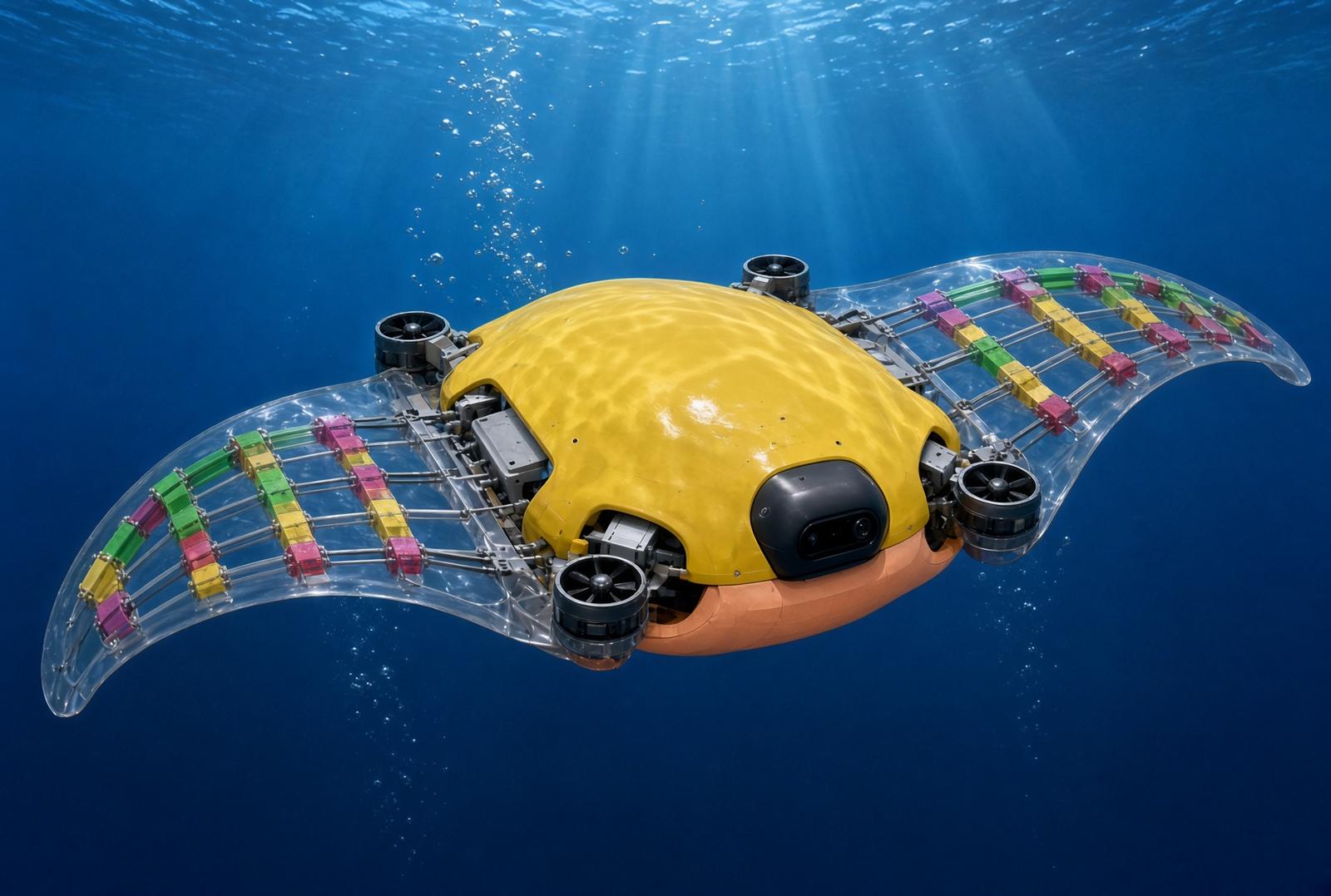
The fin will be able to perform several types of movement
The propulsion unit is based on a triangular flexible fin that attaches to the body of the underwater robot. Flexible frames are placed along its sides, and the entire structure is covered with an elastomeric shell.
Inside are flexible links, traction cables, and servo drives. The cables connect the drives to the frame and allow its bending to be controlled.
If the servo drives rotate synchronously, the links bend in one direction. The fin then performs a flapping motion up or down.
When the drives rotate in antiphase, another mode arises — controlled wave-like bending along the fin. This principle should allow for the reproduction of the characteristic movement of a stingray's pectoral fins.
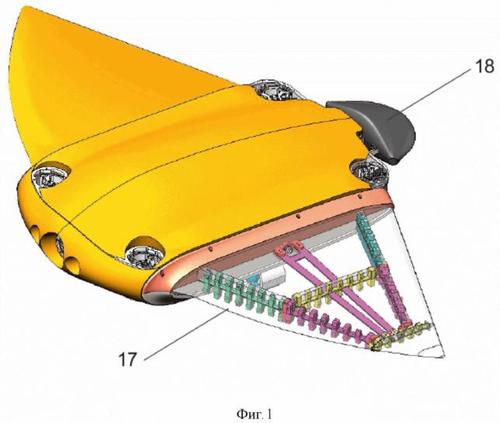
The design includes five servo drives
According to the patent description, one pectoral fin has five servo drives. Four of them control the flexible links via cables, and the central drive is responsible for twisting the fin around its longitudinal axis.
Due to this, the authors describe three components of movement: flapping, longitudinal wave, and twisting.
The operating parameters of the drives can be set programmatically. The patent states that the system allows changing the amplitude, frequency, and phase of each cable's movement.
The fin itself is made of two parts with silicone filling. Inside is a frame, and the outer part forms a flexible shell. The end part of the fin remains uncontrolled and moves by inertia.
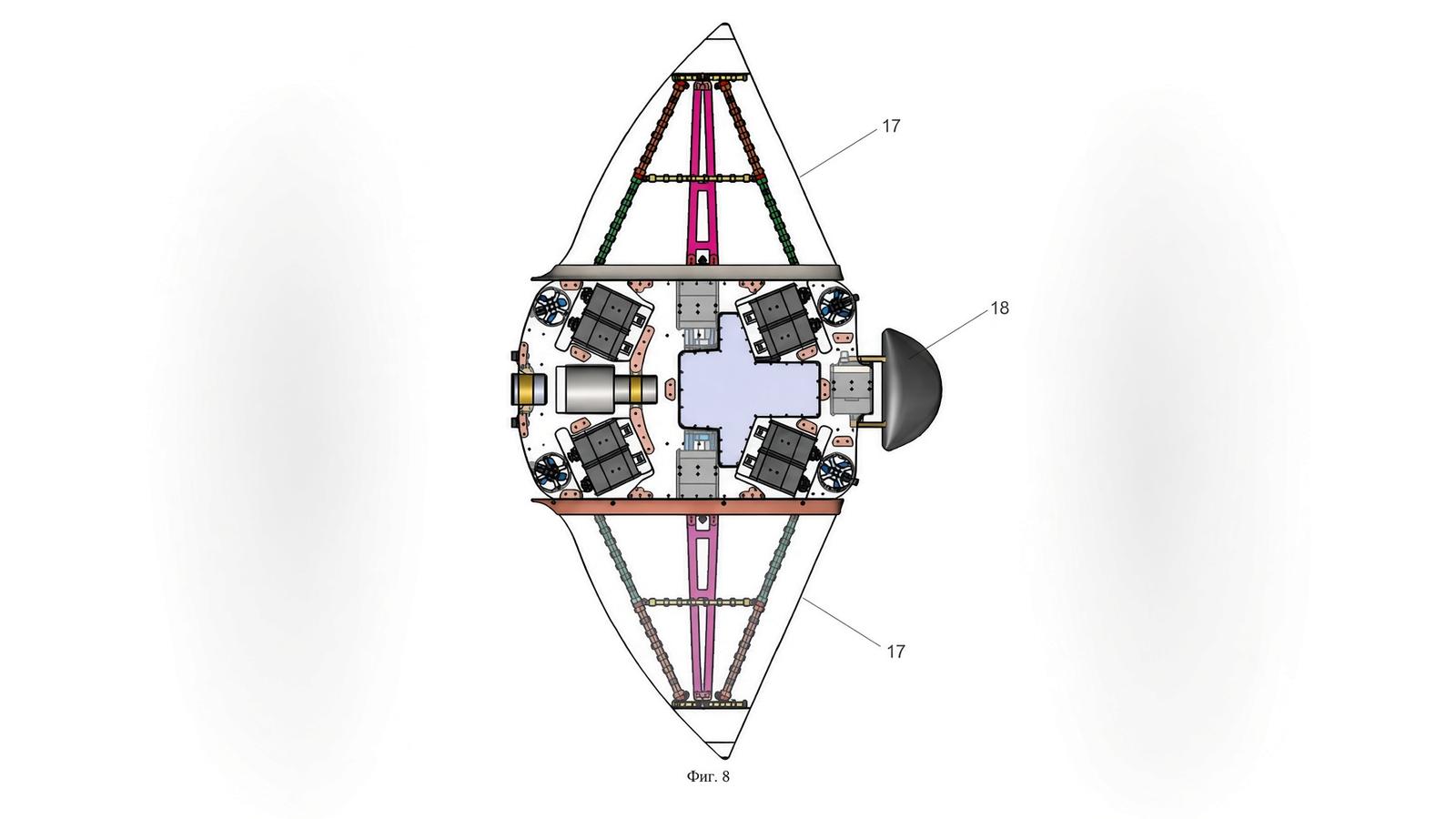
Why a robot needs a fin instead of a conventional thruster
The authors link the development to the search for more energy-efficient and silent ways of moving underwater. As an example, they consider stingrays, whose pectoral fins create complex wave-like motion.
The patent notes that the conventional design of such a fin faces a problem: it must remain both thin and flexible, but at the same time transmit force from the drives. Therefore, it is proposed to place the drives outside the thin flexible surface, and transmit its deformation through cables and a system of flexible links.
Read more on the topic:
Never miss our newsAdd this site to your preferred sources to see us more oftenAdd on Google