Translated with AI from the Russian original.
Russian scientists have developed a mathematical model for underwater drones that can change depth using a principle similar to how a fish's swim bladder works. The new approach will allow devices to consume less energy and operate autonomously underwater for longer periods. The research was conducted by MIPT scientists. The results of the study were published in Scientific Reports.
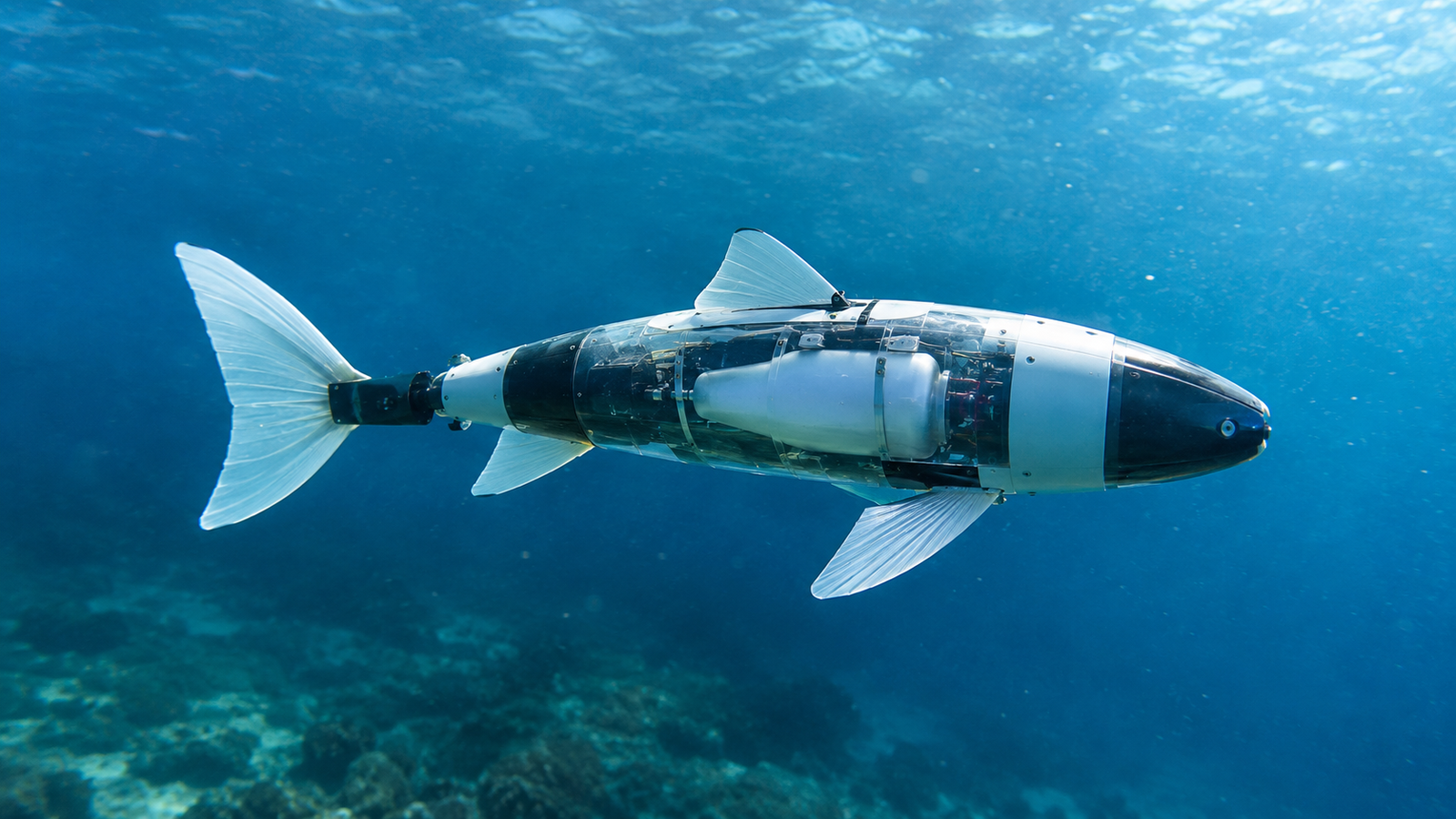
The swim bladder helps bony fish regulate buoyancy. However, this mechanism has a peculiarity — as depth changes, the volume of gas in the bladder changes due to pressure. Therefore, the fish finds itself in an unstable equilibrium. The amount of gas in the bladder can be changed physiologically, but this takes time.
Most modern underwater drones solve the problem differently. To change depth, they use ballast systems that pump water. This requires energy and creates noise.
MIPT scientists have shown that an underwater vehicle with a variable volume and a swim bladder can be stabilized during movement. In other words, the robot can use its own movement to maintain the desired position in the water.
According to Viktor Kazantsev, head of the MIPT Neurobiomorphic Technologies Laboratory, if the bladder is placed in the tail section of such a robot and its volume is reduced, the rear part of the device will begin to sink, and the fins will stabilize it. When the volume increases, the opposite happens: the tail begins to rise. By balancing between these states, the device can move.
According to calculations, stability during movement arises due to the connection between the tilt of the device and its upward or downward movement. For this, the swim bladder and the point of application of the lifting force must be behind the center of mass. However, stability only appears after a certain speed is reached. If moving too fast, the device becomes unstable again due to the speed-geometric factor.
Now, developers need to test the calculations on real prototypes. The operation of such a system will be affected by pressure at different depths, material strength, ability to withstand currents, and control accuracy.
Underwater drones can be used for environmental monitoring of water bodies, studying marine animals, researching underwater ecosystems, searching for pollution, and monitoring pipeline conditions. A bio-inspired design is particularly interesting for observing the environment and animals, as it allows for reducing the impact of the device on it.
If the calculations are confirmed, specialists will have a tool for designing economical underwater vehicles capable of performing long autonomous missions. All data and model code are publicly available on GitHub.
Read more on the topic:
Never miss our newsAdd this site to your preferred sources to see us more oftenAdd on Google

















