The bodies of the head and intermediate cars of the future high-speed train were tested with a series of impact tests at the "Uralskiye Lokomotivy" plant. At each stage, the load was increased by 20 tons, while simultaneously recording body deformations, accelerations, and the actual impact force.
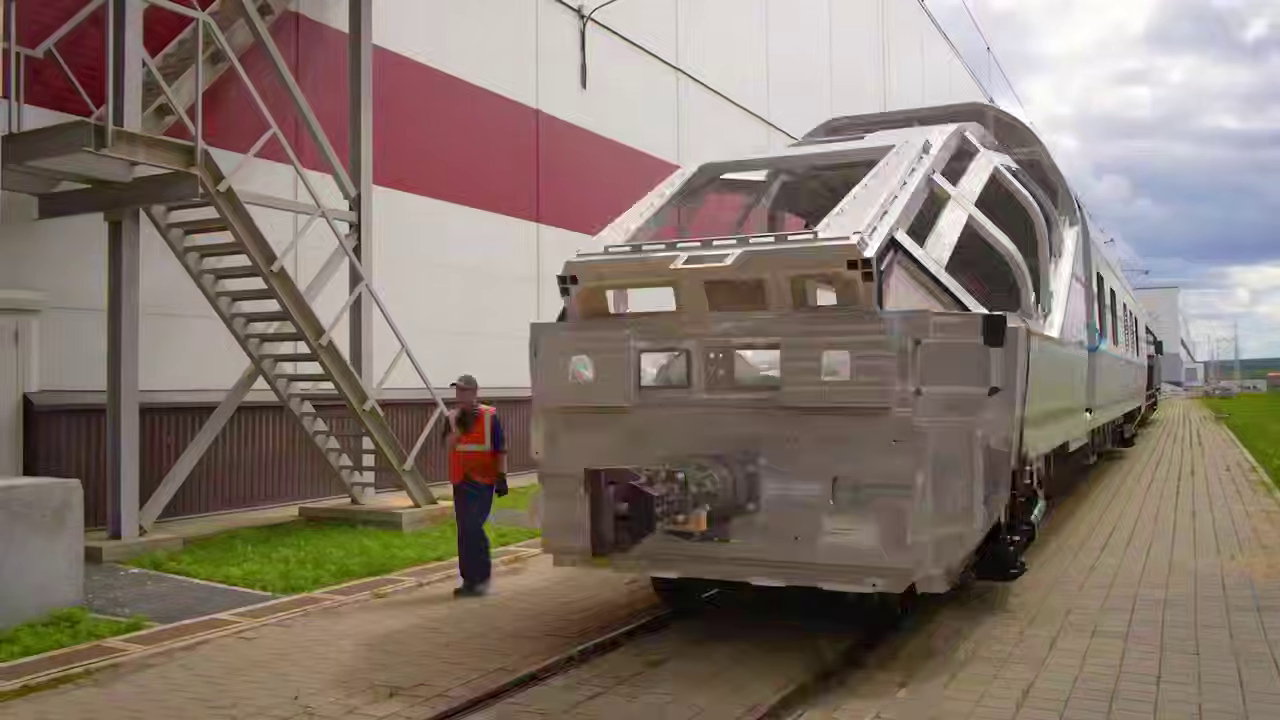
For the tests, two experimental bodies were installed on bogies, loaded to a specified mass, and combined into a special coupling. A ram car, accelerated by a locomotive, crashed into it. The tests began with small loads, which were then gradually increased in 20-ton increments.
To see how the structure absorbs the impact, dozens of strain gauges were installed on the frame, beams, door and window openings, and the cabin frame. Accelerometers were placed on the body to record longitudinal accelerations, and automatic couplers were equipped with strain gauge schemes to determine the actual impact force.
The check is especially important for a train designed to travel at speeds up to 400 km/h. In the event of a collision, the structure must absorb a significant part of the impact energy, maintaining the geometry of the cabin and passenger compartment.
The tests are conducted by specialists from VNIIZhT, and the bodies themselves are manufactured for the first trains of the domestic Moscow-St. Petersburg HSR, the first two of which are scheduled to go for certification tests in 2027.
Read more on the topic:
Never miss our newsAdd this site to your preferred sources to see us more oftenAdd on Google