Translated with AI from the Russian original.
Scientists from the Herzen State Pedagogical University of Russia have become winners of the St. Petersburg 2026 innovation projects competition in the "Physics and Mathematics" category, the university's press service told "Pervy Tekhnichesky". Their work is dedicated to materials that can accelerate the creation of new generation memory devices. The project by Doctors of Physical and Mathematical Sciences Alla Marchenko and Pavel Seregin, "Mössbauer study of the short-range order structure of amorphous and crystalline films (GeTe)x(Sb2Te3)", investigates the alloy of germanium, antimony, and tellurium (GeSbTe) — a material already used in modern computer chips and rewritable discs.
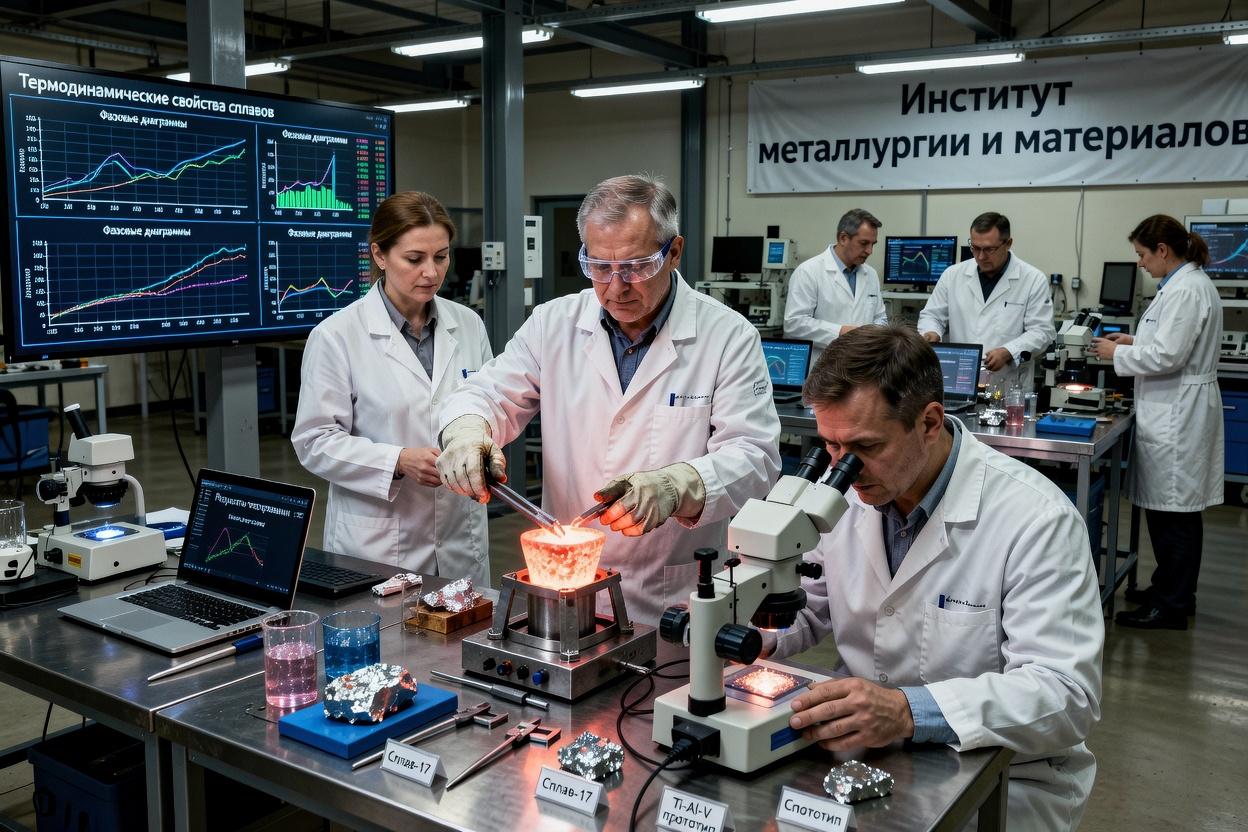
Understanding the changes in its structure during the transition from amorphous to crystalline state and back is critically important for creating faster, more reliable, and energy-efficient data storage devices. The scientists relied on the ideas of mid-20th century physicists Abram Ioffe and Aleksey Regel, who proved that the properties of semiconductors depend not on the overall structure, but on the local arrangement of atoms.
As Alla Marchenko explained, they were able to show for the first time that the phase transition is accompanied by a change in the valence state and coordination number of only germanium atoms. At the same time, the local environment of antimony and tellurium remains unchanged. In the amorphous state, germanium atoms arrange themselves into stable "pyramids" (tetrahedra), while in the crystalline state, they rearrange into a distorted octahedron. The experimental data obtained bring closer the practical implementation of these ideas in next-generation information storage devices. The competition for the best innovative projects has been held by the government of St. Petersburg since 2024 to support developments with high scientific and practical potential.
Read more on the topic:
Never miss our newsAdd this site to your preferred sources to see us more oftenAdd on Google

















