Scientists from "Kvantum Park" of Bauman Moscow State Technical University and VNIIA have developed a technology for producing tantalum-based superconducting integrated circuits. The development allows for more than a 10-fold increase in the quality of components for quantum computers. The first deliveries of quantum coprocessors on a tantalum platform are planned for autumn 2026.
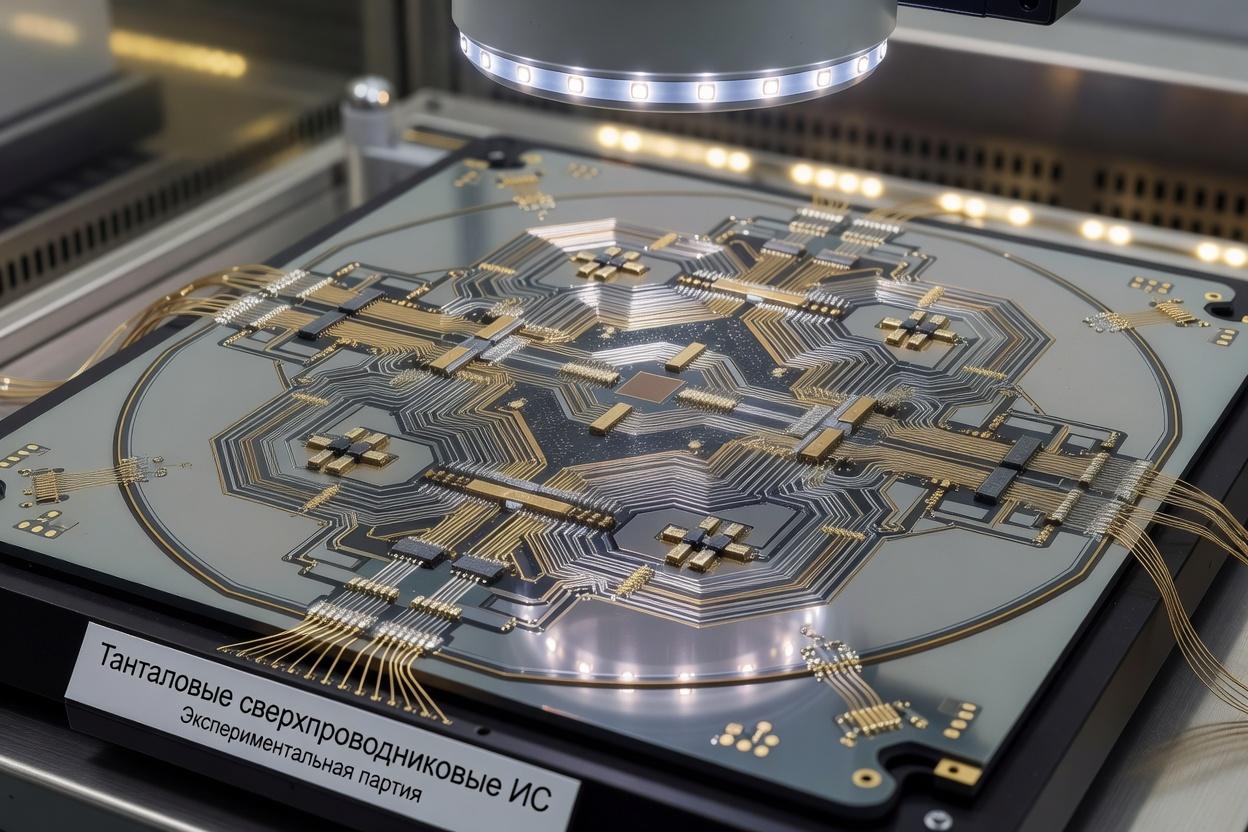
Tantalum is significantly more resistant to acids and aggressive environments than aluminum. This allows components to be subjected to more intensive cleaning, removing atomic contaminants and oxides from the surface that degrade qubit characteristics. In addition, the natural tantalum oxide contains significantly fewer defects compared to aluminum oxide, so quantum information is preserved longer.
During tests on tantalum microwave resonators, their quality factor – the ability to preserve quantum information – exceeded 10 million in single-photon mode. Russian scientists call this indicator one of the best in the world: similar values have only been achieved at Princeton University (USA) and the Belgian nanotechnology center IMEC.
One of the key technical challenges was obtaining the correct phase of tantalum. High-purity alpha-tantalum is required for superconducting circuits. Thin films of the metal grow in two phases – beta and alpha, and to transition to the desired phase, it is necessary to control the growth conditions during the film deposition stage. Specialists conducted more than 1000 experiments using atomic resolution transmission microscopy. This allowed them to track sub-nanometer structural features of alpha-tantalum on silicon, which cannot be seen with conventional instruments.
Read more on the topic:
Never miss our newsAdd this site to your preferred sources to see us more oftenAdd on Google

















