Physicists at the Joint Institute for Nuclear Research (JINR) have for the first time achieved simultaneous circulation of counter-propagating ion beams at the NICA collider, the institute's press service reported. On the night of February 12, 2026, during commissioning work, specialists from the Laboratory of High Energy Physics successfully organized the stable movement of xenon ions along the upper and lower rings, which confirms the correct and synchronous operation of all engineering systems of the complex.
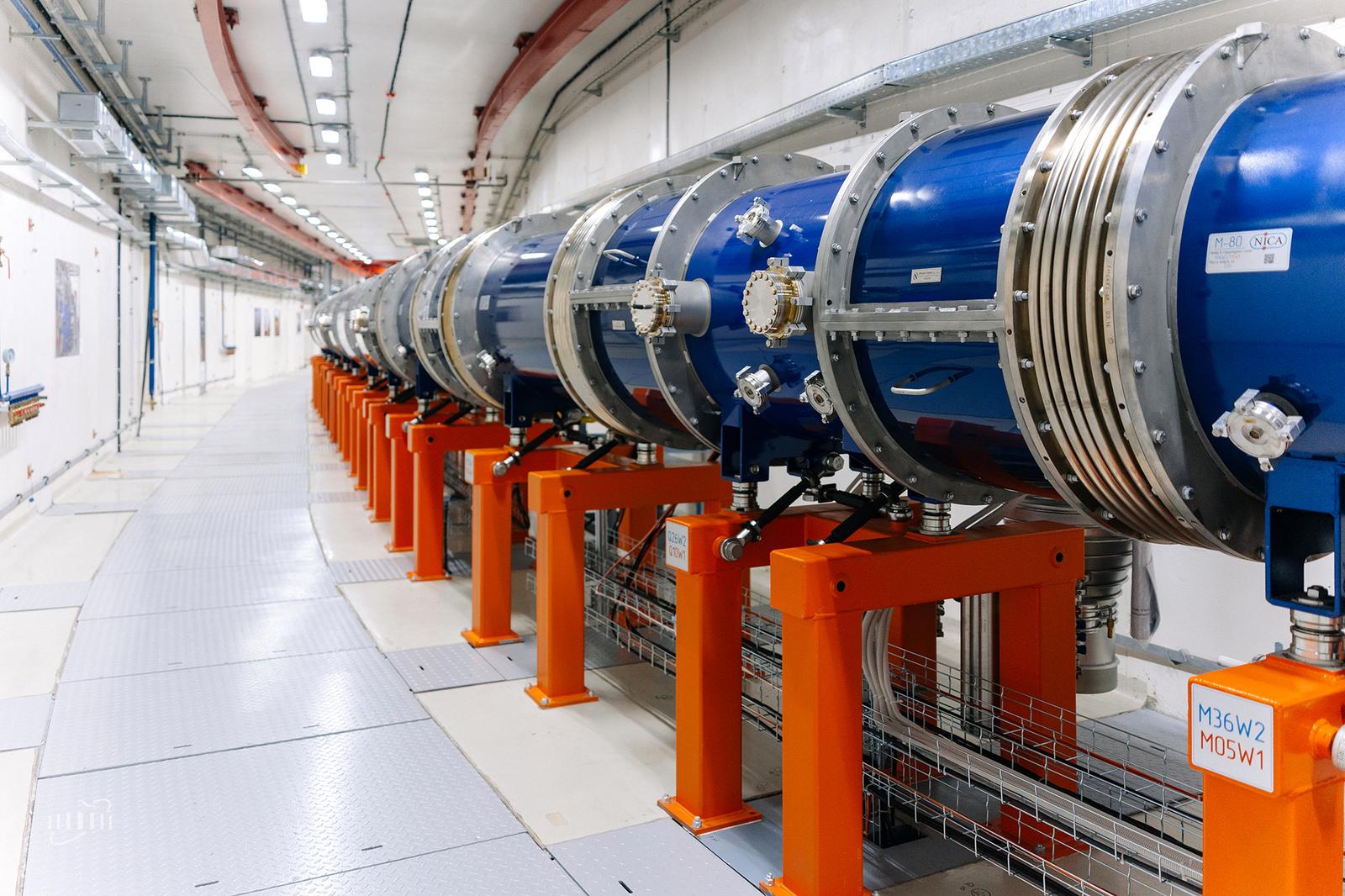
Achieving the two-beam mode is a logical development of January's success with a single beam. This opens the way to obtaining the design parameters of collisions and confirms that the characteristics of the main systems of the collider meet the technical requirements. The next steps include precise measurement and adjustment of the ring optics, increasing the intensity of the beams, and bringing the particle bunches together at the collision point to register the first collisions.
NICA (Nuclotron based Ion Collider Facility) is a Russian mega-science project aimed at studying quark-gluon plasma and the processes of formation of protons and neutrons in the first moments after the Big Bang. The first session of experiments started in the spring of 2025.
A key element of the complex's operation was also the cryogenic system, developed by specialists from BMSTU and put into operation at the end of 2025. It provides continuous circulation of liquid neon at 28.5 K through a high-temperature superconducting energy storage (SMES), allowing to maintain record parameters of the device. The use of liquid neon increases energy efficiency, improves heat exchange and reduces the size of the installation. The system is automated, capable of long-term operation without human intervention and adapted to the conditions of strong magnetic fields.
The BMSTU press service noted that the technologies developed for NICA have potential in superconducting energy, space research, microelectronics and laser technology. The success of the two-beam mode opens up the possibility for Russian physicists to conduct full-fledged experiments that will provide unique data on the state of matter in the first fractions of a second after the Big Bang and expand the understanding of the fundamental laws of particle physics.
Read more materials:
- Board for the NICA Supercollider Developed and Tested by TSU Scientists
- New Supercomputer for Nuclear Research to Process Data from the NICA Collider Launched in Samara
- Calorimeter for the NICA Collider Being Tested in Novosibirsk Using Electron Beams
Never miss our newsAdd this site to your preferred sources to see us more oftenAdd on Google

















