Translated with AI from the Russian original.
The published image of the Pantsir-S1 anti-aircraft missile and gun system (SAM) on the KamAZ-6560 (8×8) chassis shows for the first time the integration of multi-level protection elements - from anti-drone and anti-cumulative threats to active electronic warfare (EW) equipment. Particular attention is drawn to the modular mounted spaced armor and compact multi-band EW modules located directly on the combat vehicle.
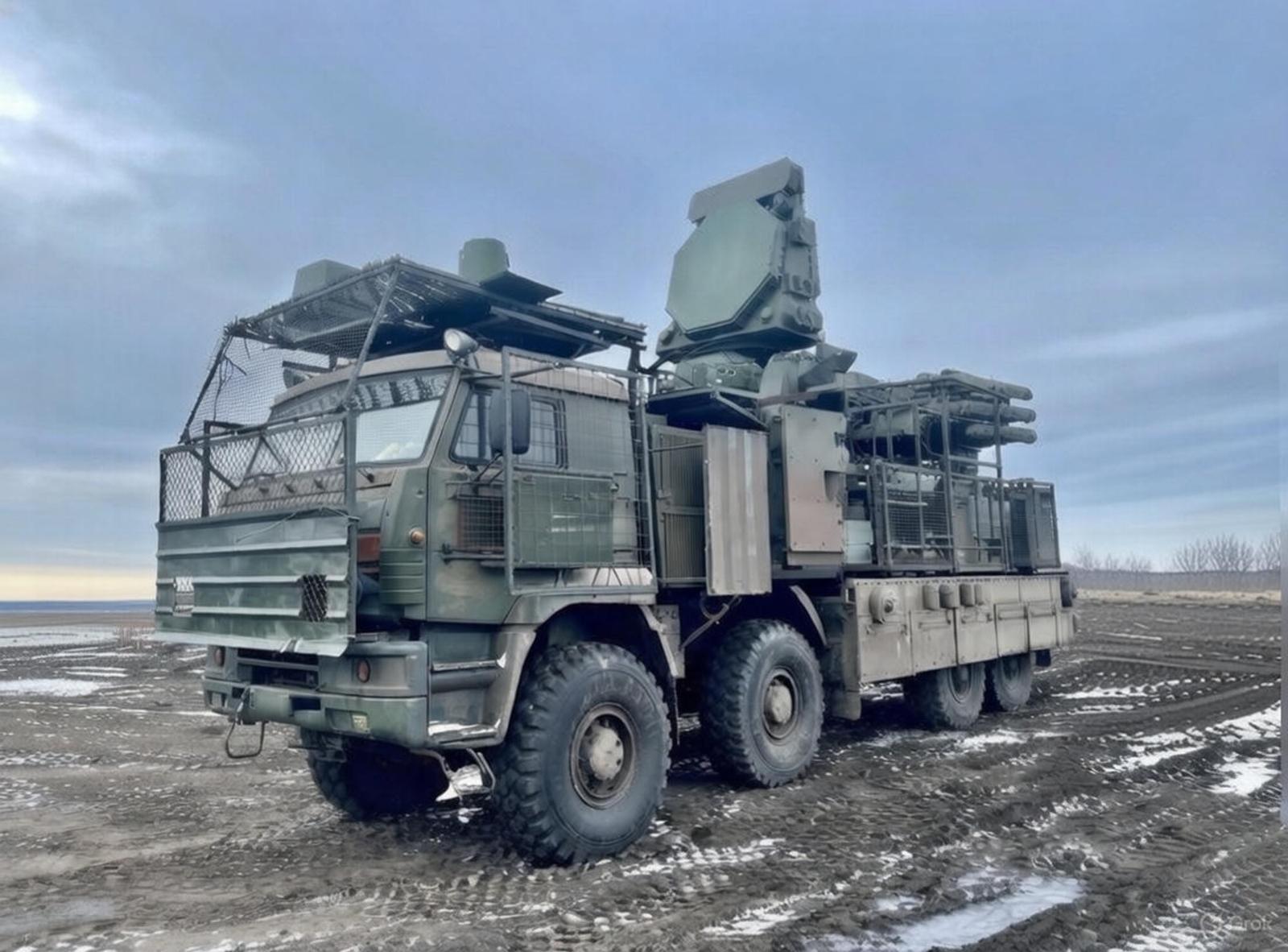
This arrangement poses a challenge for engineers to ensure stable operation of onboard radar stations against the background of their own interference. The solution was found in a flexible electromagnetic compatibility (EMC) architecture. As the design analysis shows, stable formation of the radiation pattern of the detection radar - RLM SOC (S-band) - is achieved in two key ways:
- Temporary shutdown of EW modules at the time of active airspace surveillance and firing. This eliminates internal interference when working with targets with a small effective reflecting surface (ERS), especially in difficult meteorological conditions.
- Physical separation of the antenna post. The RLM SOC antenna is raised 1.5–2 meters above the level of the EW modules. In combination with an active phased antenna array (APAA) and the possibility of electronic beam scanning, this provides partial spatial and electromagnetic isolation.
As for the missile guidance and tracking radar - 1RS1-2 (Ka-/X-bands) - it demonstrates a high degree of EMC with EW systems, since the latter operate mainly in the L/S-bands. Nevertheless, in critical modes (for example, when tracking UAVs or highly maneuverable targets), preference is still given to temporarily disabling EW to ensure maximum guidance accuracy.
Read more materials on the topic:
- Minister of Defense of the Russian Federation called for accelerating the production of the Pantsir-S1 SAM system
- Mi-24 attacked, Mi-8 rescued, Ka-27PL hunted: Baltic Fleet exercises took place
- The Ministry of Defense of the Russian Federation showed the combat work of the naval Pantsir-M SAM system
Never miss our newsAdd this site to your preferred sources to see us more oftenAdd on Google

















