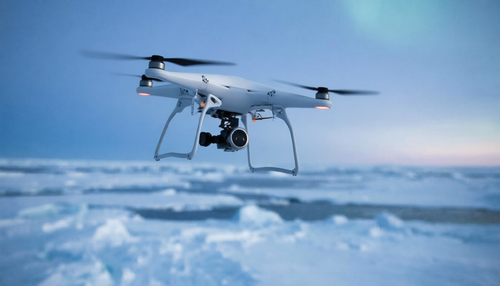
The St. Petersburg Federal Research Center of the Russian Academy of Sciences (SPC RAS), together with the Immanuel Kant Baltic Federal University and the Russian company "R-Sensor", presented a prototype of an unmanned aerial vehicle equipped with a seismometer and a mechanism for burying it in the ground. The development is aimed at automating geological exploration in hard-to-reach Arctic regions and can radically simplify the collection of seismic data in extreme conditions.
Traditional seismic exploration methods today still depend on wired measuring systems, requiring the involvement of hundreds of specialists, complex logistics and significant time costs. This problem is particularly acute in remote areas with developed infrastructure - for example, in the Arctic, where climate, transport isolation and lack of communication complicate field work many times over.
The new drone, developed as part of a project supported by a grant from the Russian Science Foundation, is capable of autonomously performing tasks for deploying seismometers and providing more reliable contact with the surface through a burial system. This allows you to obtain high-quality seismic data without the need for physical presence of operators at each measurement site.
The design of the device and the software for coordination with other unmanned platforms were created in the Laboratory of Autonomous Robotic Systems of SPIIRAS - a division of the St. Petersburg Federal Research Center of the Russian Academy of Sciences. Scientists are already testing the prototype in conditions close to the Arctic and plan to further optimize the system for use in industrial geological exploration.
Read more materials:
- Adapted for operation in Arctic conditions: the new Geoscan 701 drone entered service in Chukotka
- Arctic UAV test center opened in Salekhard
- Russian company Neiry made drones out of live pigeons using neurochips
Never miss our newsAdd this site to your preferred sources to see us more oftenAdd on Google