Tomsk State University (TSU) has patented three software solutions for testing and processing signals from sensors developed at the Center for Advanced Technologies in Microelectronics (PTM). The programs enhance the quality and reliability of reading devices used in medicine, industry, and scientific research.
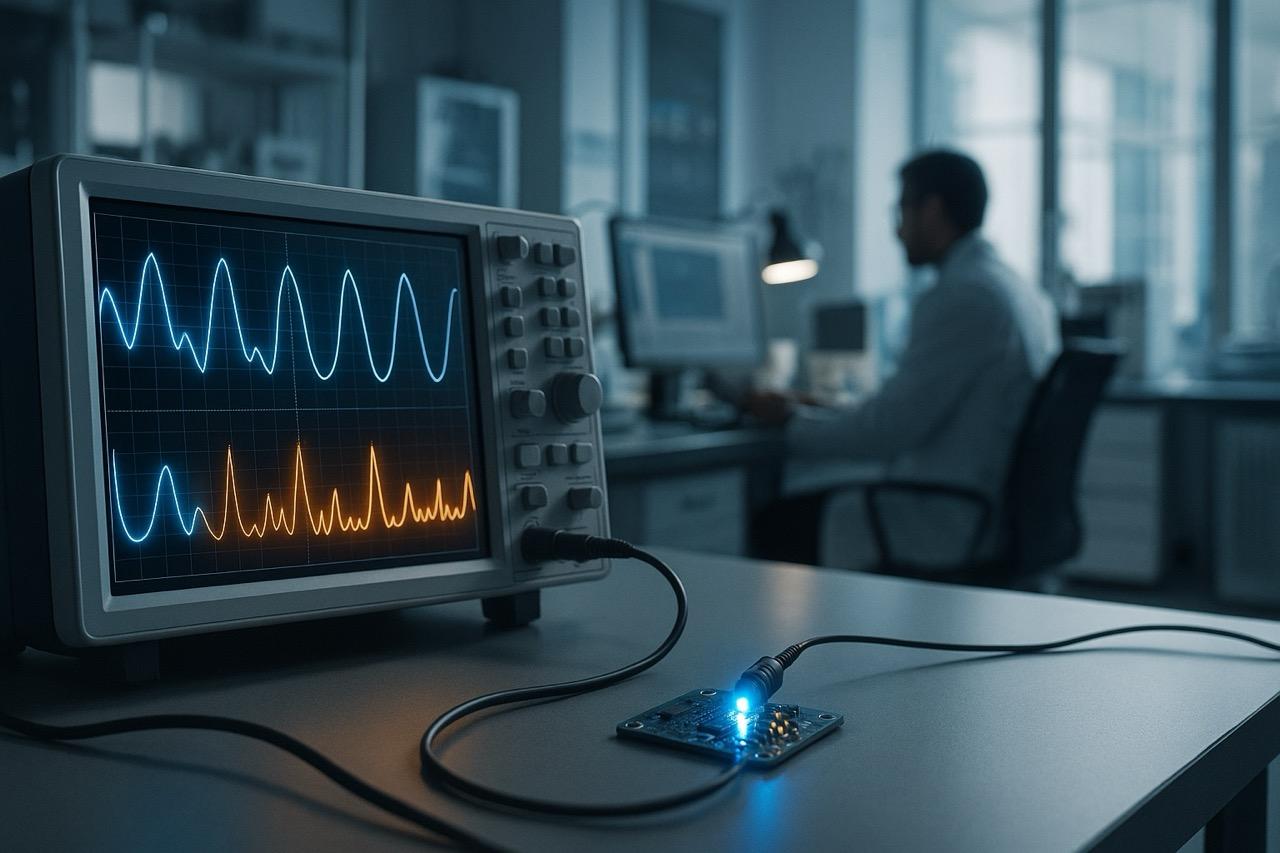
The first program is designed for digital filtering of pulse signals. It helps to isolate the useful signal from noise, which is critical for accurate measurements and high-speed radiation registration. This is particularly important in small-channel systems, where intense particle fluxes can make it difficult to identify individual sensor sectors, explained Anton Tyazhev, a researcher at PTM TSU.
The second development allows for constructing the amplitude spectrum of X-ray sensor signals in real-time. The program evaluates the charge collection efficiency of the sensor - an analog of the efficiency coefficient, showing what part of the energy the sensor converts into a useful signal. The higher this indicator, the more accurate and higher quality the device's operation.
The third program extracts the electrophysical characteristics of the sensor material, in particular, the product of mobility and lifetime of charge carriers - a key parameter for assessing the quality of the detector material. This allows for a deeper study of internal processes and optimization of sensor characteristics for specific operating conditions.
All programs can be installed on a digital oscilloscope running Windows, processing data in real-time without additional equipment. The system analyzes signals directly from the sensor after digitization, which allows tracking the intensity of radiation and spectral composition even at high-speed particle fluxes.
Read more on this topic:
- A method for reducing the size of microchips has been developed in Russia
- Russian scientists have started developing import-substituted ceramic sensors for microelectronics
- Microelectronics manufacturer "Element" has launched a direction of industrial robotics
Never miss our newsAdd this site to your preferred sources to see us more oftenAdd on Google

















