Transport remains one of the most knowledge-intensive industries. Today, Russian scientists are actively involved in its development. The President of the Russian Academy of Sciences (RAS), Gennady Krasnikov, in an interview with RIA Novosti, spoke about the joint work of the Academy and the Ministry of Transport, which is crucial for the development of the Northern Sea Route (NSR).
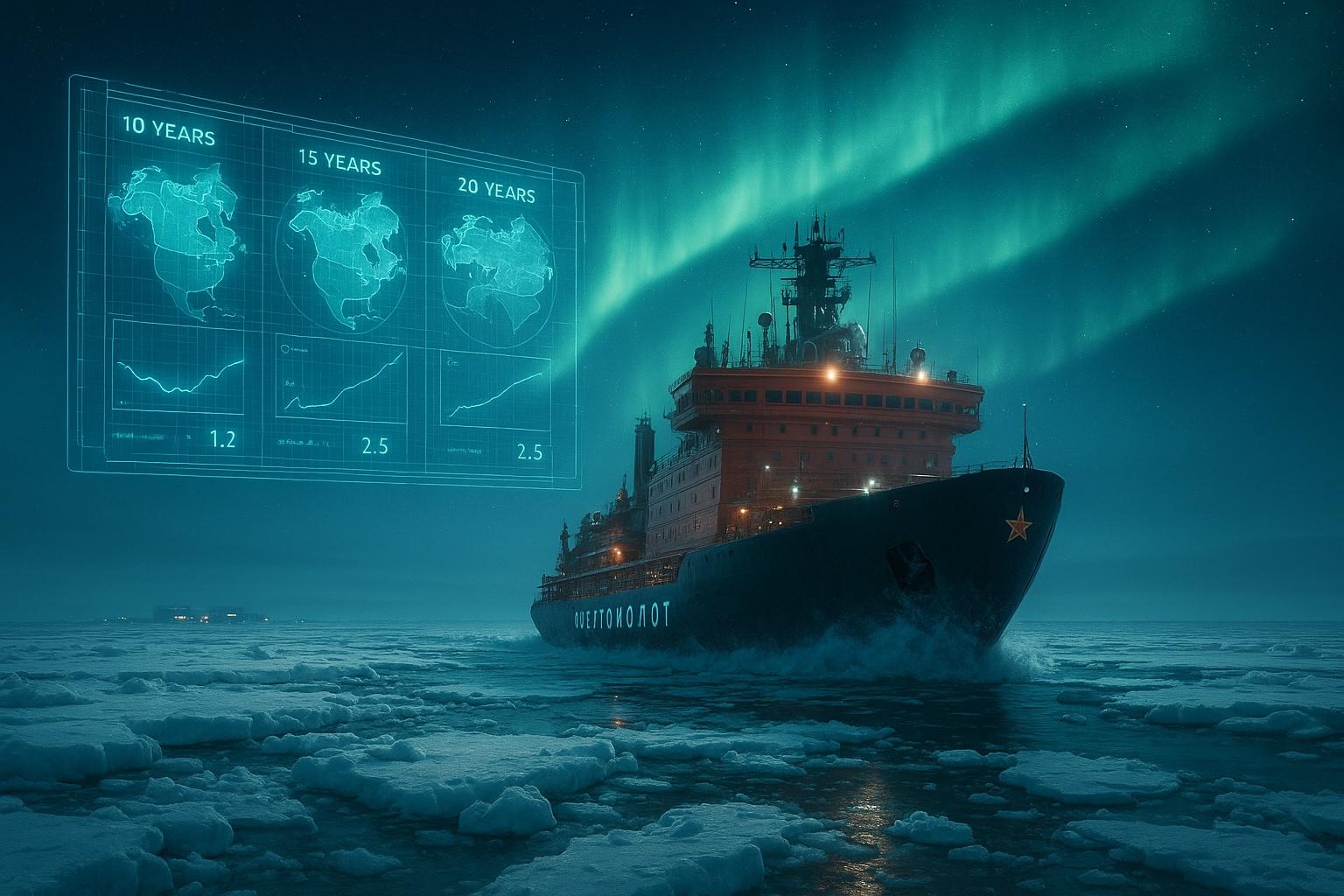
According to him, the main task is to create a long-term climate forecast. Such a forecast will allow calculating the need for nuclear icebreakers and determining what the ice regime will be in 10, 15, and 20 years. This is critical, since new nuclear vessels are designed for specific loads, and a mismatch between the real situation and the calculations could jeopardize the entire strategy for the development of the NSR.
We must clearly understand what the ice situation will be. This is not only a matter of safety, but also of efficiency. The accuracy of the forecast determines whether the new icebreakers will justify their capabilities and the investments in them
Today, the NSR is considered as a strategic route that can connect Europe and Asia, providing Russia with competitive advantages in the face of global competition. However, uncertainty in forecasts for ice thickness and the seasonality of its melting makes planning costly and risky. Therefore, scientific research should provide the basis for engineering and transport solutions.
Read more on the topic:
- New electronic compass for the Arctic developed in Russia
- Arctic group of the Northern Fleet will enter the Northern Sea Route
- Record amount of cargo transported along the Northern Sea Route in 2024
Never miss our newsAdd this site to your preferred sources to see us more oftenAdd on Google











![Growth Point: After 5G Launch, Mobile Internet in Russia Accelerated by 20%","subtitle":"TelecomDaily recorded an upload speed increase of 19.7%, and download speed of almost 14%","announce":""}[]}],](https://media.ixbt.site/fit-in/320x/ixbt-data/1727896/ai-image-nvgq0a0v5cjnyxwoc8xpelva.webp)