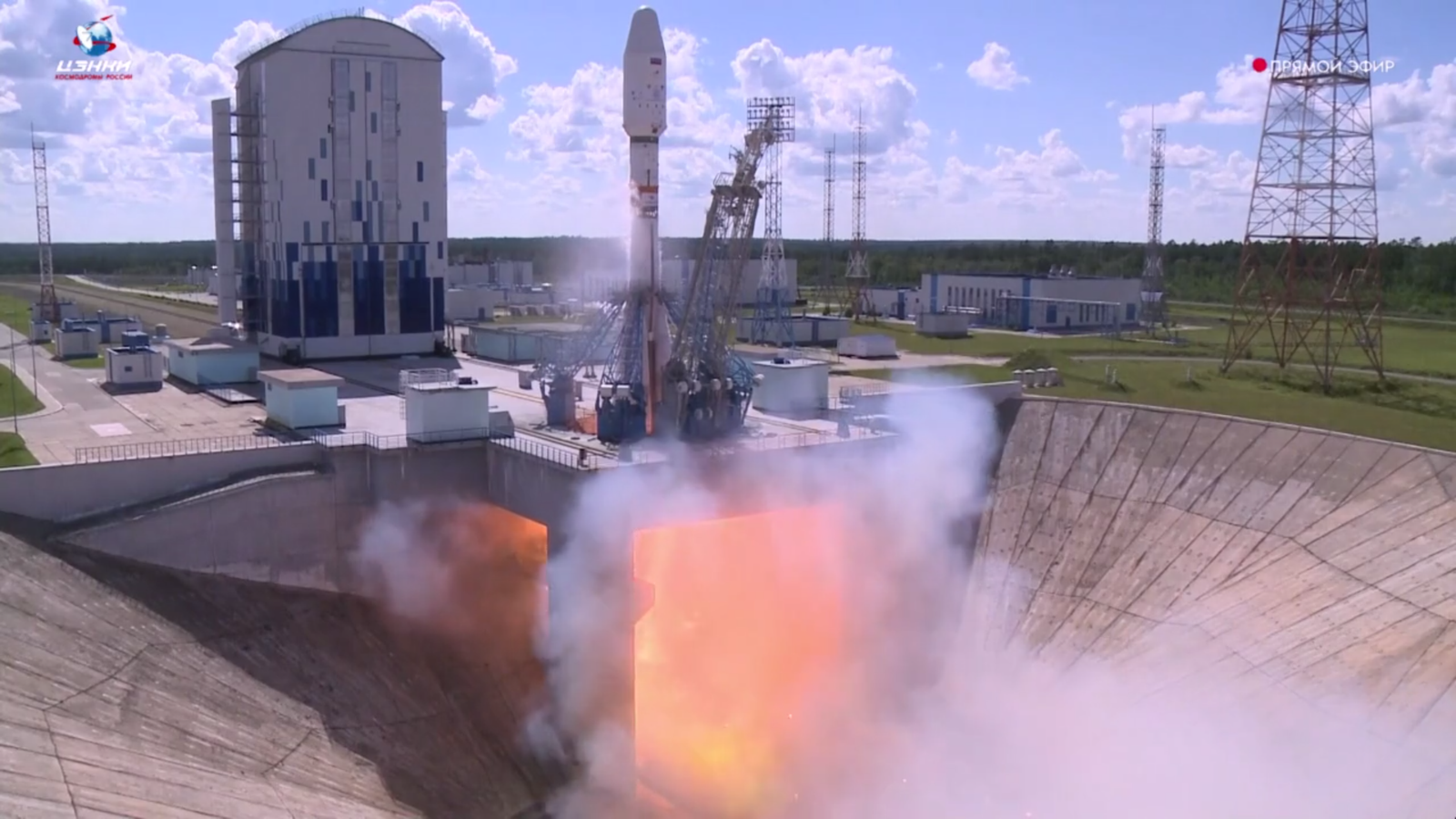
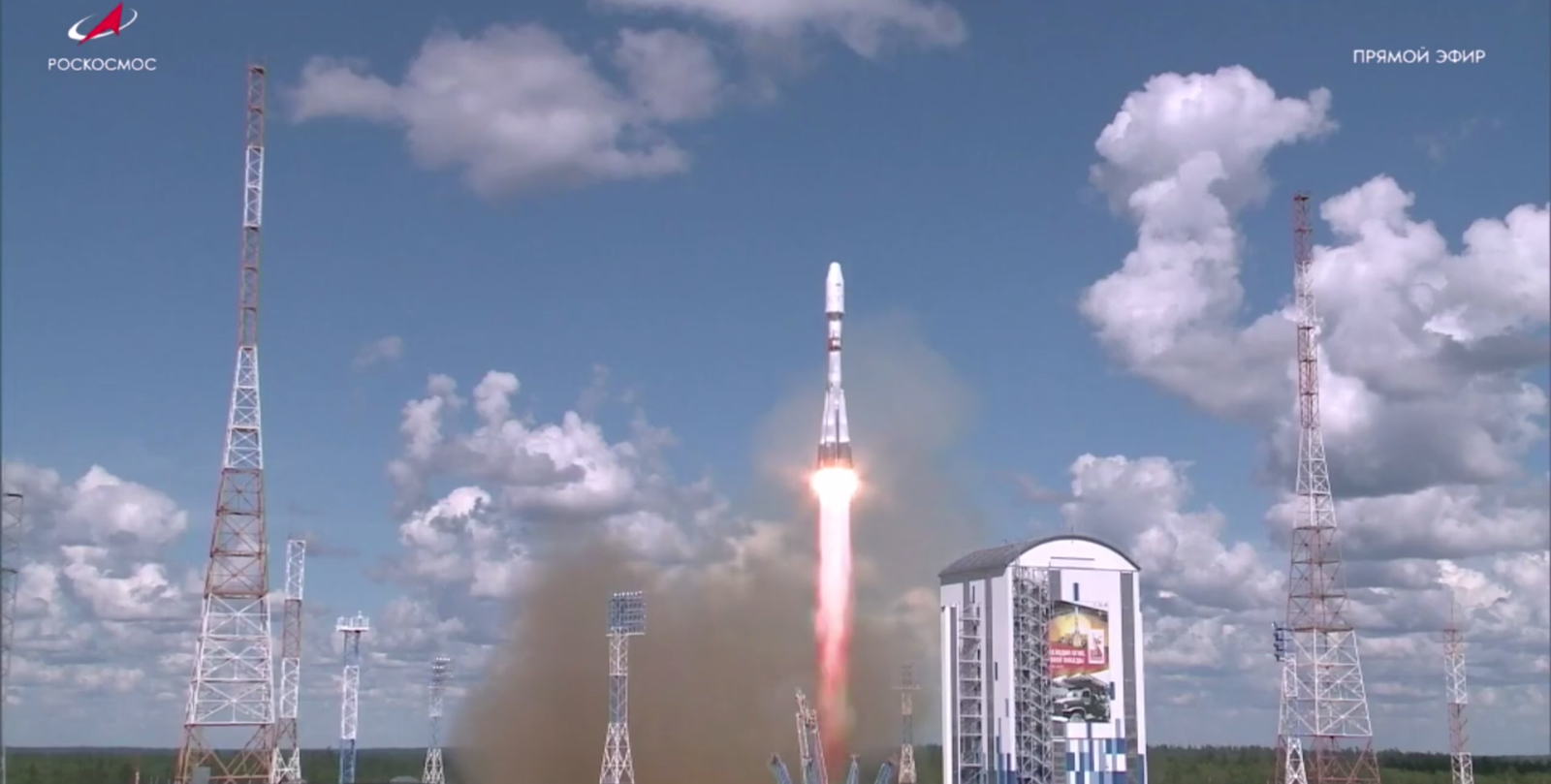
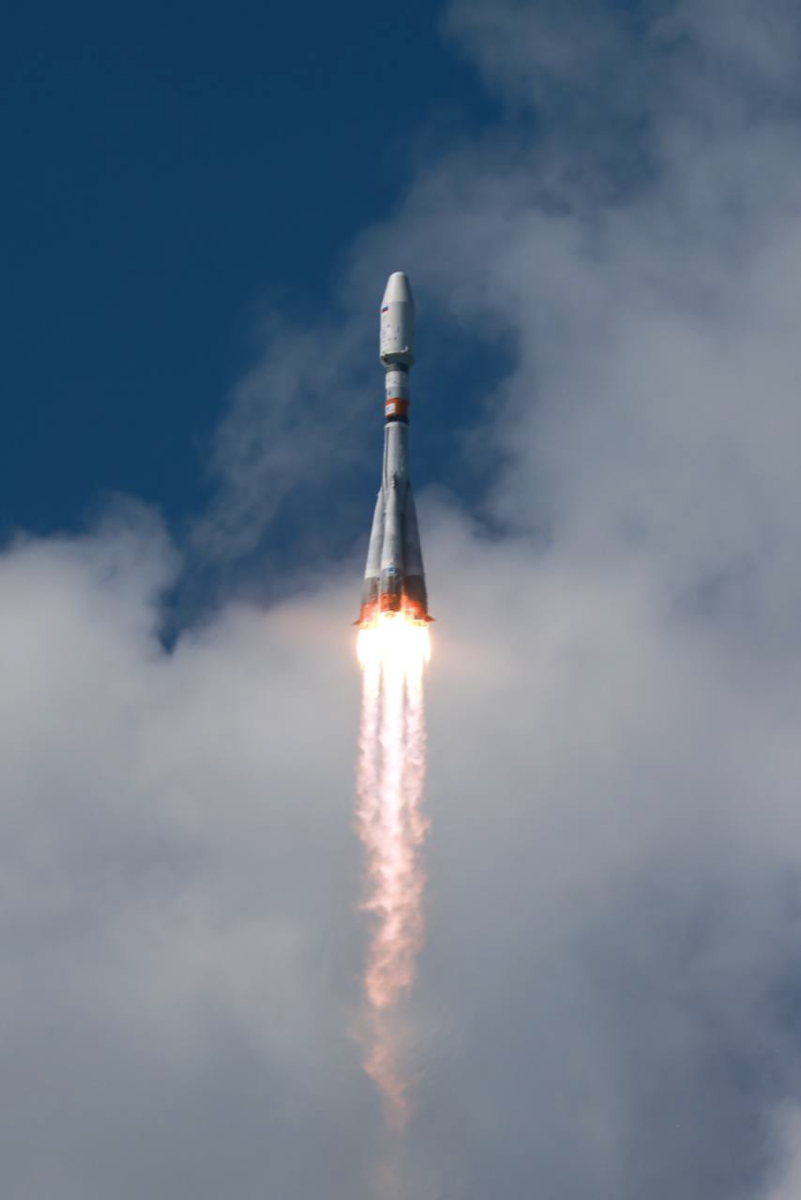
On July 25, 2025, the "Soyuz-2.1b" launch vehicle was successfully launched from the Vostochny Cosmodrome. All flight stages proceeded normally: stage separation, fairing jettison, and spacecraft injection into the calculated orbit. Approximately 10 minutes into the flight, the launch vehicle successfully deployed the payload into an unclosed support orbit.
Over the next 24 hours, they will deploy scientific equipment and begin operations. The "Ionozond" project, implemented under the auspices of the Russian Academy of Sciences and Roshydromet, aims to monitor the helio-geophysical environment, including the ionosphere, magnetosphere, and ozone layer. The "Ionosphere-M" satellites are equipped with 11 scientific instruments, including ozonometers for measuring ozone content and other gaseous components of the atmosphere, as well as equipment for analyzing the concentration of charged particles, their composition, and temperature. The satellite antennas are made of composite materials and are 15 meters long.
Two "Ionosphere-M" satellites have already been launched into orbit in November 2024. The satellite orbits will be organized on a "cross-cross" principle, which will ensure observation of both the day and night ionosphere, including the terminator region-the boundary between the illuminated and shadowed sides of the planet. In addition to the "Ionosphere-M" satellites, the launch vehicle also placed small satellites in the CubeSat format developed by GC "Geoscan" into orbit.
Eight small spacecraft are built on the "Geoscan 3U" platform. The first of these, Geoscan-1, is equipped with two Cyclop cameras with wide-angle and ultra-wide-angle lenses that capture Earth with a resolution of up to three megapixels and record video at 30 frames per second. The images are transmitted in the amateur radio frequency range. Geoscan-2 is testing automatic dependent surveillance-broadcast technology, which tracks the location, speed, and direction of aircraft, testing its applicability for drone monitoring. Geoscan-3 is testing communication in the VHF band, while Geoscan-4 and Geoscan-5, equipped with transceivers from JSC "Satellite system "Gonet", are testing packet data transmission for the Internet of Things and remote monitoring. Geoscan-6 combines Cyclop cameras and a gamma spectrometer, developed jointly with the Ioffe Institute of Physics and Technology of the Russian Academy of Sciences, to localize gamma-ray bursts and study cosmic processes. InnoSat3 is designed to test an automatic identification system that helps track marine vessels and prevent collisions. The 239Alferov spacecraft, created for the Space-π project, carries a gamma spectrometer and a VERA plasma engine from MEPhI for orbital maneuvers. Its onboard memory contains the names and drawings of participants in the "Send Your Name to Space" campaign, which are broadcast at a frequency of 436.27 MHz.
Another spacecraft, InnoSat16, is built on the "Geoscan 16U" platform-the first Russian CubeSat of this size. It is equipped with a panchromatic camera from JSC "NPO "Lepton" with a focal length of 1100 mm and a resolution of 2.5 meters per pixel, designed for remote sensing of the Earth in shades of gray with an extended spectrum of visible light.
Another spacecraft, InnoSat16, is built on the "Geoscan 16U" platform-the first Russian CubeSat of this size. It is equipped with a panchromatic camera from JSC "NPO "Lepton" with a focal length of 1100 mm and a resolution of 2.5 meters per pixel, designed for remote sensing of the Earth in shades of gray with an extended spectrum of visible light.
This grouping is the result of Geoscan's systematic work in the space sector in recent years. Such launches allow us not only to develop technologies and foster cooperation with partners, but also to solve research problems that go beyond educational ones. CubeSat 3U and 16U form factors are suitable not only for universities-relatively inexpensive and compact spacecraft allow us to economically test advanced domestic technologies for communication and remote sensing, as well as gain experience that will be useful for the implementation of larger-scale space projects, such as a flight to orbit around the Moon.
The results of the "Ionozond" project have both fundamental and applied significance. Data on the state of the ionosphere will help predict space weather, minimizing risks to satellite systems, aviation, and ground infrastructure.
Read more related materials:
Roscosmos is preparing to launch the "Bion-M" №2 satellite with unique experiments
"Soyuz-2.1b" will launch an Iranian satellite into orbit from the Vostochny Cosmodrome
Never miss our newsAdd this site to your preferred sources to see us more oftenAdd on Google

















