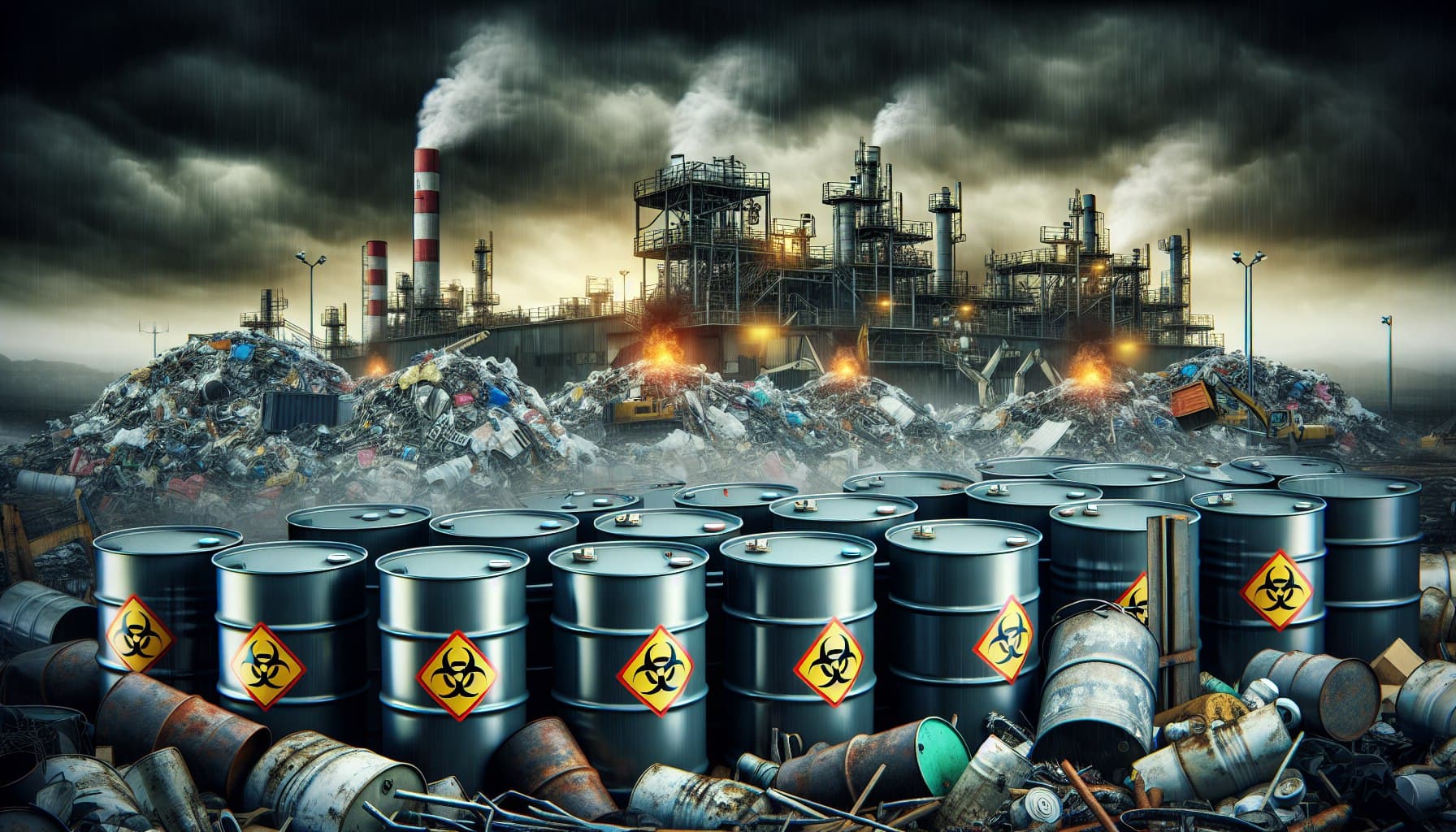
The landfill 30 kilometers from the northern capital and 6 kilometers from the city of Kolpino was once chosen by Soviet scientists for the temporary, and then for the permanent storage of industrial toxic waste by chance. There are Cambrian clays 80-110 meters thick, which prevent toxic substances from penetrating into groundwater. Over time, when the landfill has been operating for more than forty years, it has become an environmental problem not only for Russia, but also for other countries. Storage tanks as deep as a nine-story building turned out to be higher than the Vodokanal water intake of St. Petersburg, and only 7.6 kilometers from the Neva. From there, pollution could get into the Gulf of Finland, and then into the Baltic Sea.
The FSUE "FEO" was entrusted with the elimination of harm from waste. FSUE "FEO" is a "daughter" of the Rosatom State Corporation. This is the only company in the country that deals with the elimination of long-term environmental damage at Russian landfills as part of the federal project "Clean Country" as part of the national project "Ecology".
Certain results have already been achieved. In particular, with regard to the Krasny Bor landfill, where we are working today. Historically, hazardous waste from all over the Soviet Union was brought here. At the moment, its remediation has been completed by 60%. And, of course, this object no longer poses such a danger to people and the environment as before. Nevertheless, the work must be continued, and it continues. And, given the scale, it will take several more years
At the first stage of work, the company's specialists strengthened the dams of the five open storage tanks and replaced the pontoon cover that had expired. This made it possible to completely eliminate the risk of waste leakage. Then, the FSUE "FEO" began to bring the landfill to a safe state around the entire perimeter. As measures:
- 70% of the anti-filtration echeloned curtain is ready, which will prevent the migration of pollutants to adjacent territories. Its length will be about 3.5 km, and its depth will be up to 7 meters;
- an innovative technological infrastructure has been created for the neutralization of more than 340 thousand cubic meters of liquid and pasty waste accumulated in open storage tanks. Their complete processing will be completed in December 2025.
Then the surface of the landfill will be covered with a multifunctional reclamation screen, including eleven structural layers for various purposes. They will prevent atmospheric precipitation from entering the landfill and the formation of contaminated leachate.
This is not the only object of accumulated environmental damage that the Rosatom State Corporation is working with as part of the national project "Ecology". A closed cycle of safe and efficient handling of industrial waste of hazard classes 1-2 and the elimination of the most dangerous objects are planned in the cities of Magnitogorsk and Usolye-Sibirskoye, and at the Baikal Pulp and Paper Mill.
Read materials on the topic:
Rosatom is testing steel for a new research liquid-salt reactor