The creators of the online encyclopedia "Ruwiki", the Russian analogue of "Wikipedia", are taking their product out of beta testing. From January 15, all functions of the new open Internet encyclopedia will be available to Internet users. Its launch was announced by the creators in May 2023, warning that they would first copy content from the Russian-language "Wikipedia", checking it for reliability and "modifying it in accordance with the requirements" of their project. On June 24, 2023, "Ruwiki" started operating in test mode, and in six months it has matured to full operation.
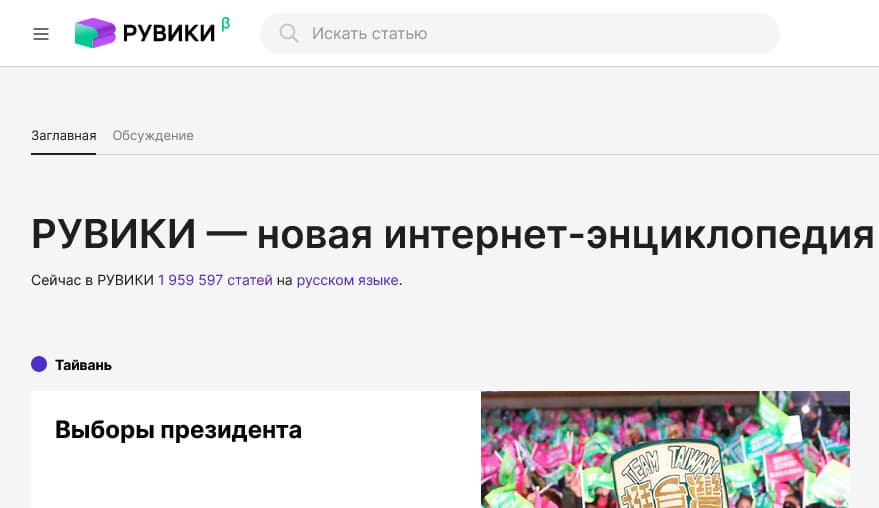
Access to "Ruwiki" is available not only in Russian, but also in eleven other national languages of the Russian Federation. More than a million articles have been written on the project in Altai, Bashkir, Mari, Moksha, Sakha, Tatar, Tuvan, Udmurt, Chechen, Chuvash and Erzya languages. The number of national languages in the project and the number of articles in them will grow.
Why is "Ruwiki" needed?
According to the developers, the Russian online encyclopedia is essentially similar to a library. It is designed to "become part of everyday life for every person to form a basic qualitative understanding of any subject without fear of encountering an error".
The main differences and values of "Ruwiki" are convenience, openness, neutrality, and reliability of information. If the project has competitors in terms of the first two parameters, then many large online encyclopedias have a problem with the positions of neutrality and reliability of information.
Often, co-authors of such projects, when writing articles, can distort history or individual events in it. They create fake cognitive information that users will perceive as reliable. Checking the reliability of articles takes a long time, during which thousands of people manage to enrich themselves with pseudo-knowledge from the online encyclopedia.
The most striking example of this, which has spread all over the world, is the falsification of the history of the Chinese Qing dynasty and the history of Russia by a resident of China. Since 2010, the Chinese woman has been a co-author of "Wikipedia", and has written more than two hundred articles there. In many of them, she described fictional facts and passed them off as real historical events. The forgery was discovered only in 2022.
How is the reliability of articles checked in "Ruwiki"?
Materials can be written by any participant in the project. However, they are then strictly checked for reliability. The materials are divided into "verified" and "reviewed".
The "verified" materials are worked on by the editors of "Ruwiki". "Reviewed" articles are prepared with the help of experts whose professionalism is beyond doubt. Thus, the Russian Academy of Sciences, the Moscow Planetarium, the Association of Cosmonautics Museums, the N. E. Zhukovsky Scientific Memorial Museum, the State Museum of the History of Cosmonautics in Kaluga, the Central House of Aviation and Cosmonautics, the Russian Felinological Society of the Russian Federation and other large organizations and experts are already working with "Ruwiki". This makes "Ruwiki" articles a quite authoritative source of information.
How will "Ruwiki" develop?
The platform plans regular updates, which, according to the company, "will include innovative technological solutions, including interaction with artificial intelligence".
In the process of development - the interface and articles in more than ten other national languages of the Russian peoples.
In addition, technological changes will be presented during the year. These are content personalization, thematic collections, audio retelling of the full and short versions of the article, an updated user account, videos and podcasts.
Will "Ruwiki" displace "Wikipedia"?
It is not yet possible to say unequivocally that "Wikipedia" in Russia will be blocked after the official full launch of "Ruwiki". However, the probability of this is significant.
The resource has already been guilty before Roskomnadzor: in 2023, for failing to remove illegal materials in relation to Wikimedia Foundation, Roskomnadzor drew up 12 administrative protocols under Part 2, Article 13.41 of the Administrative Code of the Russian Federation. The total amount of fines amounted to 22.4 million rubles.
Also, "Wikipedia" does not comply with the provisions of Articles 15.1 and 15.3 of the Federal Law "On Information, Information Technologies and Information Protection". It does not remove from its pages unreliable information about the SVO, a number of extremist and terrorist materials, materials on the manufacture of explosives and other content that is subject to restriction in Russia and violates the law.
Now on home

The service contains data on 45,000 fraudulent sites

The state has accelerated the introduction of unmanned solutions, integrating them into the real sector of the economy

Modernized engines may equip the Lada Azimut crossover

The price is 132 billion 265.8 million rubles

The manufacturer plans to strengthen its lineup of light commercial vehicles

The production of carbon fiber was organized in the shortest possible time

Electric vans will speed up the repair of urban transport infrastructure
Countries are working to synchronize regulations in the field of AI

The service's average daily audience is 55 million people

Stable Isomaterial Based on Metakaolin Has a Density Below 300 kg/m³

Re-identification quality improved twofold with new DynaMix method

Russians will be able to find out about debts online