An insider at RIA Novosti suggests that a malfunction of the "Bius-L" device (angular velocity measurement unit), which had no prior space testing, could have triggered the crash of the interplanetary station "Luna-25".
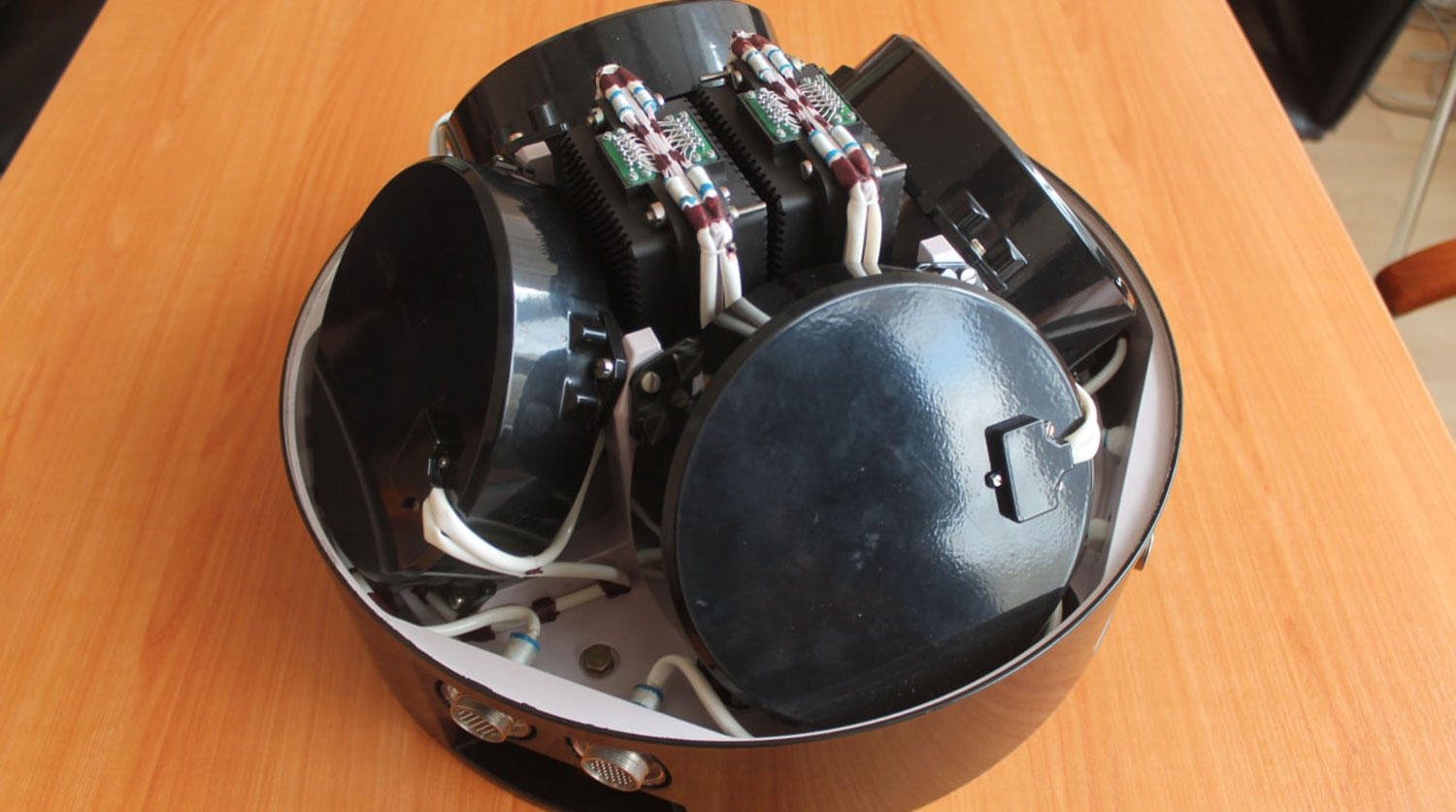
This device is responsible for determining the orientation and speed of the station. It then transmits the received data to the computer of the spacecraft. However, since "Bius-L" has not passed field tests in space, this malfunction may be one of the preliminary versions to be further considered by the accident commission.
It is always better to choose the second option between a "new" and a tested device. However, "Bius-L" has not been tested in space.
The "Bius-L" was developed by the Scientific Production Center of Automation and Instrument Engineering named after Academician N. A. Pilyugin (NPTSAP). Initially, cooperation with the foreign company "Astrix" was assumed, and a contract was even concluded. However, due to sanctions and global events, the contract was canceled, and there was an urgent need to replace foreign equipment. Thus, in just a year and a half, scientists were able to develop "BIUS-L" with the same characteristics and dimensions. The device is an inertial unit that uses fiber optic gyroscopes and an accelerometer to determine the orientation and acceleration of a spacecraft. This device consists entirely of domestic components, including electronics.
The principle of operation is based on the Sagnac effect. From a radiation source - an LED - two light beams of the same frequency are launched in opposite directions into the fiber circuit. When the fiber circuit is stationary, both beams travel the same path before meeting, but when the circuit rotates, one of the beams travels a greater path than the other, and the phase of the light wave shifts at their meeting point. The magnitude of this shift can be used to estimate the rotational speed of the fiber circuit
The "Bius-L" device has an accuracy of 0.2''/s, which was confirmed by preliminary tests. Its power is 35-40 Watts. Two "Bius-L" were to be installed on "Luna-25" — they are installed in pairs and deployed relative to each other. The need for two devices is due to the fact that in the event of a failure of one of the devices, the second one will back it up.
If the control system suspects that one of the devices is not showing exactly what is affecting it, it starts working with the second device.
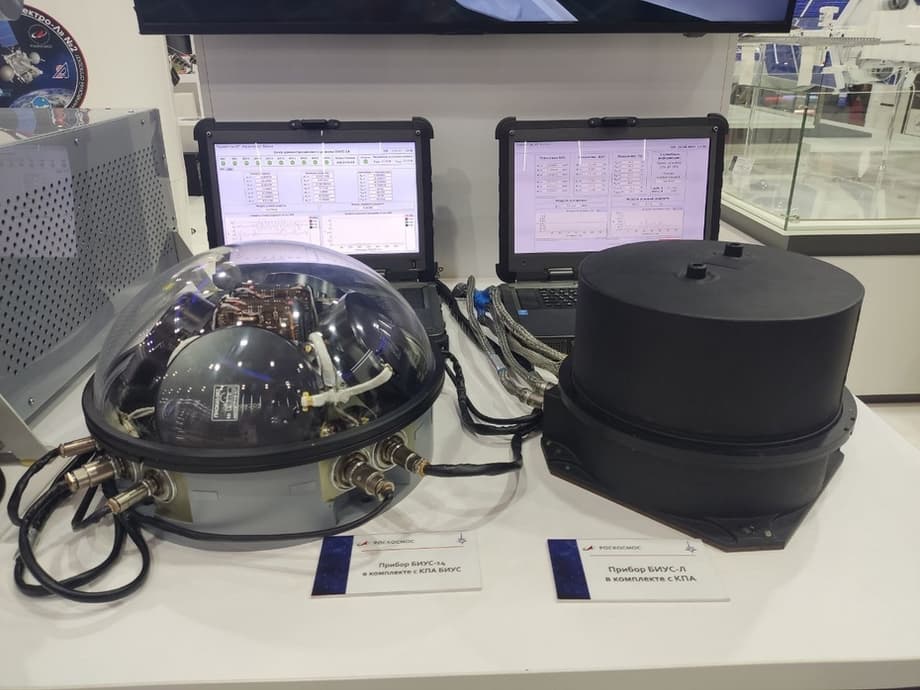
It was noted that the "Bius-L" device is being developed not only for "Luna-25", but also for the entire lunar program. But at the annual Army-2023 forum, "Bius-14" was shown.
BIUS-14 is for various spacecraft. For example, for the Samara "Progress", for the "Resource" and for a number of "closed" spacecraft. If we talk about the layout, then BIUS-L is a three-axis device, non-redundant, and BIUS-14 is a four-axis device, it can withstand the failure of any independent circuit. It performs the same tasks. This is a device for working in space, for correcting speed, orbit, and so on.
According to experts, repeating the Luna-25 mission will cost Russia 5 billion rubles. Roscosmos CEO Yuri Borisov noted that one of the preliminary reasons for the failure was an error in the operation of the correction engine, which continued to operate for 127 seconds instead of the planned 84. The results of the analysis obtained during the investigation by the emergency commission will be implemented in subsequent space missions.
Now on home

The service contains data on 45,000 fraudulent sites

The state has accelerated the introduction of unmanned solutions, integrating them into the real sector of the economy

Modernized engines may equip the Lada Azimut crossover

The price is 132 billion 265.8 million rubles

The manufacturer plans to strengthen its lineup of light commercial vehicles

The production of carbon fiber was organized in the shortest possible time

Electric vans will speed up the repair of urban transport infrastructure

Countries are working to synchronize regulations in the field of AI

The service's average daily audience is 55 million people

Stable Isomaterial Based on Metakaolin Has a Density Below 300 kg/m³

Re-identification quality improved twofold with new DynaMix method

Russians will be able to find out about debts online