August 17 in Russia celebrates a professional holiday - Air Fleet Day. In the fight against fires, the aviation of the Russian Ministry of Emergency Situations plays a crucial role, using modern technologies and high-precision instruments to detect and extinguish fires from the air. The success of operations largely depends on the skill of the pilot and the coordinated work of the crew.
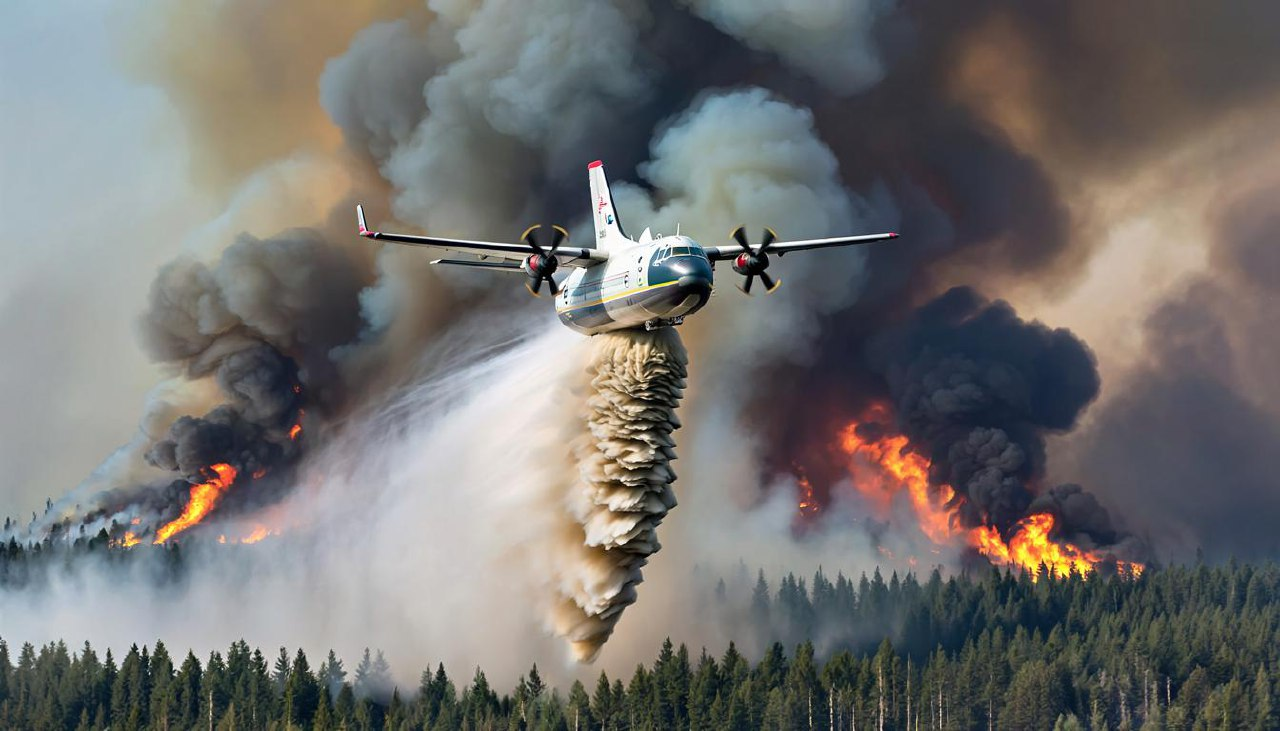
First of all, the pilots assess:
- visibility range
- scale of the fire
- weather conditions
Based on this, the crew adjusts the speed, altitude, and flight path. Aircraft are prohibited from flying into the centers of smoke and fire. Thermal imagers installed on board record the temperature in the fire zone, which allows you to accurately select the water drop point. Russian rescue aviators improve their skills at special training grounds, achieving drop accuracy within 5 meters.
At a speed of over 300 km/h, the aircraft descends to the height of a 30-story skyscraper, 60 meters above the ground.
Fire-fighting aircraft and aviation in service with the Russian Ministry of Emergency Situations:
Be-200
Be-200 is a unique amphibious aircraft capable of collecting water for extinguishing fires both from airfields and while moving on the water surface. Its multifunctionality covers fire extinguishing, search and rescue operations, protection of water bodies, environmental tasks, as well as the transportation of passengers and cargo. In terms of its flight performance, the Be-200 has no equal in the world.
The aircraft is suitable for operation from category B airfields, requiring a runway length of 1800 meters. It can also be used on water bodies if their length is at least 2700 meters and the depth is at least 2.6 meters. The Be-200 is capable of taking off and landing on water with waves up to 1.2 meters (3 points). Thanks to special anti-corrosion protection, the aircraft can be safely operated in marine conditions.
Technical characteristics:
- Maximum speed: 700 km/h at an altitude of 7000 m
- Cruising speed: 550-610 km/h
- Speed when collecting water: 180-200 km/h
- Practical range: 3100 km
- Crew: 2 people
- Passenger capacity: up to 43 passengers
- Payload mass: 5000 kg of cargo, as well as 12 m³ of water in tanks (8 sections, with the possibility of simultaneous or sequential discharge)
- Maximum take-off weight: from water - 43,000 kg, from land - 42,000 kg
Il-76P
Back in the late 1980s, experiments began on converting the standard Il-76MD into an aircraft for extinguishing fires. The need for such specialized equipment arose from an understanding of the limitations of amphibious aircraft, such as the Be-200, which requires a body of water to collect water. What to do if there is no suitable body of water near the fire where the aircraft could land to refuel with water? It was precisely to solve this problem that the Il-76P (Firefighter) was created.
Structurally, it is practically no different from the serial military transport, but it had to be equipped with additional equipment. As you can see in the picture, something similar to pipes is placed in its cargo compartment. This device is called a pourable aviation device (VAP).
Technical characteristics:
- Wingspan: 50.5 m
- Aircraft length: 46.59 m
- Aircraft height: 14.76 m
- Wing area: 300 m²
- Weight: empty aircraft - 91,800 kg, maximum take-off - 170,000 kg
- Engine type: 4 TRDD D-30KP series 2
- Thrust: 4 x 12,000 kgf
- Maximum speed: 850 km/h
- Cruising speed: 800 km/h
- Flight range: 5,000 km
- Practical ceiling: 12,000 m
- Crew: 7 people
- Payload: 44,000 kg of water or 4 firefighter-parachutists and 5,000 kg of special equipment or 150 passengers in three passenger modules
Subscribe to the news of "First Technical" in Google News to stay up to date with the latest events from the world of science and technology.
Read more on the topic:
River tanks. Armored boats of projects 1124 and 1125 became a symbol of Soviet river military power
"Kursk": the echo of the tragedy 25 years later
The first Russian passenger mainline steam locomotive is 180 years old