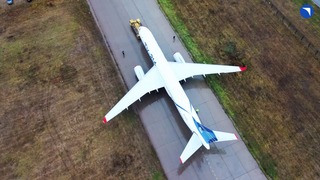
What if, instead of creating a separate long-haul aircraft, the MC-21 were enlarged enough to fly further and carry more passengers? This question arose in an experiment by aviation forum participant AlexAlex123 with a neural network. The result was two hypothetical versions of the Russian airliner with a maximum takeoff weight of 108 tons — one for increased capacity, the other for long-haul flights. What is unusual here is not so much the increase in mass as the attempt itself to find an alternative to developing a completely new aircraft.
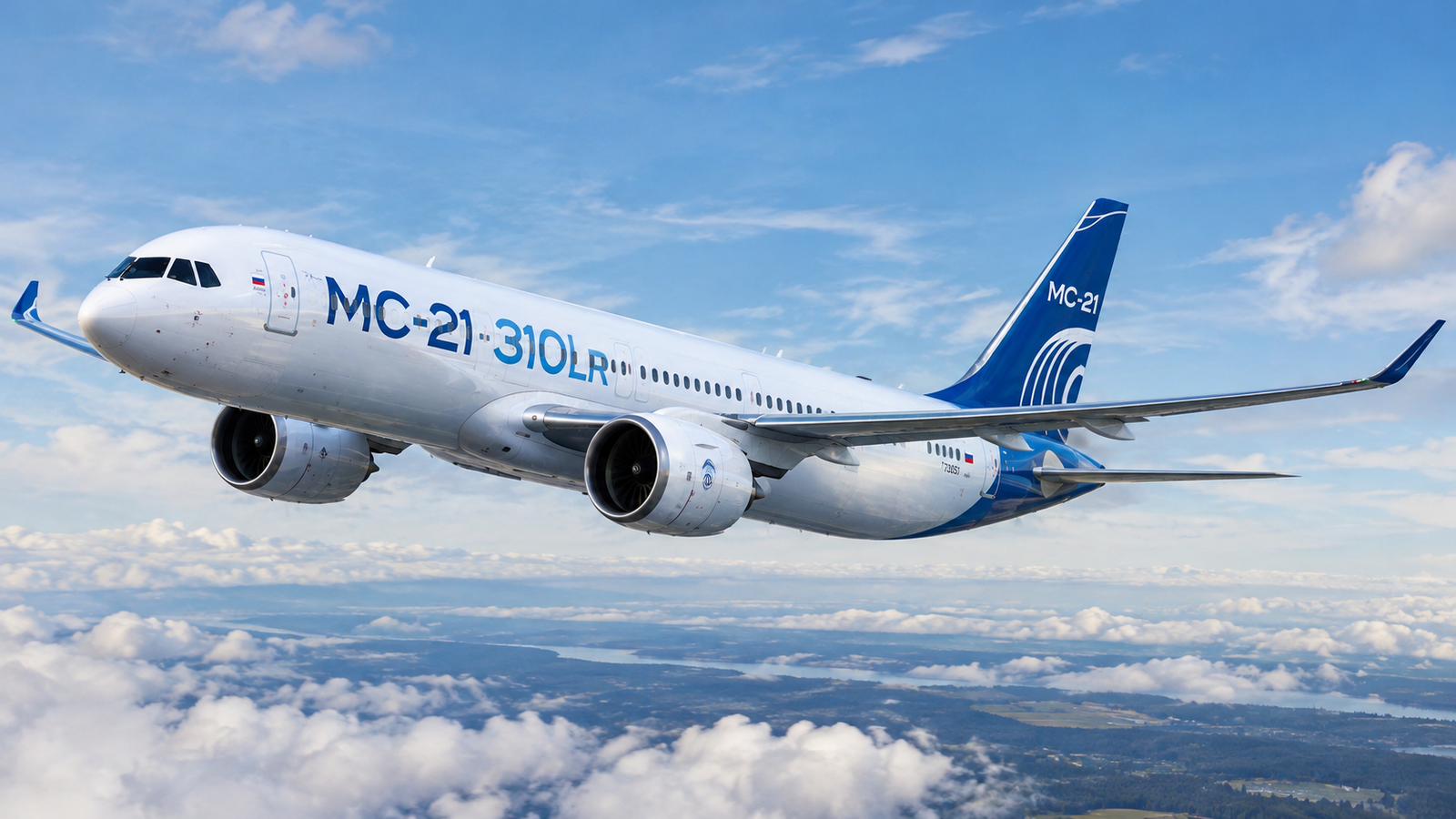
Today, the MC-21-310 is designed for transportation in the medium-haul segment. According to OAK, its maximum takeoff weight is 85 tons, and the declared range in a two-class configuration for 175 passengers reaches 3830 km. In the forum scenario, the takeoff weight is proposed to be increased by 23 tons at once — approximately 27%.
The experiment introduced the conditional MC-21-410 and MC-21-310LR. The first should have increased capacity, sacrificing some range, while the second should fly further with fewer passengers. According to the author's idea, both aircraft could use a common wing with a span of 43–45 m with horizontal winglets and one engine of the conditional PD-18 class. The level of commonality with the current MC-21 was estimated at approximately 80%.
As examples for the more capacious version, flights from Moscow to Chita and Bangkok are considered, and for the long-range version, flights to Phuket. With a reduction in commercial payload, the author even allows for a route to Cuba, bypassing EU airspace. These are not confirmed range calculations: the discussion does not provide full aerodynamic and weight models that would allow such scenarios to be verified.
It will not be possible to increase the takeoff weight by a quarter simply by adding fuel. A heavier aircraft will require a suitable wing, landing gear, power plant, and structural strength calculation. In the proposed concept, the engine of the conditional PD-18 class should be based on PD-14 technologies and PD-35 program developments, but without a gearbox.
Therefore, 108 tons is not yet a characteristic of a new Russian aircraft, but a starting point for discussing how to expand the family's capabilities. An increase in mass by itself does not guarantee the required range or efficiency: everything will depend on fuel consumption, empty aircraft weight, capacity, and operating costs.
The author of the experiment himself does not consider increasing the MC-21 to 108 tons an obvious priority. He draws attention to more immediate tasks — reducing the empty aircraft weight, increasing the service life of the PD-14, and developing the already created MC-21-310. In other words, the question is not whether a heavier MC-21 can be designed, but whether such a modification will provide enough advantages to justify a new engine, structural redesign, and a separate test program.
Read more on the topic:
Never miss our newsAdd this site to your preferred sources to see us more oftenAdd on Google