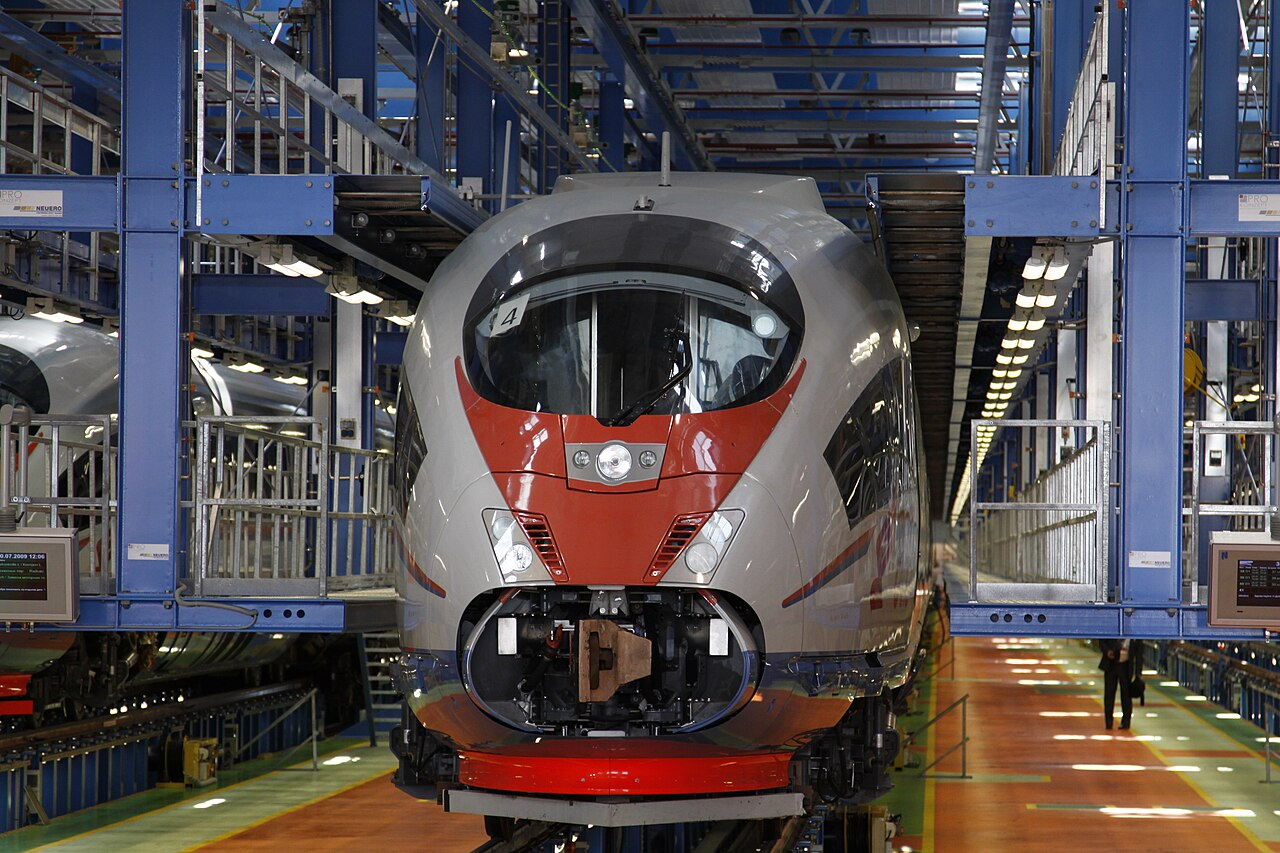
Russian Railways has begun testing the ballastless track structure for the future Moscow — St. Petersburg high-speed railway using the Sapsan train. The tests are taking place at a specially equipped test site in Sablino — Tosno in the Leningrad Region, where the infrastructure is being tested under dynamic load. According to TASS, the maximum speed during the tests reached 220 km/h.
To test the assembled section, Russian Railways created a 1.5 km long test section. On it, 207 ballastless track slabs were installed, 4,140 rail fastening units and two turnouts were mounted.
The main objective of the tests is to check the behavior of all track elements during train movement and to compare actual parameters with calculated characteristics. The results should help refine installation and operation technologies for the structure before its possible large-scale application on HSR.
The head of Russian Railways, Oleg Belozerov, called the test site a reduced model of the future high-speed railway, where developers can test not only individual elements but also their joint operation.
During the construction of the section, more than 1500 sensors were installed, including 68 inside the subgrade. Several Sapsan cars were converted into a mobile laboratory: 35 measuring systems were placed on them, recording 43 indicators of train dynamics.
Tests are conducted with a gradual increase in speed. According to Andrey Spirov, head of the department of dynamics and strength of rolling stock and infrastructure at the Research and Design Technology Institute of Rolling Stock in Kolomna, the Sapsan first passes the section at a speed of 20 km/h, after which the speed is increased in increments of 20 km/h, checking the obtained indicators. To simulate the load from passengers, special measured weights of 100 kg each, including luggage, are used in the train.
Read more on the topic:
Never miss our newsAdd this site to your preferred sources to see us more oftenAdd on Google