Translated with AI from the Russian original.
Artificial intelligence can reduce the preclinical stage of drug development from 3-5 years to approximately one to two years. This assessment was provided by Artur Kadurin, Director of the AI Center for New Drug Development at the AIRI Institute, at the Technoprom forum in Novosibirsk.
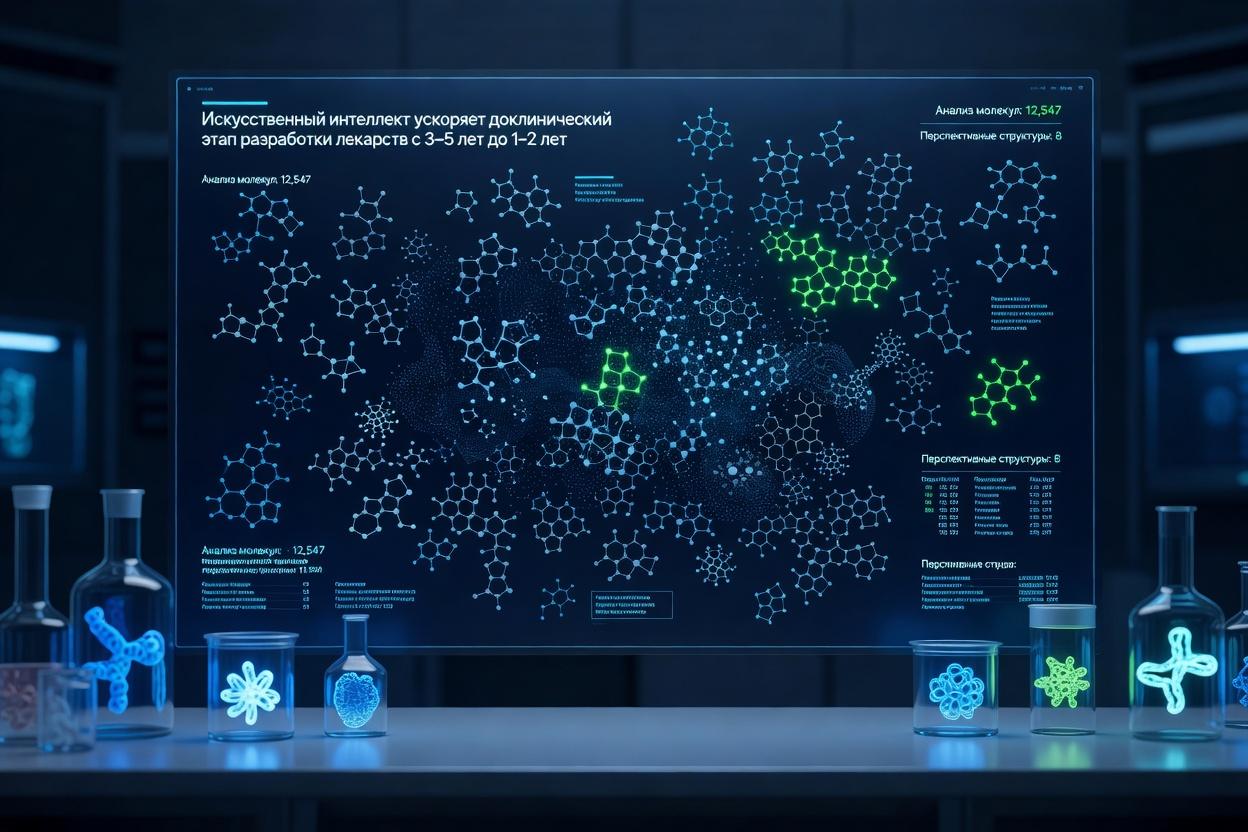
According to him, bringing one original drug to market costs an average of $2.6 billion, and 86% to 90% of candidate molecules do not reach regulatory approval. The main effect comes not from accelerating individual operations, but from earlier rejection of unpromising options: algorithms help select molecules with a lower risk of failure and find new protein targets. Kadurin highlighted three areas where AI is already changing work: large language models that read the genome like text, predicting the three-dimensional structure of proteins, and rapid calculation of small molecule properties, which previously took weeks of laboratory work.
Clinical trials are not subject to significant acceleration, but AI can significantly optimize documentation, analytics, and interaction with regulators. Kirill Peskov, Head of the Center for Mathematical Modeling in Drug Development at Sechenov University, noted that the average drug development cycle is about ten years and has hardly decreased in recent decades. According to his assessment, a significant breakthrough is possible only by combining several AI technologies into a single end-to-end process – individually, each yields a limited effect.
As an example of industry restructuring, Kadurin cited China, where over 10-15 years, government support for AI and changes in registration rules helped transition from generics to the creation of original drugs.
Read more on the topic:
Never miss our newsAdd this site to your preferred sources to see us more oftenAdd on Google

















