Translated with AI from the Russian original.
The Russian Federal Nuclear Center — All-Russian Research Institute of Experimental Physics (RFYaTs-VNIIEF) has received a patent for the design of radiation protection for a space nuclear power unit.
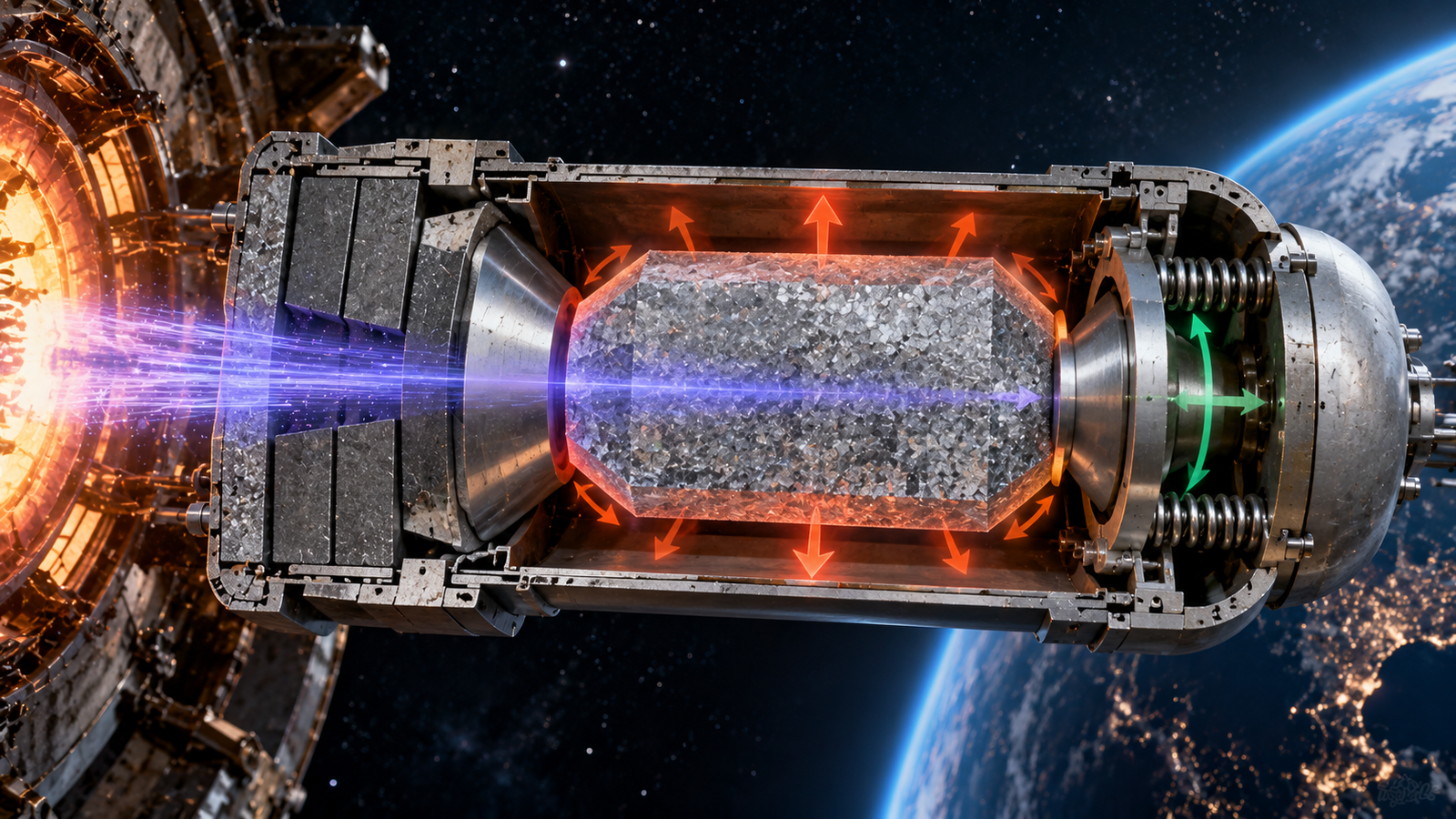
Radiation protection reduces the radiation level from the reactor to values acceptable for the spacecraft's payload. According to the patent, its elements must withstand temperature changes from –100 °С to +300 °С and mechanical loads characteristic of the flight of a heavy multi-stage launch vehicle and the module delivering the unit to the lunar surface.
The main problem solved by the design is related to the protective briquette, which reduces the energy of the neutron flux. The description considers, in particular, lithium hydride and lithium deuteride: these materials expand significantly when heated, and swell during prolonged irradiation. At the same time, they are significantly more brittle than the metal casing of the protection.
In the patent, the inventors propose installing the briquette inside an axisymmetric shell with gaps relative to most of its internal surfaces. It is held by a fixed and a movable support: the latter is made in the form of a ring with a conical support surface and is pressed against the briquette by one or more springs.
When heated, the protective material expands more than the casing and displaces the movable support; when cooled, it returns. The conical surfaces of the supports hold the briquette in axial and radial directions, and constant compression reduces the likelihood of it hitting the casing during vibrational and shock-vibrational loads. The diameter of the base of the fixed support's cone, according to the patent, ranges from 15 to 60% of the briquette's smallest diameter — this balances the risk of peripheral chipping and pressure on the material.
Separate clauses of the patent provide for an axisymmetric thin-walled casing around the peripheral part of the briquette, connected to it by thin elastic spokes: it presses the periphery towards the center and holds it in case of chipping or cracks, so that fragments do not get into the gaps between the briquette and the casing. Another option involves a modular design with partitions between sections: this reduces the mass of each spring-loaded briquette and the required compression force, and partitions made of gamma-radiation absorbing material allow alternating light and heavy layers of protection, further reducing mass.
The patent description also provides for the placement of metallic elements made of materials with a high atomic number — for example, uranium or tungsten — at the bottoms to attenuate gamma radiation. The neutron component is proposed to be reduced by a briquette made of lithium hydride, lithium deuteride, or similar material.
Read more on the topic:
Never miss our newsAdd this site to your preferred sources to see us more oftenAdd on Google

















