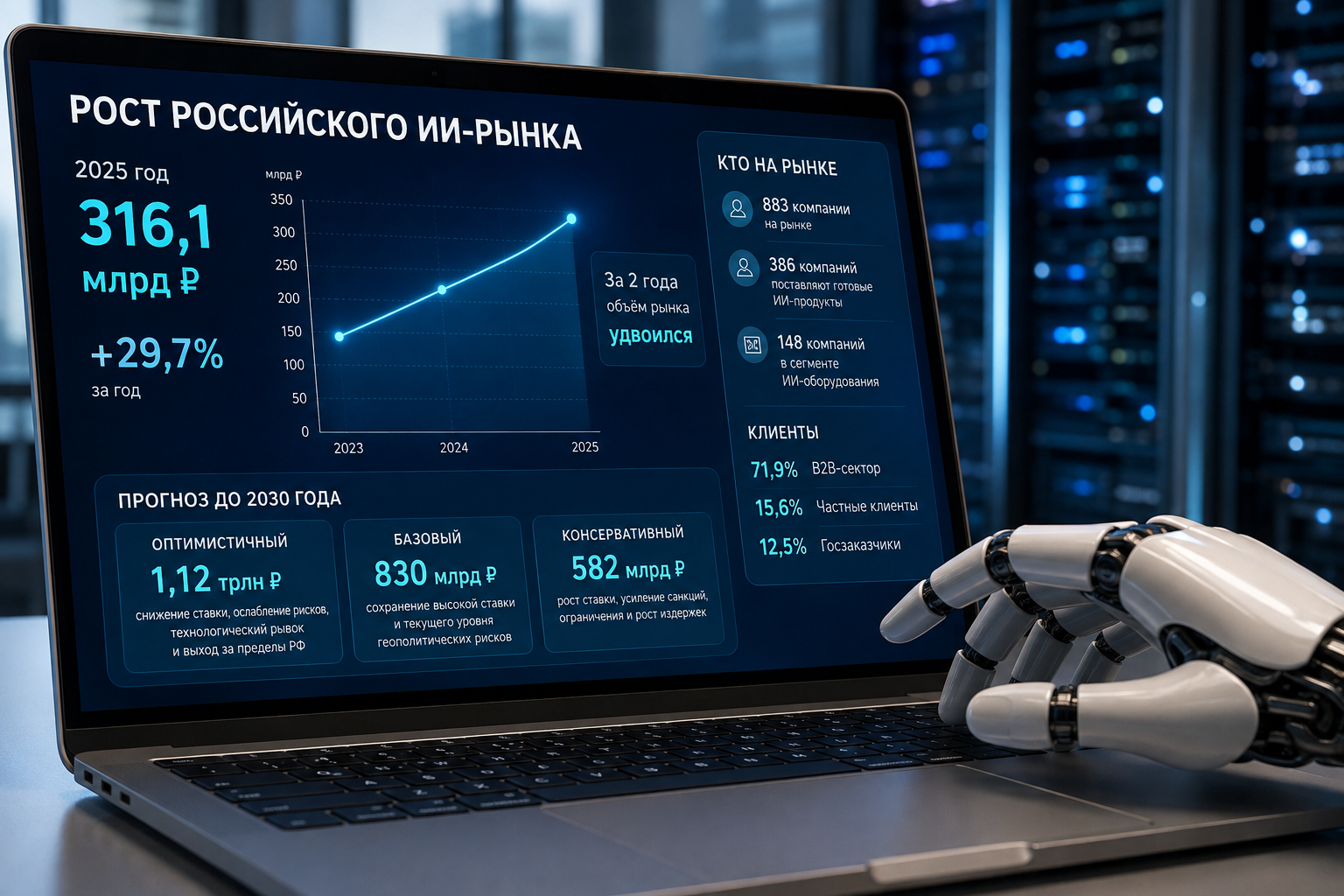
The Russian AI market grew by 29.7% in 2025, reaching 316.1 billion rubles. Over two years, its volume doubled, according to experts from the analytical agency AIANA. According to them, the average pace hides a change in development phases: money that was previously spent on equipment purchases is now going into renting capacities and implementation.
Players in the Russian AI market
AIANA analysts calculated that there are currently 883 companies in the market, most of which – 386 – supply ready-made AI products for specific tasks. However, they account for only 22.6% of revenue. The largest market segment by revenue is AI equipment (31.1%), with 148 companies.
The main client of AI companies, according to the study's authors, has become the B2B sector – accounting for 71.9% of companies' revenue, with another 15.6% from private clients and 12.5% from government customers.
Where the market will grow
According to the baseline forecast, the market will reach 830 billion rubles by 2030, given "the preservation of a high key rate and the current level of geopolitical risks".
Under an optimistic scenario, the market volume will reach 1.12 trillion rubles by 2030, with "a proactive reduction in the key rate, weakening geopolitical risks, the formation of its own technological base, and the expansion of domestic solutions beyond the internal circuit".
Under a conservative scenario, the market will grow to 582 billion rubles, with an increase in the key rate, strengthening sanctions, limited access to foreign computing resources, infrastructure, and models, as well as rising costs, which lead to higher prices for end solutions, reduced demand for AI services, and slowed implementation and "technological stagnation".
In a five-year perspective, AI infrastructure will move to the clouds, the market will begin to consolidate, and we will see true technological giants in artificial intelligence.
What to expect next in the AI field
The market is shifting from the development of models themselves to applied solutions based on them, primarily AI agents and virtual employees, believes Maxim Voloshin, Product Director at MWS AI (part of MTS Web Services).
Experts name the shortage of competencies as the main limiting factor. Additional restrictions are related to access to computing infrastructure and capital.
The Russian artificial intelligence market is unlikely to gain a significant share on a global scale in the coming years, emphasized Maxim Ivanov, partner at TeDo's technology practice. However, he notes that it can become fully sovereign and prominent in key industrial and corporate solutions.
Read more on the topic:
Never miss our newsAdd this site to your preferred sources to see us more oftenAdd on Google