In Novosibirsk, scientists have developed catalysts with a low content of precious metals. These compounds are designed to accelerate chemical reactions and neutralize emissions from diesel car engines.
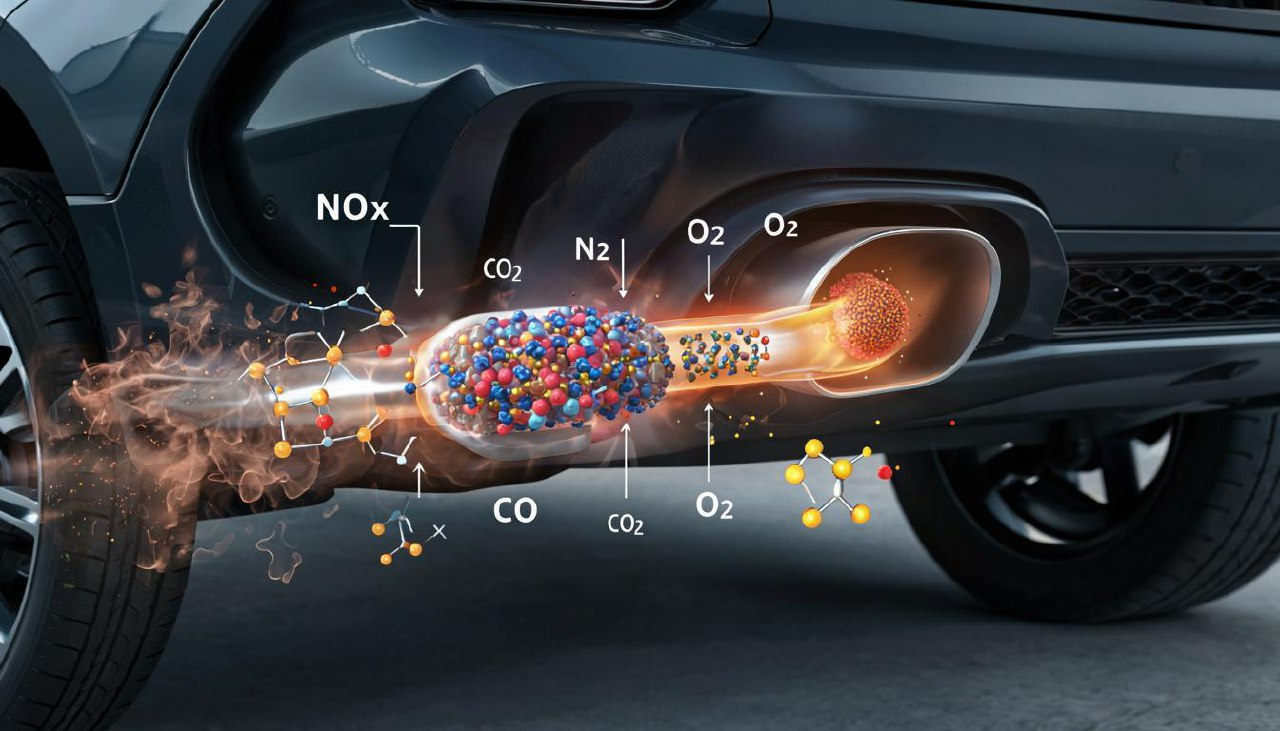
Every year in Russia, cars, including diesel ones, release about 5 million tons of harmful substances into the atmosphere. To neutralize these emissions, systems are used that are based on ceramic blocks coated with aluminum oxide with nanoparticles of platinum and palladium. However, the content of precious metals in such systems usually starts from 30 grams per cubic foot, which is equivalent to approximately 1 gram per liter of catalyst. This is a fairly high figure, and therefore the industry is interested in reducing it.
It was possible to achieve high activity and stability of catalysts at a reduced concentration of precious metals. Scientists were able to reduce the content of platinum and palladium in the catalyst to 0.17 and 0.17-0.35 grams per liter, respectively, with a 5% content of manganese oxide in the alumina coating.
Diesel exhaust contains hydrocarbons, carbon monoxide, nitrogen oxides, soot and sulfur dioxide. After neutralization, water, CO2 and nitrogen remain. Scientists have increased the activity of platinum in the catalyst by adding manganese oxide. This made it possible to reduce the platinum content by 1.5 times and even more when replacing it with palladium. A platinum-palladium catalyst at 180°C oxidizes 50% of hydrocarbons and 90% of carbon monoxide, working earlier than industrial analogues (250°C).
Read more on the topic:
A hydrocyclone with a self-cleaning system was developed by scientists from Nizhny Novgorod
A new DP2D train was tested on a difficult section near St. Petersburg
Sobyanin: four new stations of the Troitskaya metro line may open on City Day
The supply of serial VK-650V engines for light helicopters is planned from 2026
Never miss our newsAdd this site to your preferred sources to see us more oftenAdd on Google

















