The promising Russian PD-35 engine will become the mother platform for creating a line of high-thrust engines.
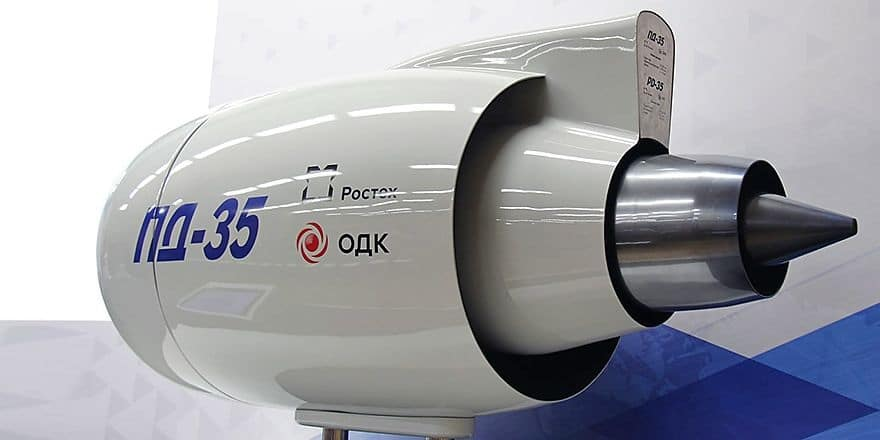
The unit will allow building motors of lesser or greater power depending on their planned use, experts in the aviation industry reported.
According to them, the new segment of engine construction has long-term prospects not only due to the uniqueness of the products for domestic machine building, but also due to the use of the latest technologies and materials.
They will not require replacement for a long time, and the units will not require modernization, and may become the most relevant offer on the global market.
Characteristics of PD-35:
- Fan diameter - 3 100 mm
- Thrust at take-off mode - 35 000 kgf
- Compression ratio - 53
- Bypass ratio - 11.0
- Cruise specific fuel consumption (compared to analogues of the 2010s) - 2-5% lower
- Noise reduction relative to Ch. 4 ICAO EPNdB - 17-20% lower
- NOX emission reduction relative to CAEP6 standards - 50-60% lower
Executive Director of the AviaPort agency, aviation expert Oleg Panteleev, noted that the PD-35 demonstrator stand produced a thrust of 37 tons.
Earlierwww1.ru reported that a project of a new wide-body Russian aircraft was shown in the photo.
Read more materials:
A millionth titanium ingot for the construction of MC-21 and SJ-100 was smelted in Russia
Millions were given for old aircraft engines of military aircraft AL-21 and AI-25 TL
The Il-96 aircraft will become twin-engine with PD-35: a difficult but solvable task
Now on home

Start of deliveries scheduled for 2027

Over 51,000 new motorcycles were sold in Russia in 2025

The car will take at least a year to assemble

The application's audience has reached 20 million users

The model will be included in the list of cars for taxis, price - from 2.25 million rubles

All parking lots of the "Administrator of the Moscow Parking Space" are connected to the service

The cars will be supplied to the Moscow Transport Service Directorate
Deliveries to India may begin in 2028

The technology provides automated search for all types of defects in power units

The plane flew 500 km, accelerating to 425 km/h

The plant stated that the information about the termination of purchases for models 6 and 8 is not true
Scientists are using the "Ekran-M" installation