Geoscan has presented the "Pioneer Mini 2" - the first Russian development with full-fledged onboard artificial intelligence. This compact aircraft, weighing less than 150 grams, is equipped with a powerful 8-core processor and a neural accelerator, allowing it to process computer vision data directly on board.
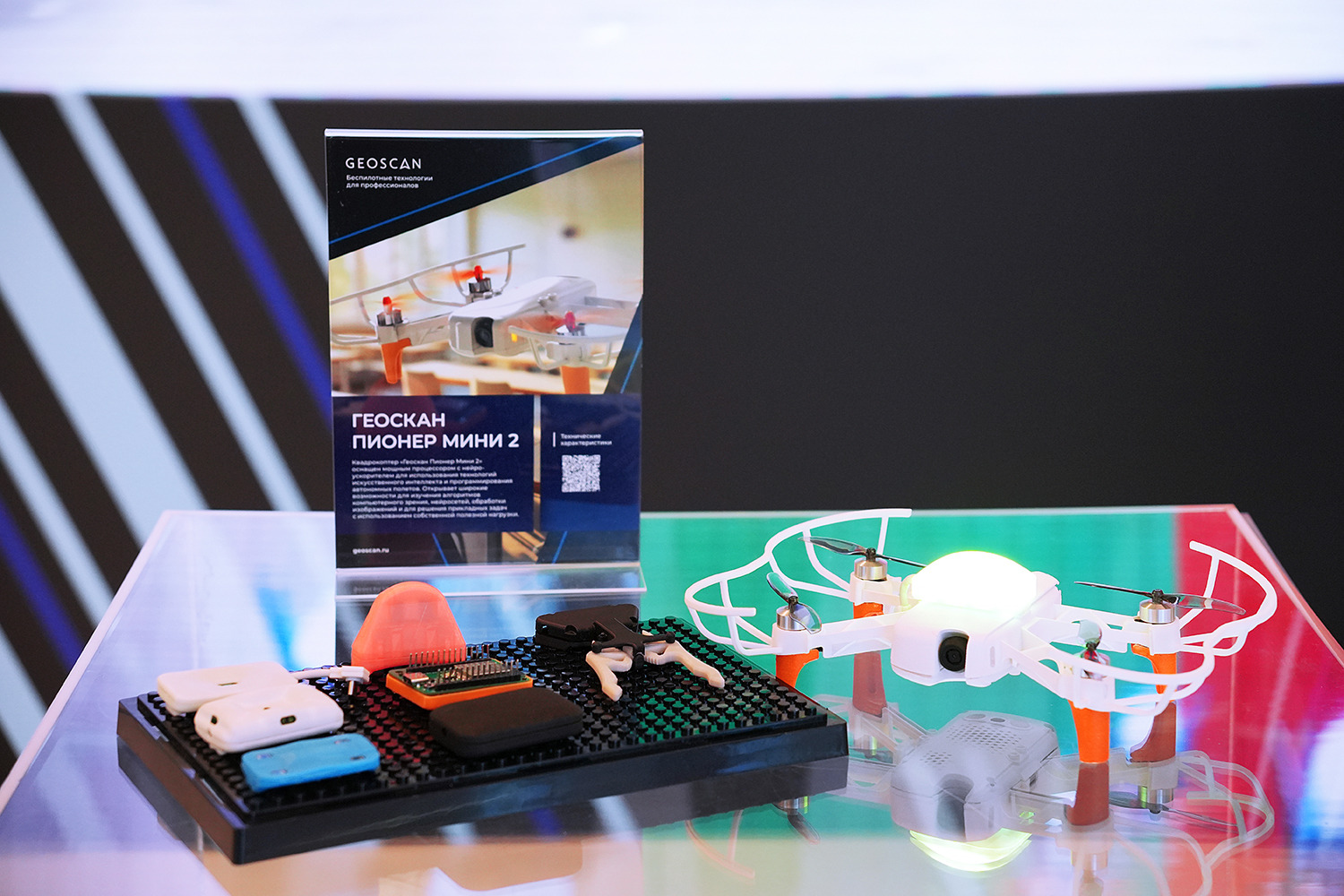
To work with drones, a modern specialist needs not only to know the basic piloting skills, but also to master new technologies such as AI. We propose to start from the school desk and have created a simple tool for this.
Technological advantages:
- Autonomous capabilities:Real-time recognition of visual markers, gestures, and objectsLocal data processing without the need to connect to external serversSupport for 5 different navigation systems for operation in any conditions
- Software ecosystem:Dual development environment: from simple block programming in Jump 2 to complex algorithms in PioneerCodeOpen platform based on Linux for in-depth study of neural network principlesSupport for dual-band Wi-Fi (2.4/5 GHz) for a stable connection
Flight platform:
- 4 brushless motors with individual control
- Maximum speed of 20 km/h
- Flight time up to 11 minutes
- Two universal mounts for payload
Vision system:
- 13-megapixel camera with 2K@30fps recording
- Single-axis servo gimbal with a range of -90°...+30°
- Optical navigation system for operation without GPS
The drone runs on Linux with open source code, allowing students to study not only piloting but also the principles of neural networks. Dual-band Wi-Fi (2.4/5 GHz) provides a stable connection even in the presence of interference - critical for swarm flights.
The "Pioneer Mini 2" will be available to schools and universities in Q3 2025. It can be used in projects from drone shows to 3D mazes, and the modular system expands the possibilities for experiments. The modular architecture and open platform make this drone a versatile tool for educational institutions - from schools to technical universities.
Read more on the topic:
The Moon and Mars will have domestic 3D twins: Geoscan's CubeSat satellites will be used
Never miss our newsAdd this site to your preferred sources to see us more oftenAdd on Google

















