The unique Saturn welding robot is being tested at the hull and welding production facility of Sevmash. It was developed for the enterprise by specialists from the domestic company ITS-Engineering under the USC program "Reducing the construction time of serial SSBNs."
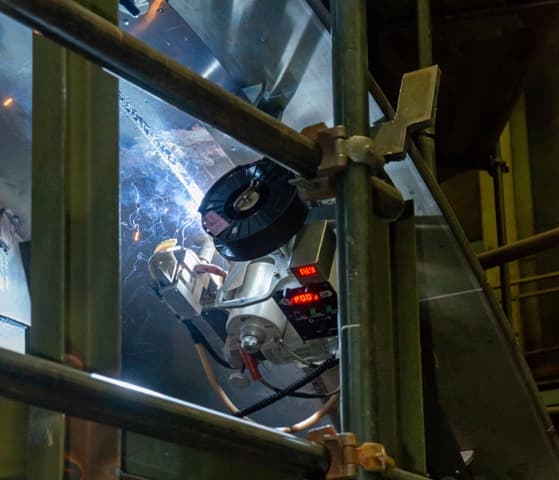
Saturn's specialization is automatic welding of hull assembly joints in a shielding gas environment in slipway conditions; it is also intended for use in hull and welding production.
For the first time in global practice, this equipment enables mechanized welding in all spatial positions using not only flux-cored wire, but also solid-section austenitic wire. This is ensured by new orbital welding heads and special welding power sources, as well as constantly improving software. In addition, the new complex is based on the idea of a universal modular system that allows for the initial preparation of the edges of structures by gas (plasma) cutting, and then carrying out mechanized welding in a shielding gas environment on the same guides, changing only the working modules. And in the future, the introduction of ultrasonic and X-ray diagnostics modules, which will make it possible to quickly, almost immediately after welding, carry out quality control of welded joints.
It is expected that the robot will be able to increase productivity and quality of work by at least four times compared to conventional manual electrode welding. This means that Russian submarines will be built faster, and fewer employees will be required for this. According to the developer's calculations, Saturn will reduce the number of people in the areas from 20-30 welders to only 6 operator-welders.
Based on the results of welding pilot work at Sevmash, the quality of welds will be checked by non-destructive methods (UT, RT), and a set of mechanical tests will be carried out to verify the compliance of welded joints with the requirements of regulatory documentation.
Read materials on the topic:
More than 50 Russian tankers of the shadow fleet have fallen under new EU sanctions
Now on home

The service contains data on 45,000 fraudulent sites


Modernized engines may equip the Lada Azimut crossover

The price is 132 billion 265.8 million rubles

The manufacturer plans to strengthen its lineup of light commercial vehicles

The production of carbon fiber was organized in the shortest possible time

Electric vans will speed up the repair of urban transport infrastructure

Countries are working to synchronize regulations in the field of AI

The service's average daily audience is 55 million people

Stable Isomaterial Based on Metakaolin Has a Density Below 300 kg/m³

Re-identification quality improved twofold with new DynaMix method

Russians will be able to find out about debts online