A reservoir microcomputer for drones has been developed at St. Petersburg Electrotechnical University "LETI". It will enable the creation of a new family of AI systems that recognize objects, words, and numbers. Instead of a bulky system inside, there is a device that fits in the palm of your hand.
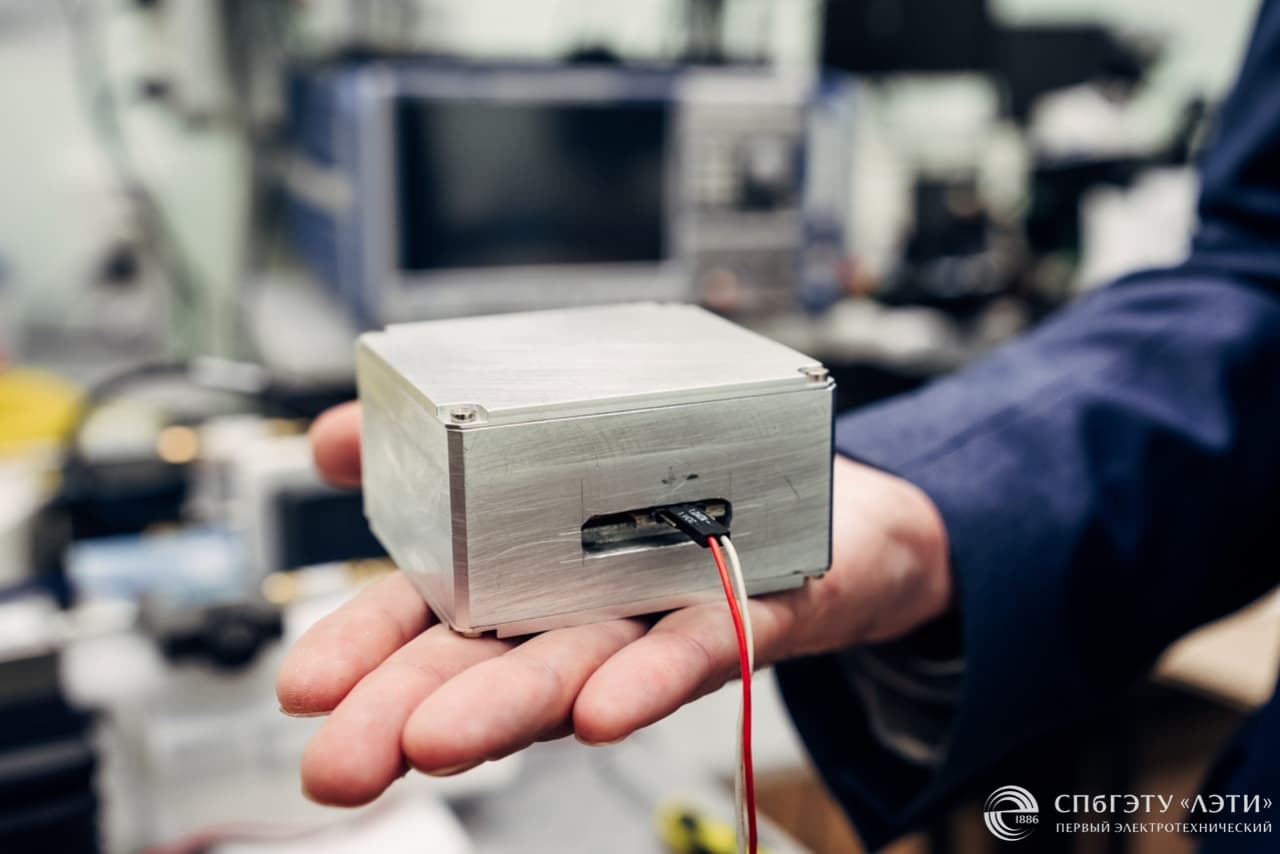
The reservoir computer operates on the principles of magnonics: spin waves and their quanta, magnons, are involved in the process. Magnons, which exist in magnetic films, can be used as information carriers. They can also perform recognition and classification tasks at high speed, while consuming less energy compared to transistor computing devices.
According to the developers, a magnonic physical reservoir is a spin-wave delay line with a feedback loop—a hardware analogue of a neural network. At St. Petersburg Electrotechnical University "LETI", they took advantage of this and created the first prototype of a reservoir computer that was capable of performing neuromorphic computations: for example, recognizing objects and measuring temperature. The design consisted of a film delay line, an electronic attenuator (an electronic device that reduces the amplitude or power of a signal without significantly distorting its shape—ed.) and an RF amplifier in the feedback loop.
In a new study published in the journal Applied Physics Letters, researchers improved the control system for the information signal entering the reservoir. To do this, an electric current was applied to a specific area of the magnetic film, locally changing the initially homogeneous bias field. This regulated the amplitude of the information signal processed by the reservoir. This method allowed bit signals to be directly transmitted to the reservoir (for example, local current supply – "1", its absence – "0"). This solution eliminated the need for an electronic attenuator to control the signal amplitude, which was used in the previous version of the reservoir computer. This made the prototype more compact. Experiments also showed that the proposed method of computer operation required approximately an order of magnitude less energy compared to the attenuator.
The new reservoir computer is lighter, more compact, and more energy-efficient. Such a device can be used in a new generation of unmanned underwater, land, and air vehicles.
Earlier, Yaroslav the Wise Novgorod State University (NovGU) developed a new technical vision system for civilian and military drones of any purpose. It is suitable for UAVs of various purposes, as well as for unmanned trucks or agricultural machinery.
Read more on the topic:
One of the world's largest chips for quantum computing tested in Russia
Russia is developing tools for controlling high-speed magnetic microelectronics
A new Russian method for fast three-qubit operation on fluxoniums has been developed
Russia will increase production of ultra-strong wires for space and electronics fivefold