If we imagine looking at a star whose light has traveled to us for billions of years, when the Universe was very young and the Earth was not even born yet, and multiply the brightness of that light by thousands of times, we get a quasar - one of the most powerful and mysterious objects in space. These cosmic beacons, shining with incredible force, allow us to look into the distant past of the Universe, when the first galaxies were just beginning to form. Among them, blazars stand out - quasars whose jets of plasma are directed straight at us, like giant spotlights. One such object is PKS 1614+051, located more than 11 billion light-years away. Its study, like the recent discovery of the powerful quasarSRGA J2306+1556, helps scientists unravel the mysteries of the birth of galaxies and supermassive black holes.
Giant Space Engines
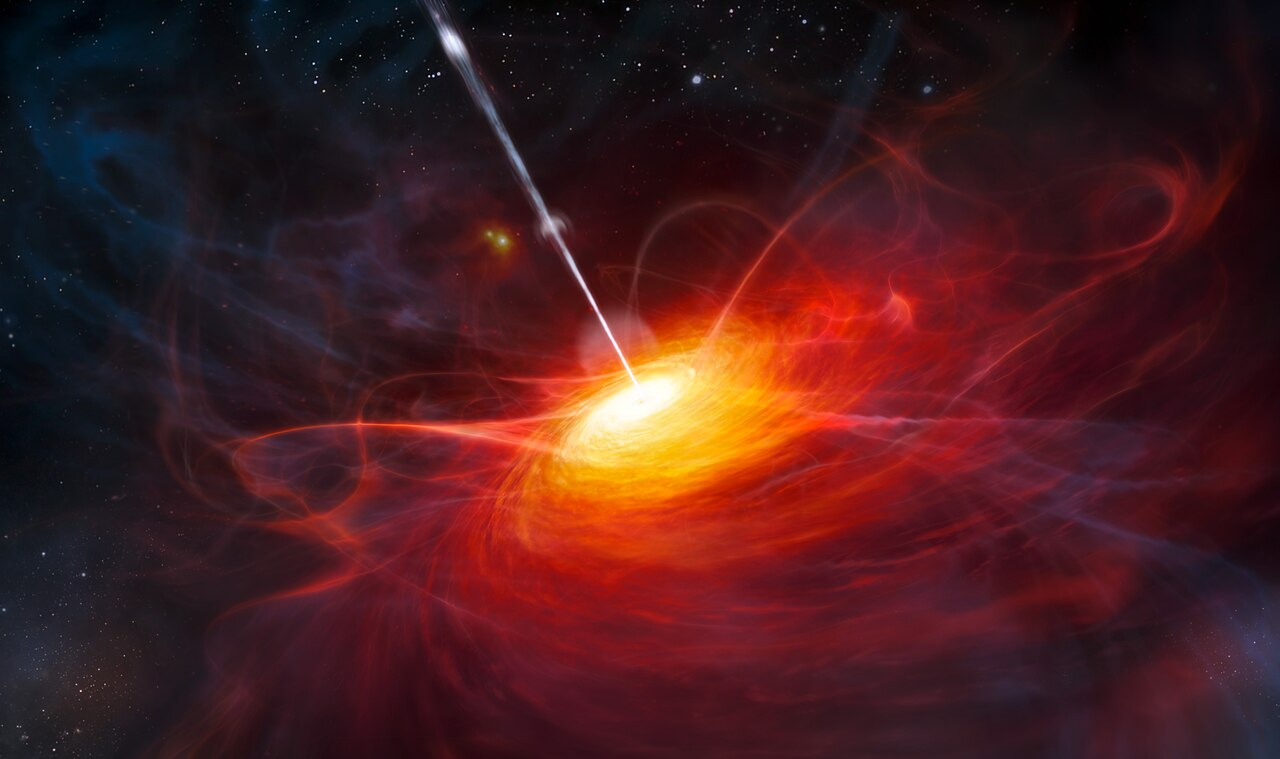
At the center of almost every large galaxy lies a supermassive black hole - an object with a mass billions of times greater than the mass of our Sun. When gas, dust, or even stars fall into its gravitational embrace, they form an accretion disk - a hot structure rotating at tremendous speed. This disk emits in all ranges - from radio waves to gamma rays - making quasars one of the brightest objects in the Universe. Their luminosity can exceed the total radiation of all the stars in a galaxy consisting of hundreds of billions of stars by thousands of times.
Quasars are active galactic nuclei where a black hole "feeds" on surrounding matter, releasing colossal energy. About 10-15% of quasars, such as PKS 1614+051, are "radio-loud": they emit strong radio wave radiation, which is created in relativistic jets - narrow streams of plasma that are ejected from the region around the central black hole at speeds close to the speed of light. Due to the effects of Einstein's theory of relativity, these objects appear particularly bright and variable to us: their brightness can change over hours, days, or years.
Observing PKS 1614+051 for almost three decades, we were like watching a movie about the life of a giant space engine in the early Universe, only in very slow motion. Our data from many years of observations at RATAN-600, together with data from other members of the collaboration, revealed that the variability of this source and the delays between changes at different frequencies correspond to blazars from the nearby Universe, although for PKS 1614+051 they are stretched in time due to the large redshift. This emphasizes the importance of long-term multifrequency monitoring of active galactic nuclei for their reliable classification.
The Mystery of PKS 1614+051
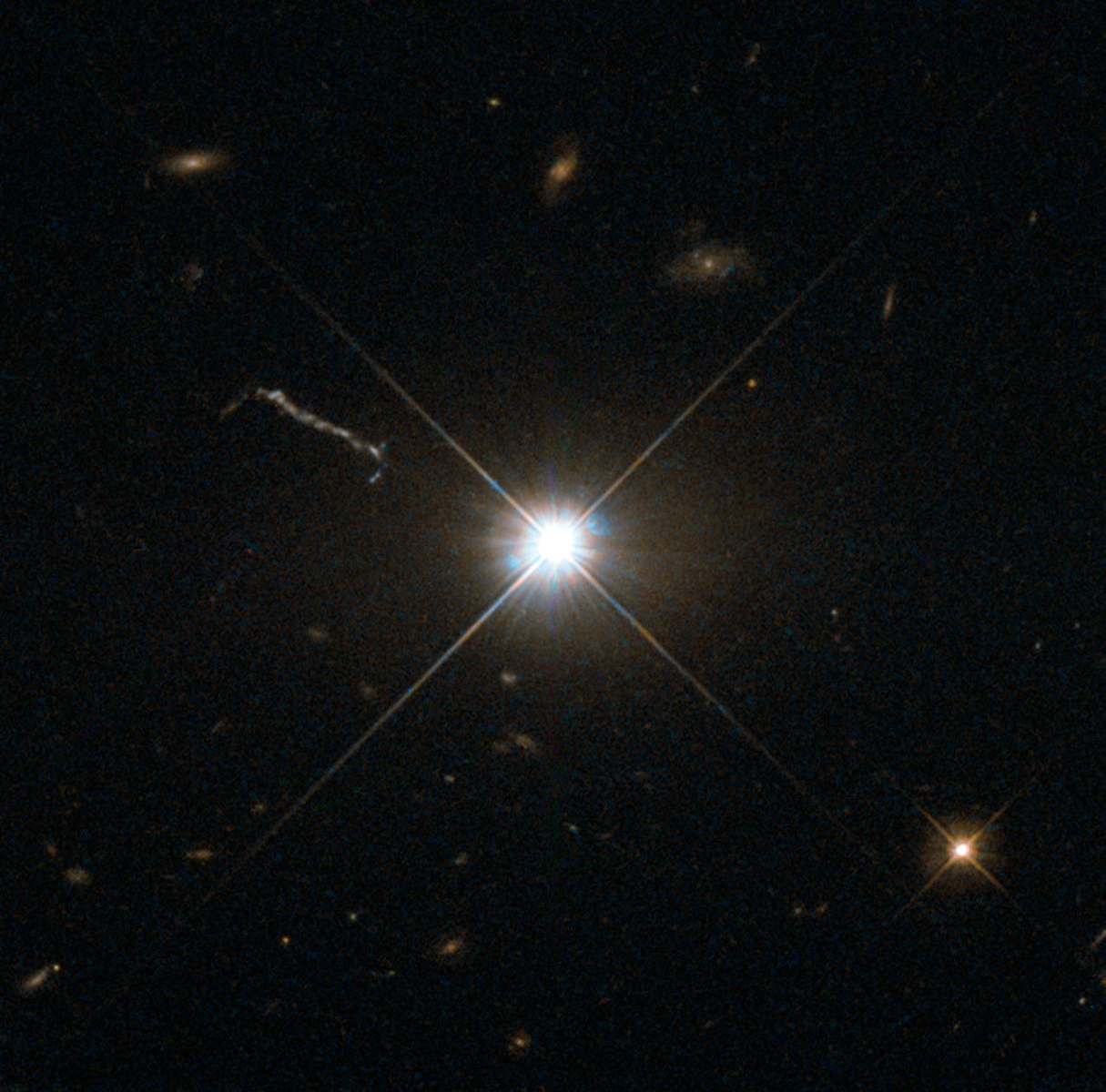
PKS 1614+051 is one of the most distant blazars known to science. Its light, which we see today, was emitted when the Universe was only 10-15% of its current age, about 11.5 billion years ago. This makes it a window into the era when the first galaxies and black holes were just beginning to form. Scientists from the Special Astrophysical Observatory of the Russian Academy of Sciences and other institutions have been studying this object for 27 years, using the unique Russian radio telescope RATAN-600 and other instruments. Their work, published in 2024 in the journalAstrophysical Bulletin, reveals the amazing features of this blazar.
One of the mysteries of PKS 1614+051 is its radio spectrum, which has a pronounced maximum at a frequency of about 5 GHz. Usually, the radio spectrum of quasars smoothly decreases with increasing frequency, but some objects, called HFP-sources (from high-frequency peaker), have a peak in brightness.
However, this source differs from ordinary blazars by a pronounced maximum in the spectrum in the region of 5 GHz, which is practically stable in time.
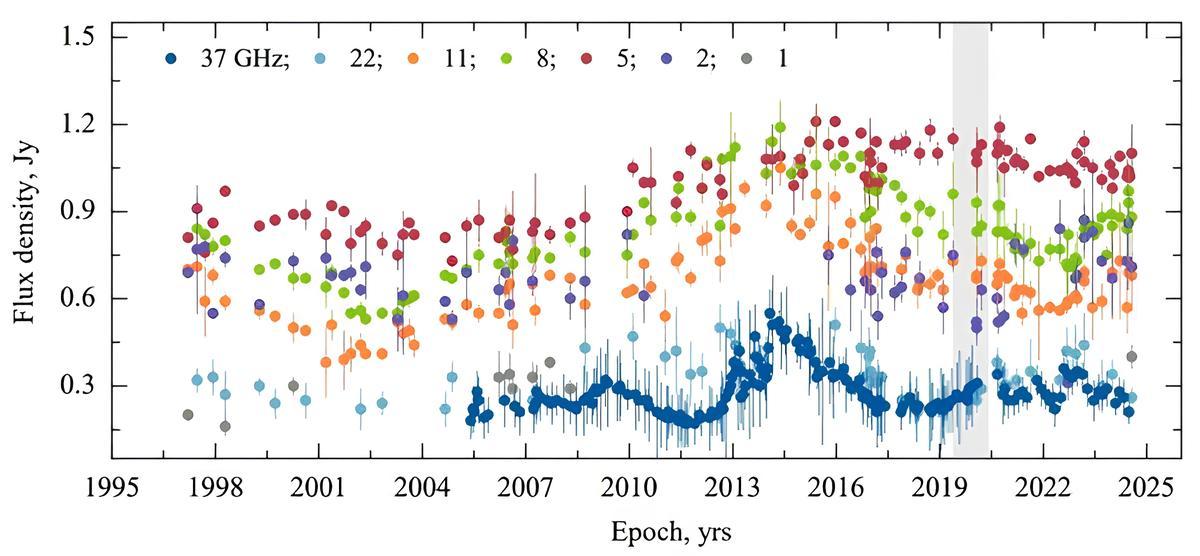
Scientists suggest that such peaks may indicate either the youth of the object (it is only a few thousand years old) or its environment with a dense cloud of gas that absorbs part of the radiation. PKS 1614+051 is unique in that its spectrum maximum remains stable for decades, which is unusual for blazars, whose characteristics often change due to flares in their jets.
The main value of the study lies in the combination of long-term multifrequency monitoring of a distant blazar with a detailed spectroscopic study of its environment.
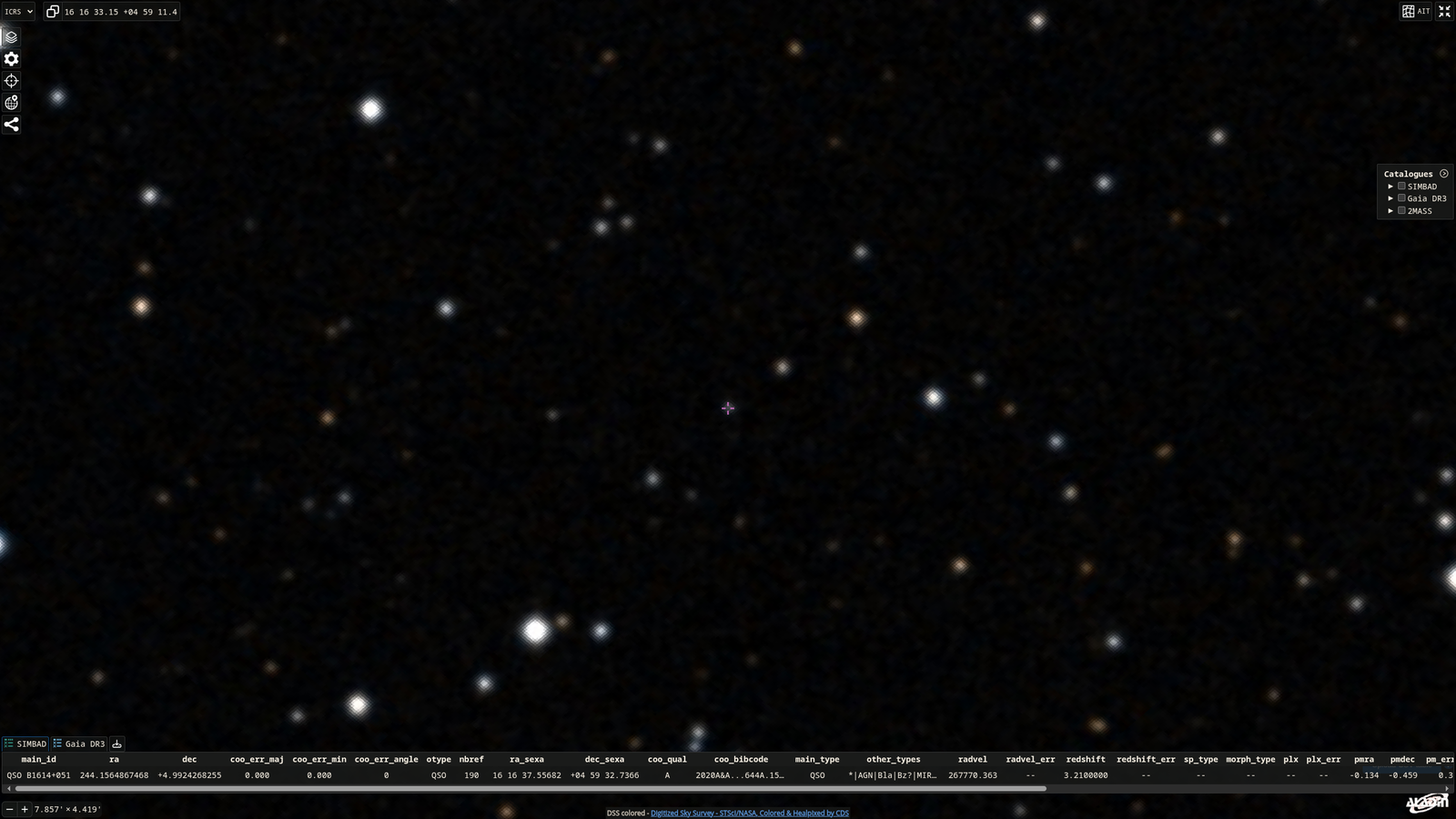
This allowed scientists to detect signs of rotation of a gas cloud around the blazar, which may be the key to understanding its nature. Spectroscopy on the Big Telescope Azimuthal (BTA) showed that the gas around PKS 1614+051 moves in an orderly manner, possibly forming a giant disk tens of thousands of light-years in size. This discovery hints at a complex interaction between the black hole and the environment, which may determine the properties of the blazar.
The discovery of signs of rotation of a gas cloud directly links the radio properties of the blazar with optical data about its environment. Our results convincingly show that to understand the nature of such objects, one 'snapshot' is not enough - long-term multiwave research is needed with the involvement of the best instrumental capabilities.
SRGA J2306+1556: A Quasar That Surprised Scientists
While PKS 1614+051 takes us to the early Universe, another quasar,SRGA J2306+1556, discovered by the ART-XC telescope on board the Spectrum-RG observatory, allows us to study processes characteristic of later eras. Discovered in 2020, this object is at a redshift of z=0.4389, which corresponds to an age of the Universe of about 9 billion years. Despite its relative 'proximity' compared to PKS 1614+051, its X-ray luminosity - about 5×10^45 erg/s - makes it one of the most powerful quasars in the last five billion years.
This allows us to classify the object as a giant radio galaxy and suggests that, thanks to accretion onto the black hole, enormous energy is released not only in the form of electromagnetic radiation, but also in the form of mechanical energy of jets of matter accelerated to almost the speed of light, and this process is maintained for millions of years.
Radio images showed that this quasar emits two giant plasma jets, forming 'radio ears' 3 million light-years long. These jets are the result of accretion of matter onto the black hole, which releases energy not only in the form of radiation, but also in the form of mechanical force, accelerating the plasma to almost the speed of light.
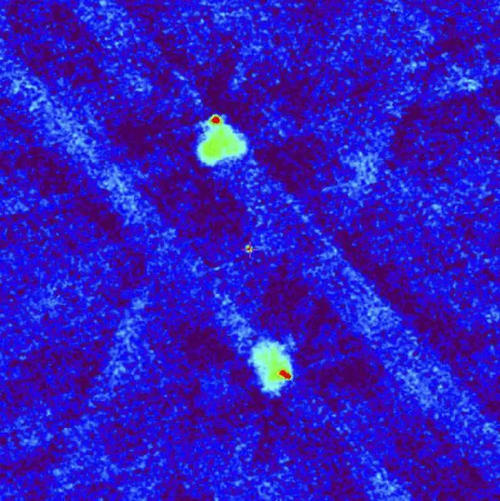
It is worth noting that the X-ray radiation of SRGA J2306+1556 varies greatly: over several years, its brightness has decreased several times, which indicates an unstable accretion process.
After processing the X-ray data obtained from both X-ray telescopes, we found that there is a strong 'blockage' in the spectrum of the source at low energies. In other words, there are fewer photons with low energy than more energetic ones.
This makes SRGA J2306+1556 a unique laboratory for studying how the environment affects the behavior of quasars.
Studying quasars and blazars, such as PKS 1614+051 and SRGA J2306+1556, helps us understand how the first galaxies and supermassive black holes were formed. These objects are not just bright spots in the sky, but a key to unraveling the fundamental processes that determined the evolution of the Universe. For example, data on the rotating gas disk around PKS 1614+051 indicate that black holes in the early Universe could grow by interacting with a dense environment. This confirms the 'feedback' theory, according to which active galactic nuclei influenced the formation of stars and galactic structures.
Quasars also serve as natural laboratories for testing physical theories. Their extreme conditions - powerful magnetic fields, relativistic speeds, high energies - allow scientists to study processes that cannot be recreated on Earth. For example, analysis of blazar jets helps to understand how particles are accelerated to speeds close to the speed of light, and how magnetic fields control these flows.
Modern technologies are opening up new horizons for the study of quasars. The Russian telescope RATAN-600, used for observations of PKS 1614+051, allows simultaneous measurements at different frequencies, which is critical for studying variability. The Spectrum-RG observatory with the ART-XC telescope continues to scan the sky, discovering new quasars, such as SRGA J2306+1556. Quasars and blazars are not just cosmic phenomena, but keys to understanding the history of the Universe. They allow us to look into the era when the first galaxies were born and study the processes that shaped the cosmos as we know it.
The brightness of quasars allows us to record objects located at distances of billions of light-years. The light of quasars passes through the intergalactic medium and inevitably interacts with the matter in its path. These interactions leave unique imprints in the emission spectrum, which become a source of data on the composition, temperature, and density of gas between galaxies. In addition, observations of quasars provide an opportunity to study the dynamics of hypothetical dark matter. One of the key tools for studying its structure is the phenomenon of gravitational lensing, when light from a distant quasar is bent by the gravity of massive objects in its path. This creates an effect in which the image of the quasar is divided into several components or stretched into rings.
In the future, global networks of radio telescopes, such as the Event Horizon Telescope, will be able to create images of jets with incredible detail, allowing us to measure their speed and structure. In addition, the development of technologies using quasars for navigation may open up new opportunities for exploring deep space.
Read more on this topic:
A mysterious object larger than Earth, resembling a bird or a spacecraft, was spotted above the Sun
One of the strongest coronal ejections in recent years was recorded at the south pole of the Sun
Never miss our newsAdd this site to your preferred sources to see us more oftenAdd on Google