Translated with AI from the Russian original.
An aerostat barrier for physical interception of drones is being tested at one of the Russian testing grounds. The structure, consisting of two aerostats with a volume of 150 m³ each, was demonstrated in action by NPP "Spetsradio". During the tests, a drone attempting to pass through the barrier got caught on a cable, wound it around its propeller, and hovered.
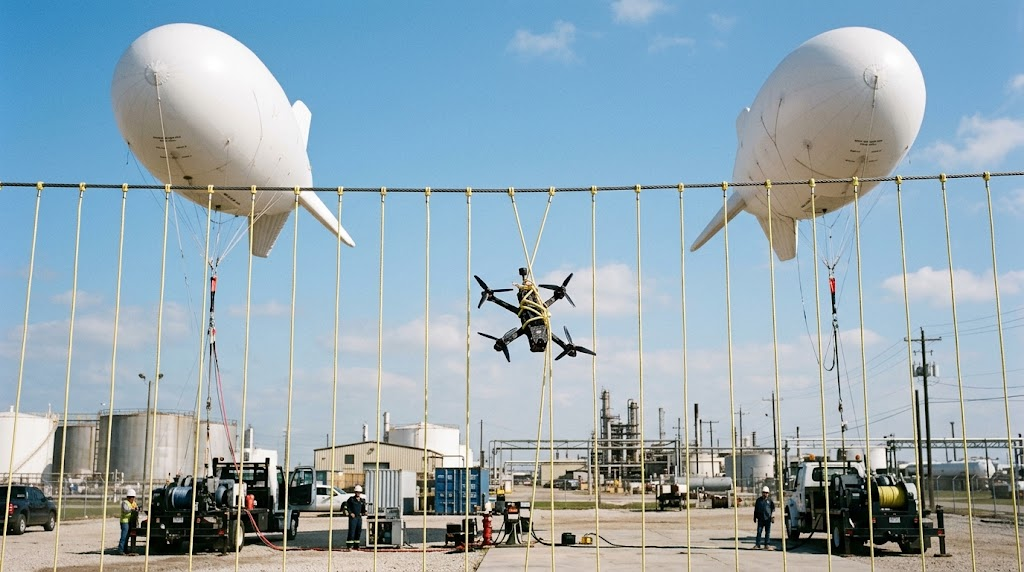
The scheme is arranged as follows: aerostats rise to a predetermined height, a cable is stretched between them, and Kevlar cords hang down from it. Several Russian companies claim to be developing aerostat barriers, but only "Spetsradio" has demonstrated a fully ready system in action.
The distance between the vertical cords is about one meter. According to the developer, the composite cable is three to four times lighter and stronger than its steel counterpart, and its ultimate load reaches 800 kg. During tests, a device that crashed into one of the cables stopped, wrapped around its propeller.
According to the developers' plan, the barrier should work in conjunction with the "Gepard" complex: radars determine the height of the approaching drone, and automatic winches adjust the aerostats' lift so that the cables are directly in the drone's path.
The idea itself is not new: aerostat barriers with cables and nets were used as early as the first half of the 20th century — in 1941, they were used to protect the sky over Moscow from enemy aircraft raids. Modern ground-based physical drone interception systems, such as protective and catching nets, are already used in Russia. The current tests differ in that a specific working configuration with two aerostats and Kevlar cords is shown.
A representative of the enterprise reported that to protect an object on the scale of the oil refinery in Kapotnya, at least ten such complexes would be required, and for all strategic objects in the country — hundreds of aerostats. If the technology is scaled up, aerostats could become one of the physical elements of a multi-level object protection system, along with radar detection, electronic warfare systems, and ground-based anti-drone nets.
Read more on the topic:
Never miss our newsAdd this site to your preferred sources to see us more oftenAdd on Google

















