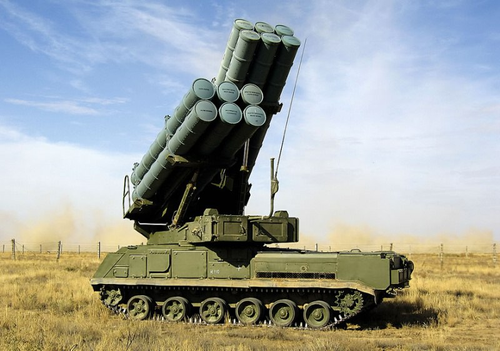
Crews of the new "Buk-M3" SAM systems spoke about the practical application of the system against glide bombs: one of the vehicles has already hit four Western-made guided munitions. This was stated by crew commander Anton Medzhidov, who previously worked on the "Buk-M2".
A glide bomb creates a separate challenge for military air defense: its dimensions are significantly smaller than the carrier aircraft, making it more difficult to detect and track such an object. According to Medzhidov, the ability to confidently engage small aerial targets has become one of the practical advantages of the new "Buk-M3".
The bombs are small. We clearly see a large aircraft due to its size, but with a bomb, it's more difficult. But they still won't escape us.
The new version of the system differs from the "Buk-M2" not only in updated electronics but also in missile armament. The self-propelled firing unit carries six missiles in transport-launch containers, while the launcher of the system accommodates another 12 missiles. In full composition, a division can simultaneously track and engage up to 36 targets, and the declared range of engagement of aerial objects reaches 70 km at an altitude of up to 35 km.
The key change is the 9M317M missile. According to the developer, it has increased characteristics compared to the 9M317 from the "Buk-M2", including range and speed, as well as improved capabilities for engaging cruise missiles, ballistic missiles, and aerial bombs. At the same time, the "Buk-M3" retained the ability to use previous generation missiles.
The radar part has been seriously redesigned. The self-propelled firing unit received a multifunctional radar with a phased array antenna and electronic beam scanning, as well as an optoelectronic channel with thermal imaging and television matrices. This is especially important for operating in conditions of electronic countermeasures.
Read more on the topic:
Never miss our newsAdd this site to your preferred sources to see us more oftenAdd on Google