Russian unmanned systems have gained a new tactical capability: FPV drones equipped with microphones can detect and attack moving vehicles by sound, reports "Rossiyskaya Gazeta".
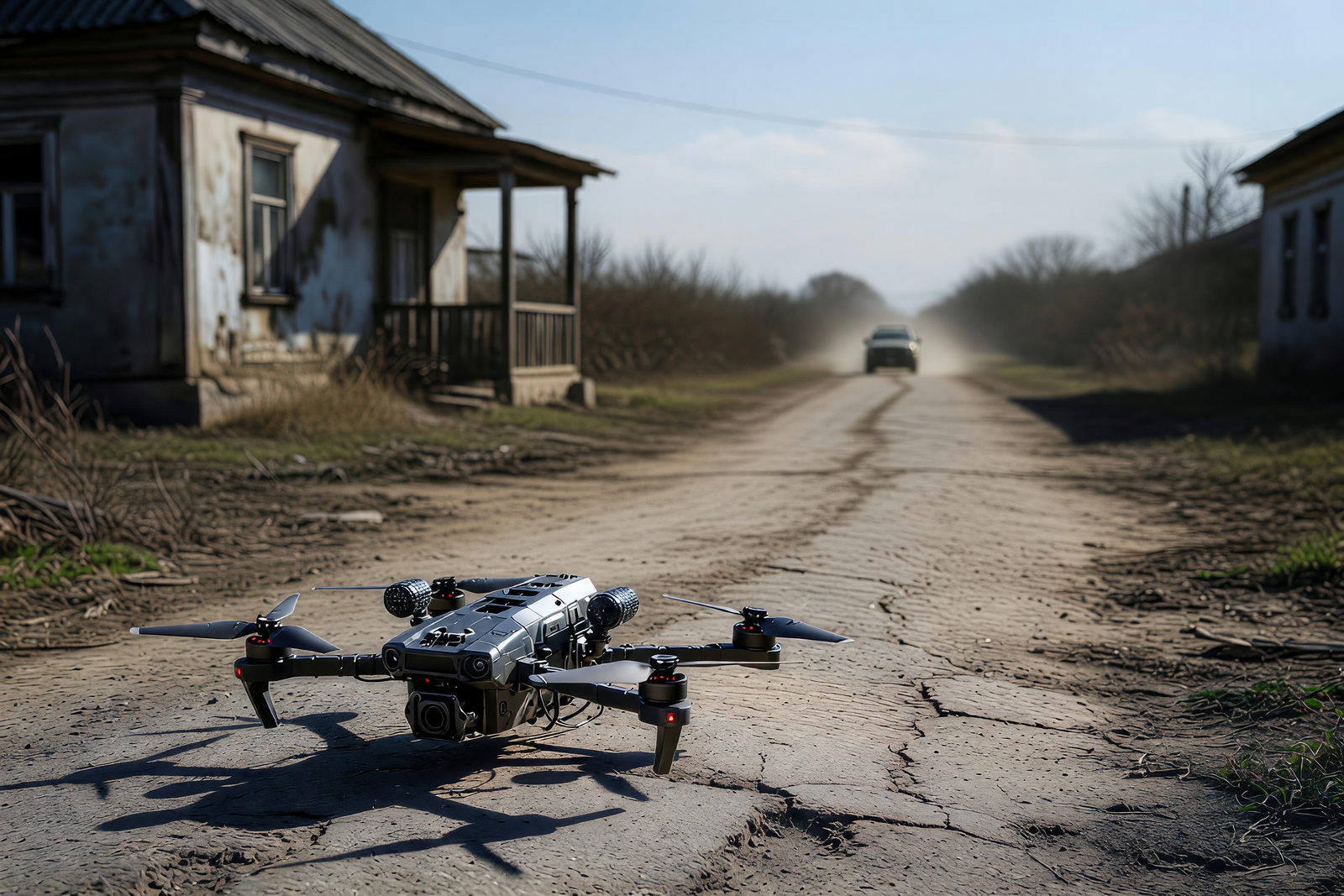
The "listener" drone hides out of sight, for example, in a house yard along a road, and is in standby mode. An integrated microphone records the sound of an approaching vehicle. After that, the drone takes off from ambush and attacks the target. According to local data, the fiber-optic FPV drone "Knyaz Vandal Novgorodsky" (KVN) is used as a platform for this tactic. It was this drone that was used as a "listener" in the published footage.
The new tactic solves a key problem of the previous strategy, where "waiter" drones waited for targets directly on the road: they were easily detected by reconnaissance drones. The use of an acoustic sensor makes the ambush significantly more stealthy.
We have already discussed in detail the evolution of the fiber-optic FPV drone "Knyaz Vandal Novgorodsky", developed at the SPC "Ushkuynik". The key advantage of the device is control via a fiber-optic cable, which makes it completely invulnerable to electronic warfare systems: it is impossible to intercept the signal or suppress communication by traditional methods.
The ambush tactic is not new for this drone. Back in late 2025, "Knyaz Vandal" was turned into a "waiter drone" – the device could land and wait for a target on the road. It was then that SPC "Ushkuynik" carried out a major modernization: increased the range due to coils with a longer range and added an electronic target sensor. However, an ambush directly on the road had an obvious flaw – the drone was easily detected from the air by reconnaissance drones.
In parallel, the platform increased its combat capabilities: a new modification with a range of 30 km entered service in 2026, whereas previously the 23 km version was considered the main one. The addition of an acoustic sensor in the current iteration logically continues the line of successive improvements – each time engineers eliminated a specific drawback identified in real combat conditions.
Read more on the topic:
Never miss our newsAdd this site to your preferred sources to see us more oftenAdd on Google