In July, Russian aviation used a record number of guided aerial bombs — more than 8.3 thousand units, which exceeds the previous maximum. According to blogger Oleg Tsarev, the frequency of use is about five minutes per bomb.
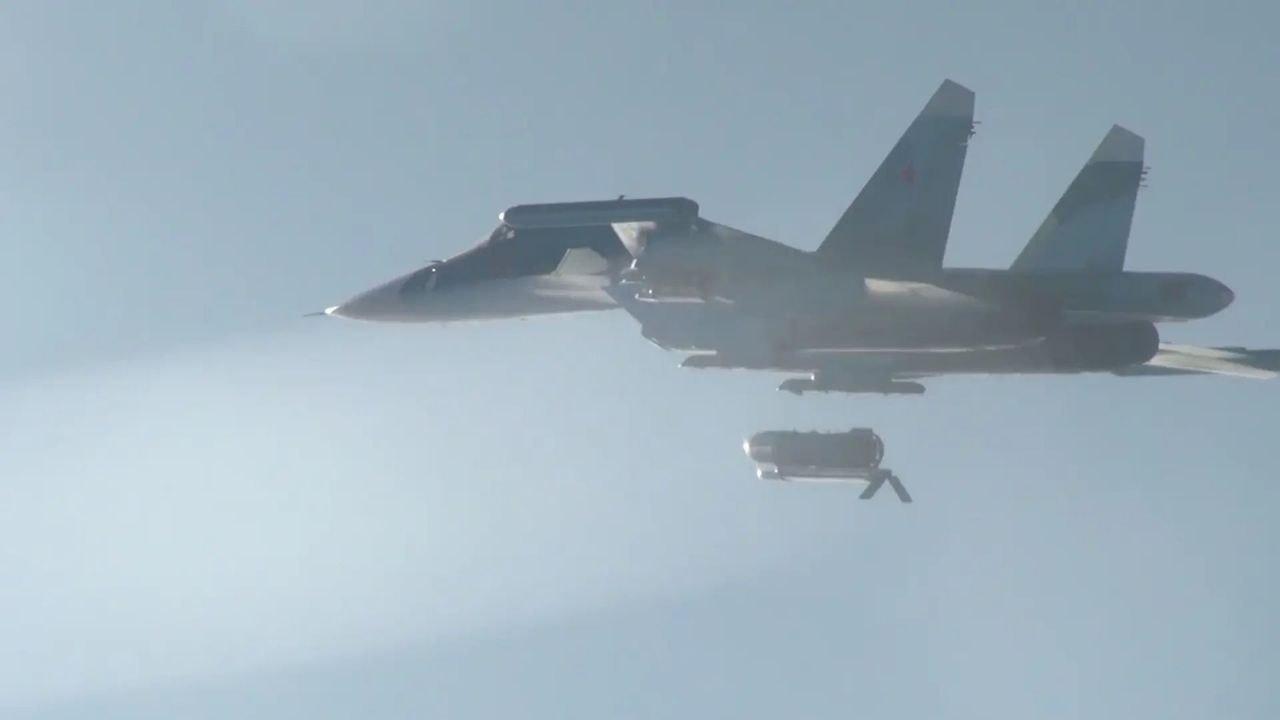
Such volumes became possible due to equipping conventional FAB-500, FAB-1500, and FAB-3000 bombs with universal planning and correction modules (UMPC). This turns them into gliding munitions with a range of 60–100 km — the Russian analogue of the American JDAM-ER. The bomb is launched outside the air defense zone, and the accuracy, thanks to satellite correction, is 5–10 meters.
According to Tsarev, the next stage of evolution should be the replacement of satellite guidance with machine vision, which does not depend on GPS or GLONASS and is not afraid of electronic warfare systems. The bomb compares the target image with a pre-loaded reference image and independently corrects its trajectory, reducing the deviation to several meters.
As the blogger emphasized, Russia is already doing this: the UPAB-1500TV-E bomb received a television homing channel in addition to satellite guidance, and the Kh-101 cruise missile is equipped with the "Sprut" optoelectronic correction system. The American JDAM-ER and its new version ERAM are based on protected GPS/INS, full-fledged machine vision has not yet been confirmed.
Evolution of Russian gliding aerial bombs with UMPC
Back in 2023, the FAB-1500M-54 appeared — the first large gliding bomb with retractable wings and satellite guidance, whose declared accuracy was 5 meters, although independent analysts at the time questioned these data.
Since then, the characteristics of the munitions have significantly improved. In May 2025, information appeared that Russian guided aerial bombs deviate from the aiming point by only one meter — a result that until recently seemed unattainable for serial munitions of this class. At the same time, engineers worked on protection against electronic warfare systems: in July 2025, it became known that the "Kometa-M" module ensures stable GLONASS/GPS reception at interference levels 100,000 times higher than the threshold for a conventional receiver. The transition to optical and television homing develops the same approach, completely eliminating dependence on external navigation signals.
Read more on the topic:
Never miss our newsAdd this site to your preferred sources to see us more oftenAdd on Google

















