Translated with AI from the Russian original.
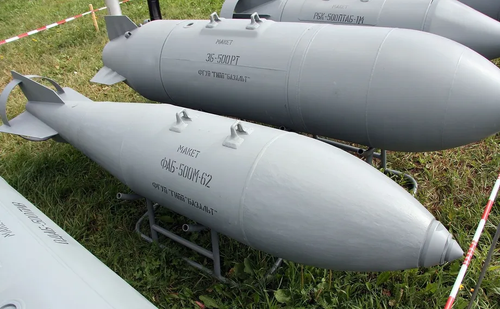
Russian high-explosive aerial bombs with universal planning and correction modules (UMPC) demonstrate an increased level of accuracy. FABs deviate from the aiming point by only one meter, which is considered a very good result.
Two such munitions with a small interval fell on the aiming point in the forest belt. It can be seen how the shock wave diverges in different directions, and clouds of gray smoke rise into the sky after bright flashes.
Russian front-line aviation aircraft use a wide variety of high-precision weapons, their mass ranging from 250 to 3000 kg.
For example, the range of the FAB-1500 M54 with UMPC has significantly increased compared to the range of smaller caliber bombs equipped with planning modules. The declared accuracy of the refined product is 5 m. At the same time, when a bomb filled with 700 kg of explosives explodes, a crater with a diameter of 15 m is formed. The continuous destruction zone is 2 km.
Currently, each Su-34 can carry two such bombs. In the future, their number will be increased to three.
Earlier www1.ru reported that Dan-M decoy drones with a jet engine have been developed in Russia.
Read more materials:
Su-30SM specification for Belarus revealed: goodbye to French avionics
GShG aircraft machine gun from Mi-24 attached to a car: a half-century-old weapon has found a new use
The first shots of loading Kh-101 missiles onto the pylons of a Tu-95MS bomber have appeared
Never miss our newsAdd this site to your preferred sources to see us more oftenAdd on Google

















