Humanity, according to modern understanding, will never know what is inside a black hole, said Sergey Sazonov, head of the laboratory of experimental astrophysics at the Space Research Institute of the Russian Academy of Sciences (IKI RAS), Professor of the Russian Academy of Sciences. The reason is the event horizon, beyond which nothing, not even light, can escape.
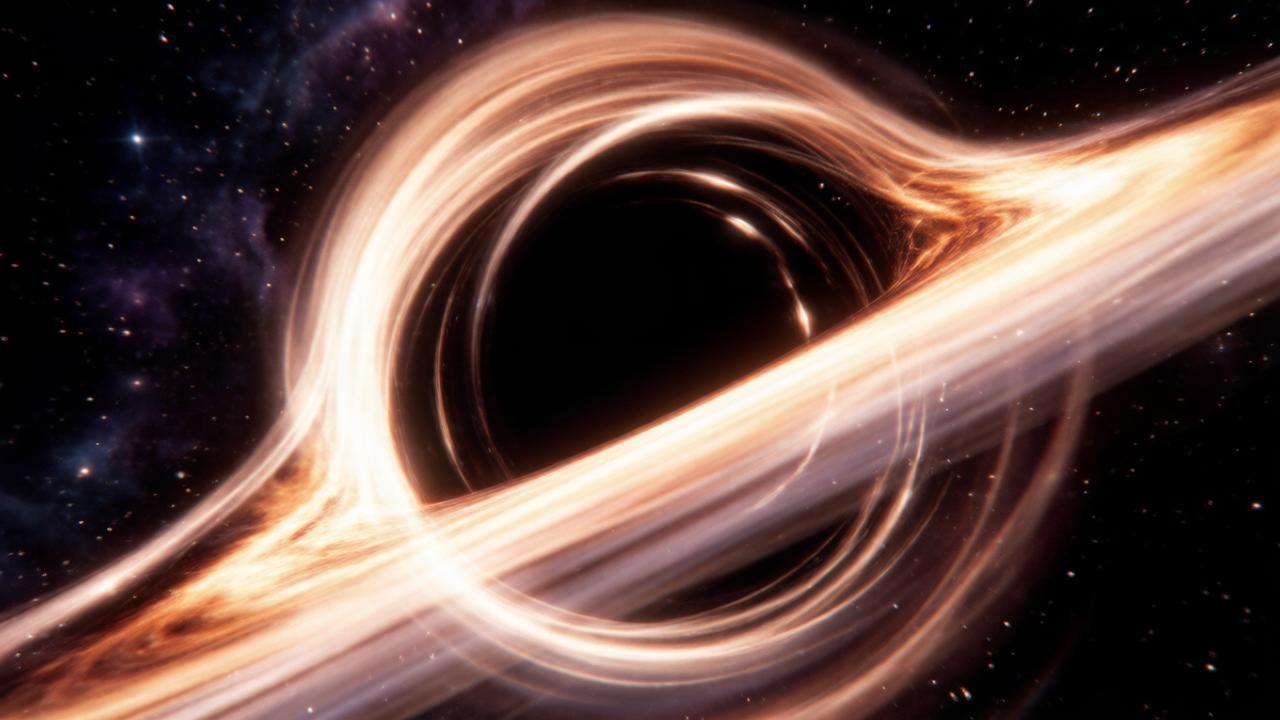
A black hole is a region of space from which it is impossible to escape. Its size can be anything: from the hypothetical compression of the Earth to a 9 mm ball to supermassive giants in the cores of galaxies. At the center of the Milky Way, there is a black hole with a mass of 4 million solar masses, and in the Messier 87 galaxy, with a mass of 6 billion solar masses.
As the scientist explained, stellar-mass black holes are born as a result of the collapse of massive stars when the pressure of degenerate neutrons cannot withstand gravitational compression. They can only be detected at the moment of accretion of matter – the flow from a neighboring star, when an accretion disk forms and powerful X-ray radiation occurs. Without this, black holes "slumber" and are invisible.
According to Sazonov, despite the rapid development of astrophysics since the 1960s, when quasars and the first X-ray sources were discovered, all observations concern only the external manifestations of black holes. We do not see the inside of a black hole, the scientist concluded. He did not rule out that future generations might find a way to explore this object, but for now, such a possibility remains beyond the scope of science.
Read more on the topic:
- Almost Like in Space: Russian Physicists Compressed Plasma into Jets and Captured Ion Separation
- Light vortices will accelerate quantum computing and help recreate black holes - SPbGU physicists
- Russian scientists with German colleagues for the first time mapped a molecule important for space and chips
Never miss our newsAdd this site to your preferred sources to see us more oftenAdd on Google