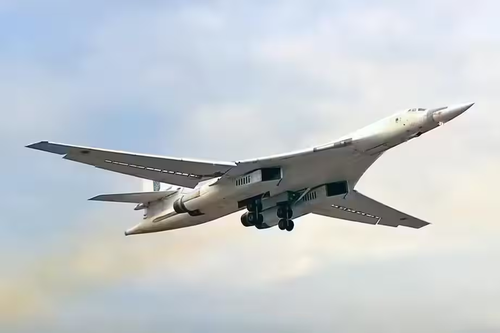
Tu-160M "White Swan" and Tu-95MS missile carriers may be armed with a new subsonic cruise missile called "Product-30". This was reported by military experts from the specialized analytical Telegram channel "Military Informant" with reference to their sources.
According to their information, the missile began to be launched in a limited way at the end of 2025. Presumably, its estimated range is at least 1500 km, flight speed is 600–800 km/h, and the weight of the warhead is 800 kg.
To counter electronic warfare (EW) equipment, the missile was equipped with interference-protected satellite signal receivers "Cometa-12M".
It is assumed that "Product-30" is a simplified and cheaper version of the Kh-101 missile for more massive use.
It should be emphasized that information from the Ministry of Defense on this missile has not been received, its official characteristics are unknown.
Basic missile for Tu-160M and Tu-95MS is the Kh-101 with a range of up to 5.5 thousand km and a warhead weight of about 450 kg. It can be concluded that in the case of "Product-30" we are talking about an operational-tactical missile.
Read more materials on the topic:
- Manufacturer of Tu-160 and Tu-22M3 bombers will spend 1.5 billion rubles on a new workshop
- The uniqueness of the new "White Swan" has been revealed: it surpasses the Tu-160 in everything
- Otherwise, we will be left without "strategists": the production of Tu-160 "White Swans" was urged to be accelerated in Russia
Never miss our newsAdd this site to your preferred sources to see us more oftenAdd on Google