On the evening of November 4, a maximum-level X1.8 solar flare was recorded on the Sun - the first event of this magnitude since June 2025. This was reported by the Laboratory of Solar Astronomy of the IKI RAS and the Institute of Solar-Terrestrial Physics of the SB RAS. The flare began at 20:15 Moscow time, peaked at 20:34, and ended at 20:51.
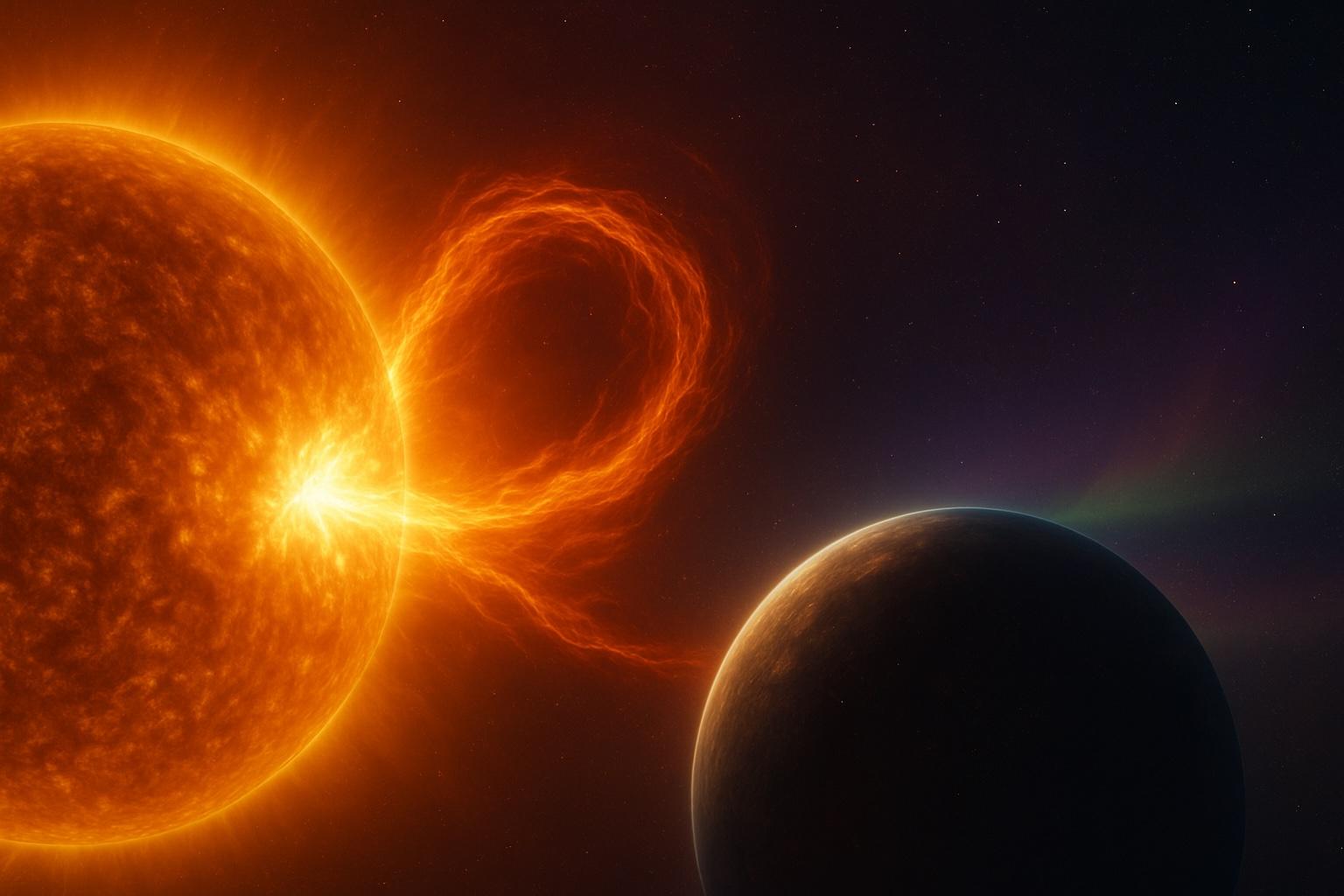
According to Russian astronomers, the flare was accompanied by the ejection of plasma into interplanetary space. The core of the ejection deviated from Earth by an angle of approximately 55 degrees. This means that a direct hit to our planet is not expected, and possible tangential effects will not exceed level 3 on a five-point scale of geomagnetic storms. Such events can only cause moderate disturbances in the magnetosphere, posing no threat to satellites and power systems.
The source of the flare is active region No. 4274, which about two weeks ago, while on the far side of the Sun, bombarded object 3I/ATLAS with plasma clouds. According to observations, this zone has shown signs of energy accumulation in the past 24 hours, and an unusually long pause in activity - about 15 hours - was recorded there before the flare. It is these "quiet" periods that often precede powerful events on the Sun.
Solar flares are classified according to the power of X-ray radiation: classes A, B, C, M, and X. Each subsequent class is ten times more powerful than the previous one. An X1.8 level event belongs to the highest category and is considered significant even against the background of the growing solar activity of the 25th cycle. The previous flare of similar strength (X1.9) was recorded on June 19, 2025.
Experts note that the probability of new powerful emissions will increase in the coming days. Active regions on the solar disk shift daily, which causes their directions towards the Earth to change by approximately 13-15 degrees.
In four days, region 4274 will come into a direct line "Sun - Earth", which will create conditions for frontal impacts. Scientists hope that the accumulated energy will be exhausted by this time, but it is impossible to completely rule out the repetition of class X events.
Solar flares directly affect the operation of satellites, communication and navigation systems, and can also cause auroras even at mid-latitudes. For Russia, this means the need for increased monitoring of space weather, especially against the background of the active development of satellite constellations and new generation communications.
Read more materials:
- Class M3.5 flare recorded on the Sun
- The star has raged: two strong flares were recorded on the Sun on November 3
- The sun erupted with a powerful flare: increased star activity is expected from October 3 to 9
Never miss our newsAdd this site to your preferred sources to see us more oftenAdd on Google

















