Russia's icebreaker fleet will grow by 14 units by 2030, according to the press service of the Federal Agency for Maritime and River Transport (Rosmorrechflot).
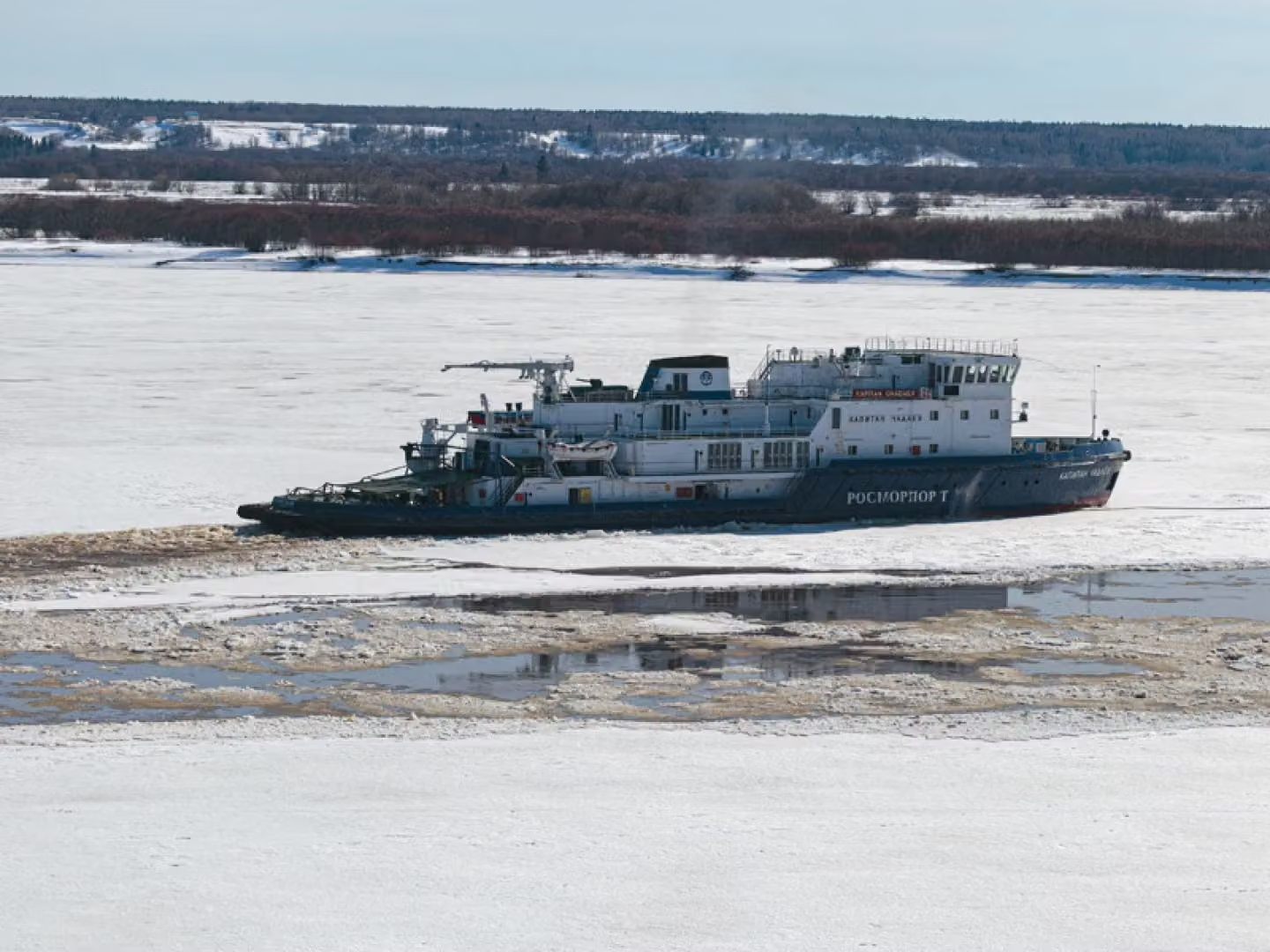
Image source: Rosmorrechflot
Today, Russia has 43 icebreakers, including 8 nuclear-powered ones, and 12 emergency rescue vessels. By 2030, 14 more will be built. Nine ice-class tankers are under construction, and a space complex for communication and remote sensing of ice conditions is being developed. Port infrastructure is being modernized in parallel.
Deputy Minister of Transport Konstantin Pashkov noted that the Ministry is focused on fulfilling the President's mandate to develop the Trans-Arctic Transport Corridor.
Key areas for further improvement of transport systems will be concentrated in the Arctic region.
This is a large field for our joint work. This includes hydrographic and hydrometeorological support for safe navigation, modeling and optimization of the Northern Sea Route routes, as well as improving the efficiency of transport flow organization and integrating railways into the port system infrastructure of the NSR. We traditionally work actively with the Russian Academy of Sciences on these issues. And now we are releasing the Concept for the Scientific and Technological Development of the Transport Complex of Russia, where all these issues are taken into account.
Earlier,www1.ru reported that the world's most powerful icebreaker, "Arktika,"is returning to Murmansk after maintenance at the Baltic Shipyard.
Read more on this topic:
- The National Interest: Russians invest more in icebreaker construction than Americans
- The newest nuclear icebreaker "Yakutia" set off on its first voyage
- Construction of the newest nuclear icebreaker "Stalingrad" began at the USC shipyard
Never miss our newsAdd this site to your preferred sources to see us more oftenAdd on Google








![Growth Point: After 5G Launch, Mobile Internet in Russia Accelerated by 20%","subtitle":"TelecomDaily recorded an upload speed increase of 19.7%, and download speed of almost 14%","announce":""}[]}],](https://media.ixbt.site/fit-in/320x/ixbt-data/1727896/ai-image-nvgq0a0v5cjnyxwoc8xpelva.webp)