Two near-top class power (M) flares were recorded on the Sun. This was reported by the Institute of Applied Geophysics.
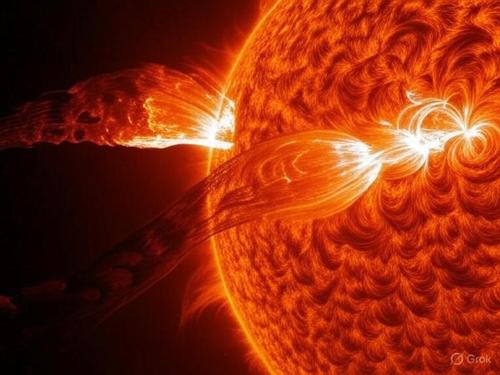
On August 4, at 08:15 Moscow time, an M1.4 flare lasting 16 minutes was recorded in the X-ray range in sunspot group 4168 (N04E14).
An M2.1 flareoccurred at 07:57 Moscow time in the same group of sunspots.
Solar flares are classified by the power of X-ray radiation into five classes: A, B, C, M, and X. The minimum class A0.0 corresponds to a radiation power at Earth's orbit of 10 nW per square meter, and with the transition to the next class, the power increases by a factor of 10. Flares can be accompanied by emissions of solar plasma, the clouds of which, reaching Earth, can cause magnetic storms.
Read more on the topic:
Over the past day, 15 flares occurred on the Sun - 2.5 times more than the day before
The Sun is again at its peak of activity: following 17 flares, another one was recorded on August 3
Magnetic storms are approaching?: A strong class M2.5 flare occurred on the Sun - the first in July
Never miss our newsAdd this site to your preferred sources to see us more oftenAdd on Google

















