The ART-XC named after M.N. Pavlinsky telescope, installed on board the Spektr-RG observatory, discovered a previously unknown X-ray source SRGA J230631.0+155633. Research has shown that it is one of the most powerful quasars in the last five billion years of the Universe's history. The results of the work have been accepted for publication in the prestigious journal Monthly Notices of the Royal Astronomical Society.
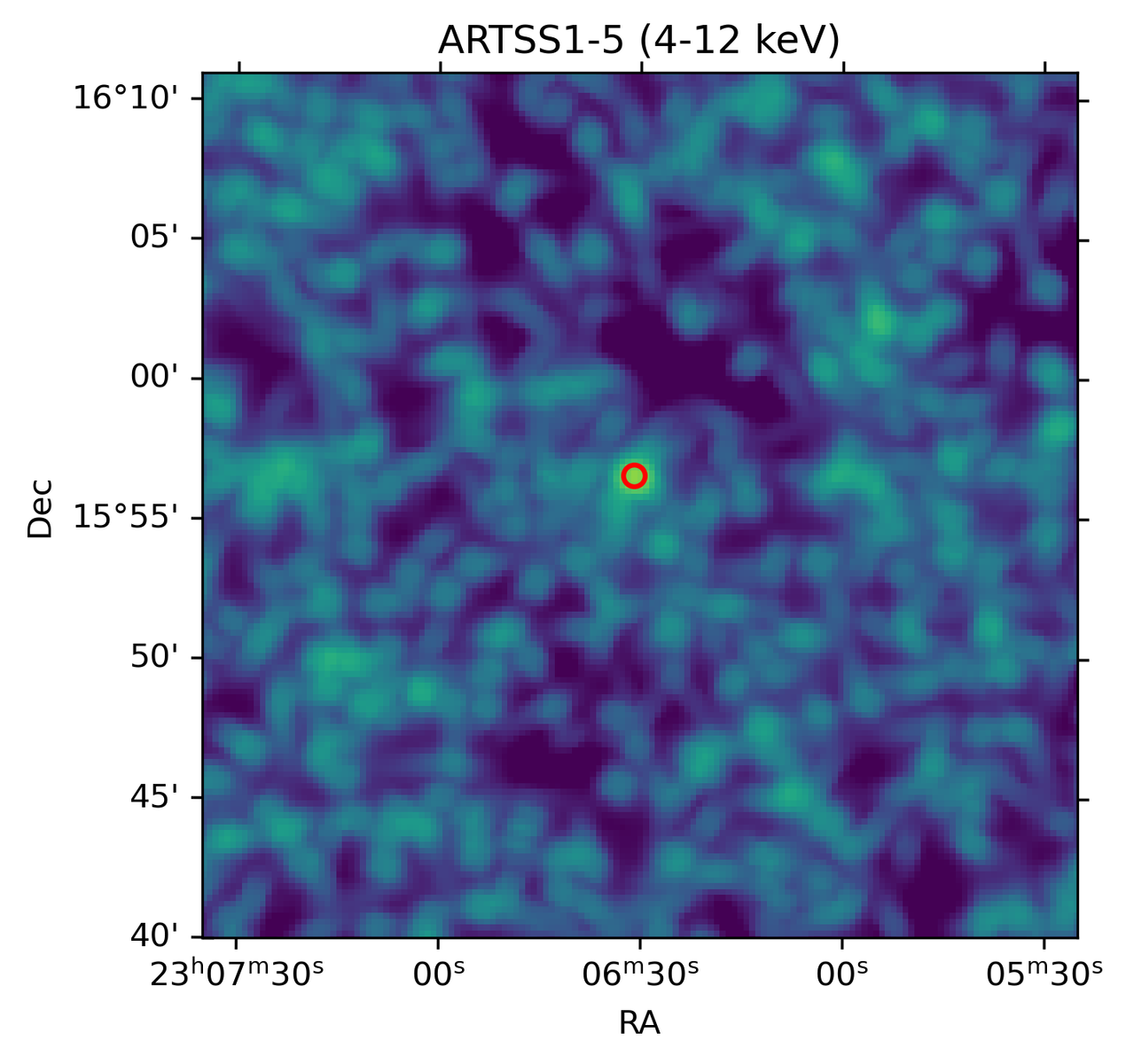
The source SRGA J2306+1556, discovered in 2020 during a sky survey, attracted the attention of scientists due to its unusual X-ray luminosity - about 5×10^45 erg/s. This value is typical for powerful quasars, which are usually found at large red shifts, corresponding to the early epochs of the Universe. The object is located at a redshift of z=0.4389, which corresponds to the age of the Universe of about 9 billion years.
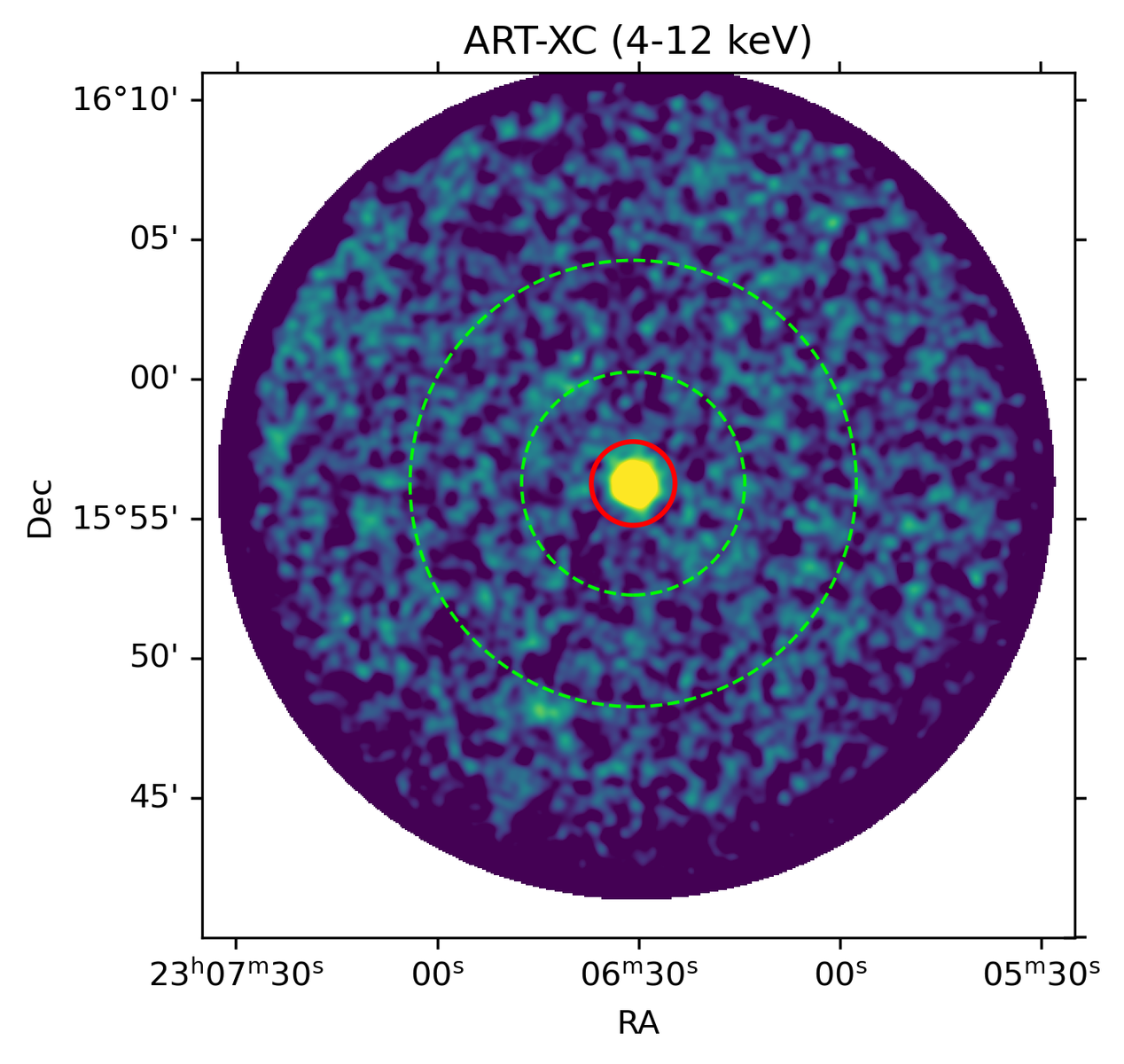
The ART-XC telescope, developed by the Space Research Institute of the Russian Academy of Sciences, operates in the hard X-ray range (4-20 keV), which allows detecting objects hidden behind dense clouds of gas and dust. In 2023, scientists conducted additional observations of SRGA J2306+1556 in the three-axis stabilization mode, which increased the exposure time to almost a day. Data from the XRT telescope of the Swift Observatory (NASA) were also used.
After processing the X-ray data obtained from both X-ray telescopes, we found that there is a strong "blockage" at low energies in the source spectrum. In other words, there are fewer low-energy photons than more energetic ones. This suggests that we are observing a central black hole through a thick layer of gas and dust. In addition, the source has become several times weaker compared to what we saw during the all-sky survey several years before. However, the luminosity still remained very high - about 1045 erg per second. During the renewed all-sky survey by the ART-XC telescope in 2023-2024, the source was no longer registered. This indicates a strong variability of the object's X-ray radiation, and therefore, an unstable nature of accretion onto the black hole on time scales of several years.
SRGA J2306+1556 turned out to be not only a powerful quasar, but also a giant radio galaxy. Radio images obtained by the VLA, GMRT and ASKAP telescopes showed two huge "radio ears" - clouds of plasma extending for 3 million light years. These structures are formed by jets of matter ejected by a black hole at a speed close to the speed of light.
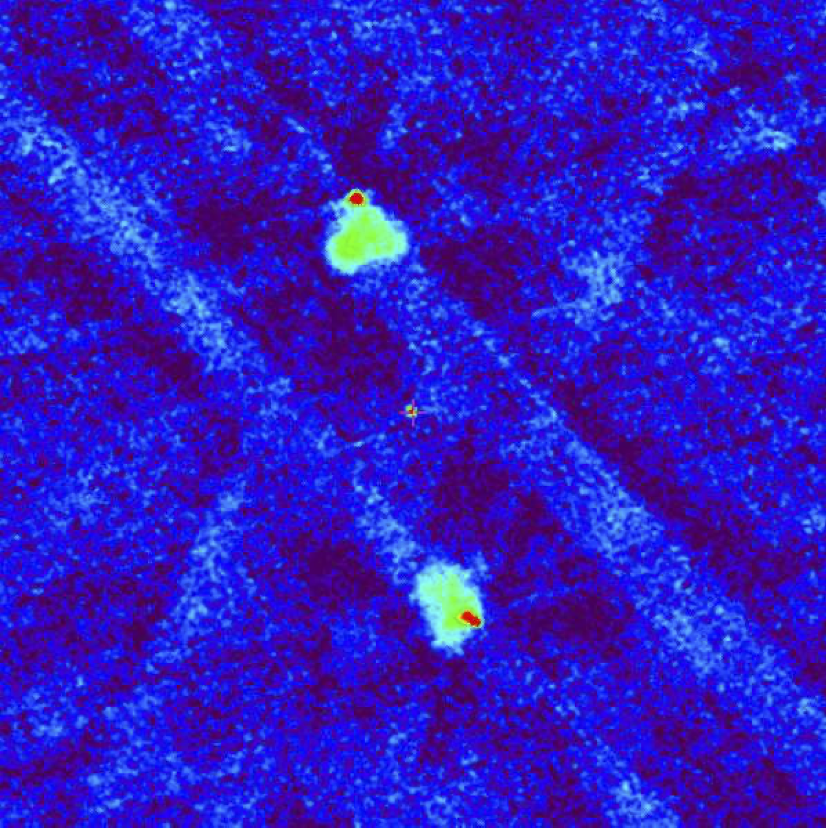
This allows us to classify the object as a giant radio galaxy and suggests that, thanks to accretion onto a black hole, huge energy is released not only in the form of electromagnetic radiation, but also in the form of mechanical energy of jets of matter accelerated to almost the speed of light, and this process is maintained for millions of years.
The discovery of SRGA J2306+1556 allows scientists to study processes characteristic of the early Universe at a relatively close distance. Such quasars are rare at redshifts z<0.5, which corresponds to the last five billion years. This discovery highlights the importance of sky surveys in the hard X-ray range, which are conducted by the ART-XC telescope. The Spektr-RG Observatory, launched in 2019, continues to scan the sky, promising new discoveries.
Read more on the topic:
Russian telescope "Spektr-RG" found quasar SRGA J2306+1556, hidden from direct observation
"Cosmos-2505": Roscosmos told about a satellite with capsule delivery of images
Never miss our newsAdd this site to your preferred sources to see us more oftenAdd on Google