The satellite information receiving station "Uniscan-24" has started operating at the St. Petersburg State University of Aerospace Instrumentation (SPb GUAP). The station was actively used for scientific research by the Space Services Center "CosmoInform-Center" GUAP, and recently underwent modernization under the Ministry of Education and Science program "Priority-2030".
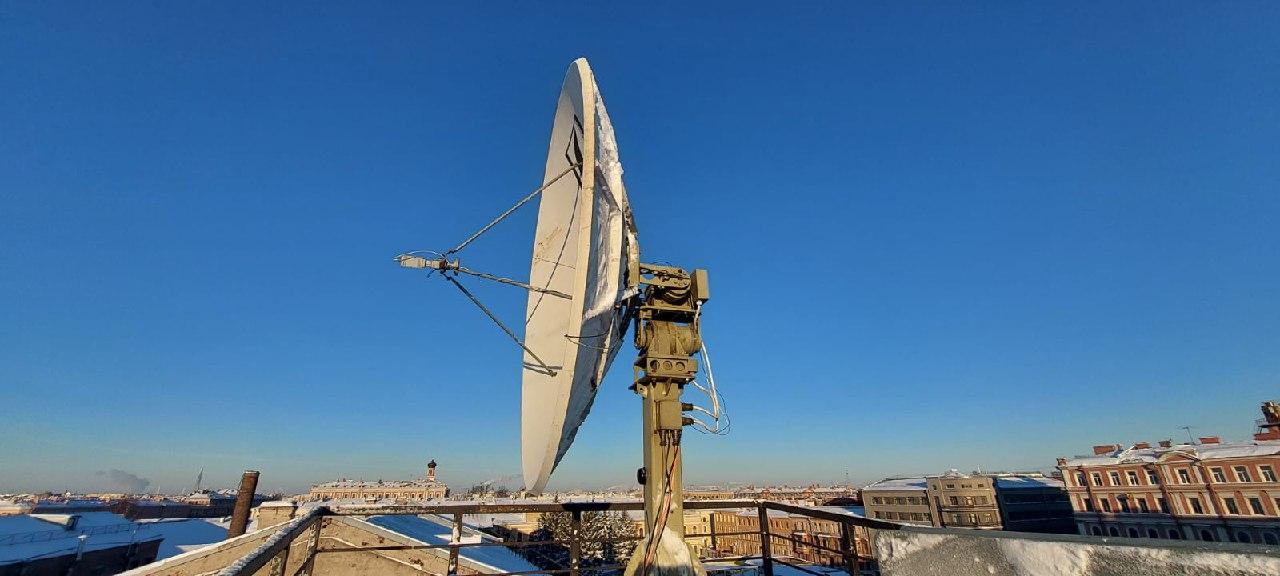
"Uniscan-24" receives data from satellites in real time within a radius of up to 2.5 thousand km at the X-band frequency (8 GHz). These are Russian spacecraft "Meteor-M", "Kanopus V", "Resurs-P", "Aist-2D". The station also works with foreign satellite constellations - for example, "Aqua", "Suomi NPP", NOAA, "FengYun-3", "Landsat-8" and "Sentinel-1A".
When processing data, the station allows you to track in real time:
- atmospheric objects - types of clouds and their development, water vapor content, smoke, dust, temperature characteristics;
- characteristics of surface waters - mineral and organic turbidity, phytoplankton, water temperature, ice;
- land objects - vegetation condition, thermal characteristics, fires, snow cover.
After the modernization of the antenna system and receiving station "Uniscan-24" at SPb GUAP, it is planned to create methods for recognizing dangerous processes and phenomena in the environment using machine data processing methods. In addition, the station will be considered as a backup for performing tasks of the Ministry of Emergency Situations in the Northwestern Federal District.
In the future, together with the scientific divisions of the Ministry of Emergency Situations, methods will be developed for processing new data from updated satellite constellations to identify potentially dangerous areas and emergency situations.
Read materials on the topic:
How to protect your eyes when observing the Sun: recommendations from the Moscow Planetarium
Elon Musk spoke about Russia's plans to build a nuclear power plant on the Moon
Never miss our newsAdd this site to your preferred sources to see us more oftenAdd on Google

















