In recent years, personal mobility devices (PMD) have become an alternative to public transport for short-distance travel in Russian cities. The international forum of digital technologies in transport and logistics "Digital Transportation-2024" hosted a partner session "Regulation and safe development of new urban transport - scooters", which discussed the regulation of this industry.
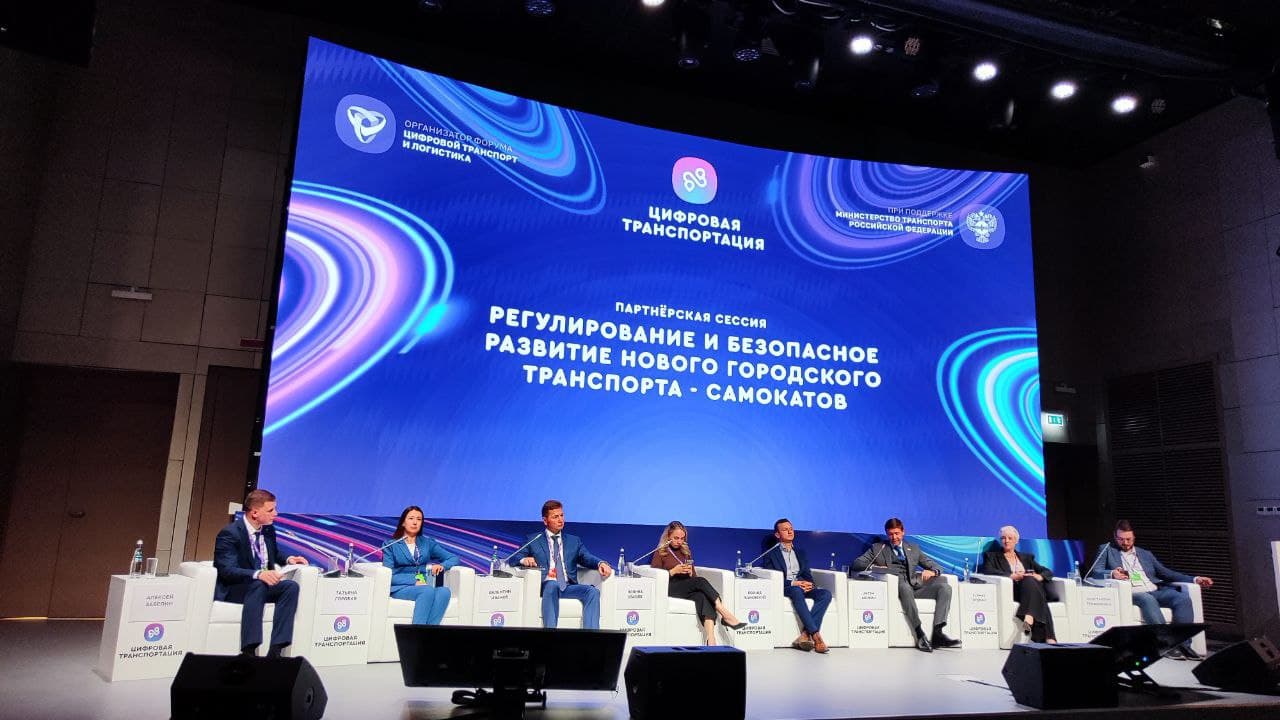
According to the First Deputy Minister of Transport of the Russian Federation, Valentin Ivanov, personal mobility devices are gaining popularity today and are becoming increasingly in demand. But this area requires careful regulation.
Currently, measures are provided that will allow monitoring of road traffic and maintaining statistics of accidents involving personal mobility devices.
To eliminate gaps in this industry, the Ministry of Transport has prepared a number of changes regarding speed limits, parking rules, and stopping of electric scooters. It was also decided to assign numbers to all personal mobility devices.
The head of new mobility projects of the Moscow Department of Transport, Polina Stasyuk, said that more than 15 thousand points have been created in the Russian capital to complete trips on electric scooters, as well as more than 350 "slow zones" - sections where the speed is limited. More than 500 kilometers of tracks have also been built for the development of micromobility in Moscow.
Leonid Yasinovsky, head of electric scooters within the Yandex Go project, emphasized that the company began assigning numbers to all PMDs, regardless of the city where the service is present, although initially this initiative did not seem promising.
We understand that we are part of cities and we are trying to implement Moscow's regulation practices at the level of the whole country.
According to Stasyuk, all PMDs imported into Russia must comply with the same standard - automatically slow down in "slow zones" and not exceed a speed of 50 km/h. She explained that all personal mobility devices traveling over 50 km/h cannot be considered as such, and the driver of such a device must have the appropriate category of driver's license to control them. It was not announced which category of rights drivers of private monowheels and scooters already developing speeds over 50 km/h should take a closer look at.
Despite the confident position in the market of transport services, experts' opinions about the future of PMDs differ. Ksenia Erdman, Director of the Association of Micromobility Operators, believes that in 10 years electric scooters will lose popularity and disappear from the streets. However, Deputy Minister of Transport of the Russian Federation Valentin Ivanov holds a different opinion. According to him, in 10 years electric scooters will become more comfortable and convenient, and perhaps even flying.
Earlier www1.ru reported that Russia plans to introduce mandatory registration of electric scooters, electric bicycles and mopeds.
Read materials on the topic:
Punishment for accidents, group and drunken driving on a scooter has been tightened in Russia
Russian AI will start making voice comments to scooter riders and smokers
"Smarter" than the one behind the wheel: Whoosh introduces computer vision in electric scooters