Russian military personnel at the forefront are using 1,500 kg volume-detonating aerial bombs (ODAB) with a universal correction and planning module. They use the spraying of a combustible substance in the form of an aerosol and the detonation of the resulting gas cloud.
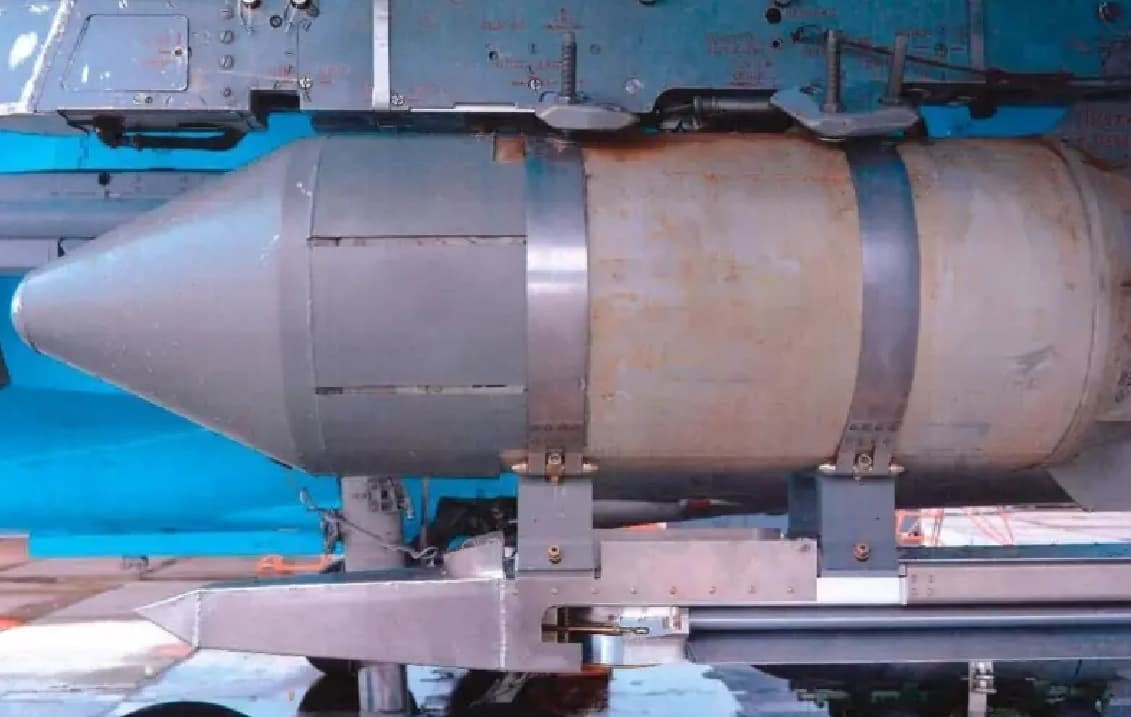
According to information from open sources, ODAB, like other volumetric explosion ammunition, does not differ in the complexity of the principle of operation or design. The ammunition is a thin-walled tank filled with flammable liquid with the necessary parameters. The ammunition is also equipped with an explosive charge for spraying the liquid and a detonator for its ignition.
Effective in different conditions
Volume-detonating ammunition is equally effective in open areas and against fortifications. In the second case, the explosive aerosol spreads in a cloud over the target, and in the second, it enters bunkers through embrasures and air ducts.
In addition to the thermal radiation of high temperature and shock wave, the damaging factor of ODAB is a sharp jump in atmospheric pressure due to the oxygen burned by the explosion.
According to the Telegram channel @RussianArms, the crew of the Su-34NVO fighter successfully used ODAB-1500 at the forefront. The pilots worked on the target from a distance of 55-65 km, being under the anti-missile barrier of self-propelled firing units 9A317M of the Buk-M3 military air defense system.
Earlier, www1.ru reported that the Russian Armed Forces created a miniature wheeled drone to blow up enemy fortified areas. The platform is capable of delivering a TM-62 mine to the enemy's dugout and blowing it up.
Read materials on the topic:
Shield of the Russian Army: Viking air defense system will reliably cover the sky from HIMARS
Return of the Molniya: the Stupinets missile boat will join the Caspian Flotilla
Strength and power: Russian MiG-29K fighters will be able to carry Kh-59MK2 and Kh-38MTE missiles
Now on home

Start of deliveries scheduled for 2027

Over 51,000 new motorcycles were sold in Russia in 2025

The car will take at least a year to assemble

The application's audience has reached 20 million users

The model will be included in the list of cars for taxis, price - from 2.25 million rubles

All parking lots of the "Administrator of the Moscow Parking Space" are connected to the service

The cars will be supplied to the Moscow Transport Service Directorate

Deliveries to India may begin in 2028

The technology provides automated search for all types of defects in power units

The plane flew 500 km, accelerating to 425 km/h

The plant stated that the information about the termination of purchases for models 6 and 8 is not true

Scientists are using the "Ekran-M" installation