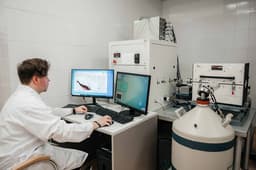
Russian scientists from MIPT, the Kotelnikov Institute of Radio Engineering and Electronics of the Russian Academy of Sciences, and the "Magnetic Metamaterials" laboratory of Saratov State University are developing tools for managing high-speed magnetic microelectronics. A scientific article with the research results has been published in the journal Applied Physics Letters.

How does it work?
In conventional microelectronics, energy or information is transferred by electric current, represented by electric charge through electrons. In magnetic microelectronics, energy or information is transferred by spin waves, in which oscillations of magnetic moments (spins) of atoms are transmitted in a chain from one atom to another. The transfer of magnetic interactions can be carried out by magnons, the quantum analogue of a spin wave.
In 2020, the MIPT press service announced that scientists from Russia and the United States had learned to control the behavior of magnons using ultrashort laser pulses. It was noted that this discovery could accelerate the creation of quantum computers and ultra-economical information transmission systems.
What's new that Russian scientists have done?
With the support of grants from the Russian Science Foundation, it was выяснено how antiferromagnets with their magnetoelastic properties can be used to control high-speed magnetic microelectronics. Using hematite Fe2O3 — iron oxide — which exhibits its properties at room temperature, the scientists showed a change in the properties of spin waves in hematite crystals under external influence.
During the experiments, they mechanically deformed a plate with the material, and then, by compressing or stretching it, increased or decreased its resonant frequency in the terahertz range.
Currently, information transfer rates are rapidly increasing and operating frequency ranges are expanding. These changes have become possible thanks, in particular, to advances in magnonics, including with the help of antiferromagnetic materials. They demonstrate ultrafast spin dynamics and have their own frequencies in the giga- and terahertz frequencies, which opens up prospects for the development of fundamentally new high-speed and ultra-precise magnetic microelectronic devices.
According to Bogdanova, antiferromagnets, due to their properties, may be promising for use in magnetic memory devices, tunable detectors, generators of gigahertz and terahertz radiation, and waveguides. In the future, it is planned to develop research and manufacture composites from layers in which the frequencies of spin waves will be changed by electrical voltage (heterostructures).
Read materials on the topic:
Russia is developing domestic software for sensors for rocket engineering, drones and oil production
The construction of the largest data center in Siberia has been completed in Novosibirsk