Alexey Likhachev, Director General of Rosatom, told reporters the timeline for the launch and connection to the grid of the world's first lead-cooled reactor, BREST-OD-300.
We have a physical start-up in 2026, connection to the grid in the first half of 2027. That's how it's going according to plan.
BREST-OD-300 is the world's first fourth-generation fast neutron reactor unit with a lead coolant. The reactor is part of the Pilot Demonstration Energy Complex (PDEC) under the Proryv (Breakthrough) industry project. Construction is underway in Seversk, Tomsk Region, the largest of Russia's closed nuclear cities. The capacity of the BREST-OD-300 nuclear power unit will be 300 MW.
The PDEC itself is a site where, for the first time in the world, a nuclear power plant with a "fast" reactor and an on-site closed nuclear fuel cycle will be built simultaneously. This includes a module for the production of uranium-plutonium nuclear fuel, a power unit with an innovative fourth-generation "fast" reactor BREST-OD-300, and a module for processing spent fuel. After processing, the spent fuel will be sent for refabrication with multiple recycling of fissile materials. That is, the system will eventually become autonomous and independent of external energy supplies.
The advantage of fast neutron reactors is the ability to efficiently use secondary products of the fuel cycle, in particular, plutonium, for energy production. At the same time, possessing a high breeding ratio, fast reactors can produce more potential fuel than they consume, as well as burn, that is, utilize with energy production, highly active transuranic elements (actinides).
The BREST-OD-300 reactor will provide itself with the main energy component - plutonium-239, reproducing it from the uranium-238 isotope, which accounts for more than 99% of natural uranium ore. Currently, uranium-235 is used for energy production in thermal reactors, the content of which in natural ore is about 0.7%. The introduction of such technologies will greatly increase the efficiency of the use of natural uranium, while its share in world reserves of energy resources is about 86% (coal - 8%, oil - 3%, gas - 3%).
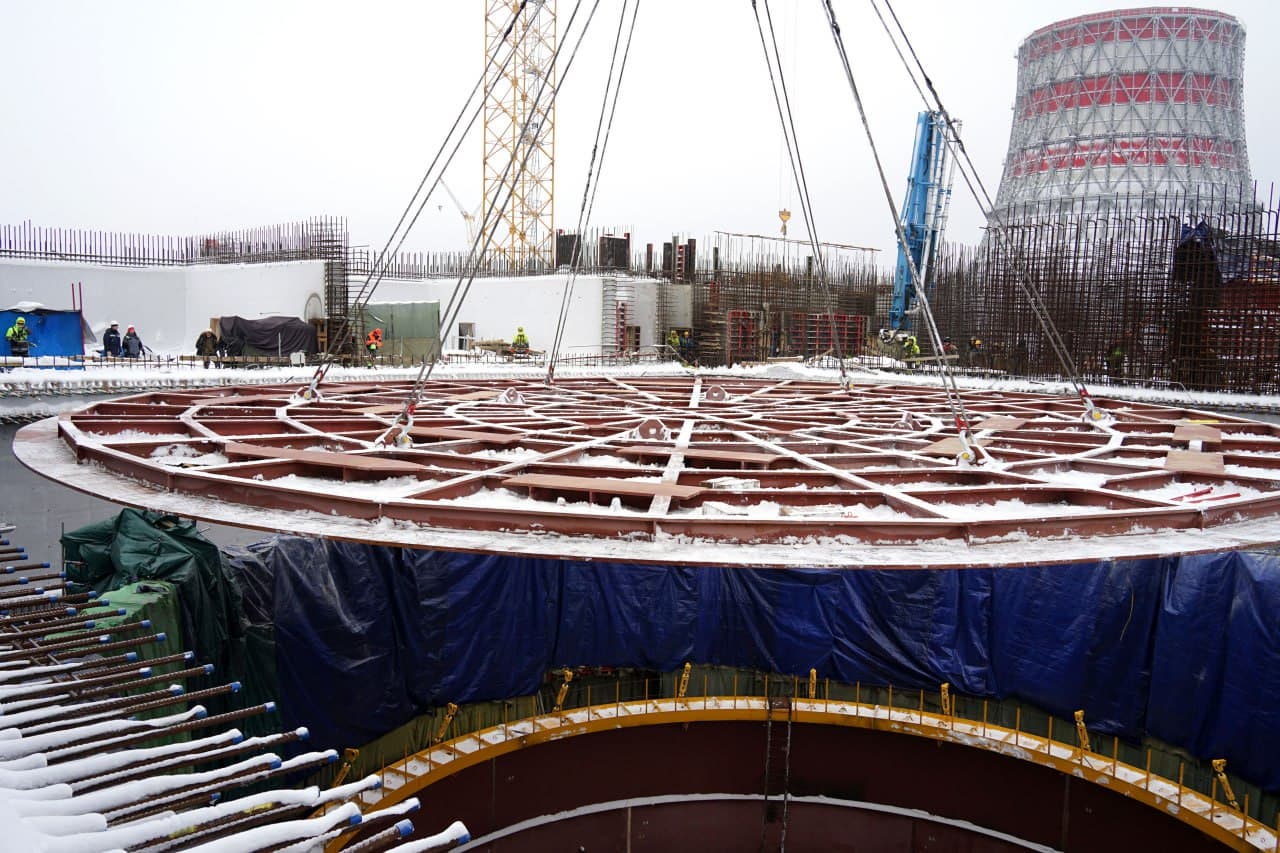
Installation of the fourth-generation BREST-OD-300 reactor unit began in January this year, and builders lowered the first part of the BREST-OD-300 reactor unit vessel – the lower tier of the enclosing structure – into the reactor shaft. It will be delivered in parts, as it is large, and its final assembly is only possible at the PDEC construction site.
The first of the PDEC facilities, the nuclear fuel fabrication/refabrication module, will be commissioned this year.