At the "Army-2024" arms exhibition, the "Quadriga" robotic transporter on a wheeled chassis with a 120-mm 2B11 mortar mounted on it was presented. Army Recognition drew attention to this combat robot with the emblem of the Kalashnikov concern.
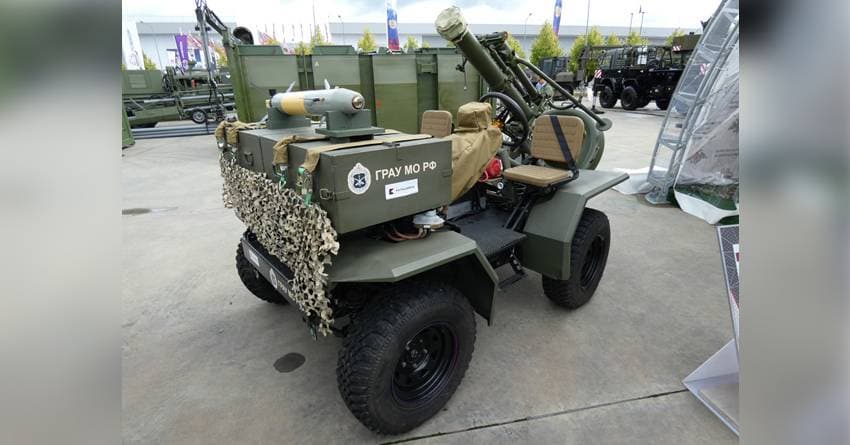
The integration of the 120-mm 2B11 mortar allows the robotic transformer to effectively destroy enemy personnel, fortifications, and equipment. This unmanned system provides a significant advantage, reducing risks to its operators.
The "Quadriga" is built on a 4x4 wheeled chassis specially designed for off-road driving. The 2B11 mortar mounted on the transporter has a firing range of 7 km. One of the features of this system is its rapid deployment. The "Quadriga" switches from a traveling to a combat position in 2 minutes.
The mobility of the "Quadriga" is enhanced by its ability to travel up to 800 kilometers on a single refueling. Despite its power and payload capacity, the transporter can reach a maximum speed of 30 km/h. The introduction of the "Quadriga" self-propelled mortar system marks a significant step forward in the Russian military robotics program.
As Army Recognition writes, by integrating advanced unmanned systems with traditional artillery, Russia is setting a new standard for how ground forces can operate in combat conditions. The development of the "Quadriga" proves Russia's commitment to maintaining its advantage in unmanned military technologies.
Read more on the topic:
Stings mortally: Russian combat robot "Scorpion-M" appeared on the front line
Now on home

The model's price starts from 10.7 million rubles
Self-propelled launchers now carry three times more missiles - production of 9M317M has reached a new level
Zala to bring the drone to UMEX 2026 exhibition

The development is based on hydrogel with the secret of mesenchymal stem cells

The plant has completely replaced the import of critical components

Engineers are testing engines, avionics, and hydraulics in extreme temperatures
The machine's operating weight has been increased from 23.5 t to 29.0 t

The use of components from Logan and "Niva" simplifies operation and reduces costs

The development will allow the production of new generation high-voltage pulse generators

The limit of 150 km/h is considered more than sufficient

The vehicle will reach speeds of up to 140 km/h and dozens of functions due to interchangeable modules

University scientists have created new polymeric materials to replace metal structures