Translated with AI from the Russian original.
Scientists at the Institute of Automation and Control Processes of the Far Eastern Branch of the Russian Academy of Sciences are developing a “lab-on-a-chip” that should analyze the biochemical composition of blood in real time. It will require a small amount of biomaterial, and in the future, the results are planned to be displayed directly on a smartphone. This was announced by the Vice-President of the Russian Academy of Sciences, Chairman of the Far Eastern Branch of the Russian Academy of Sciences, Yuri Kulchin.
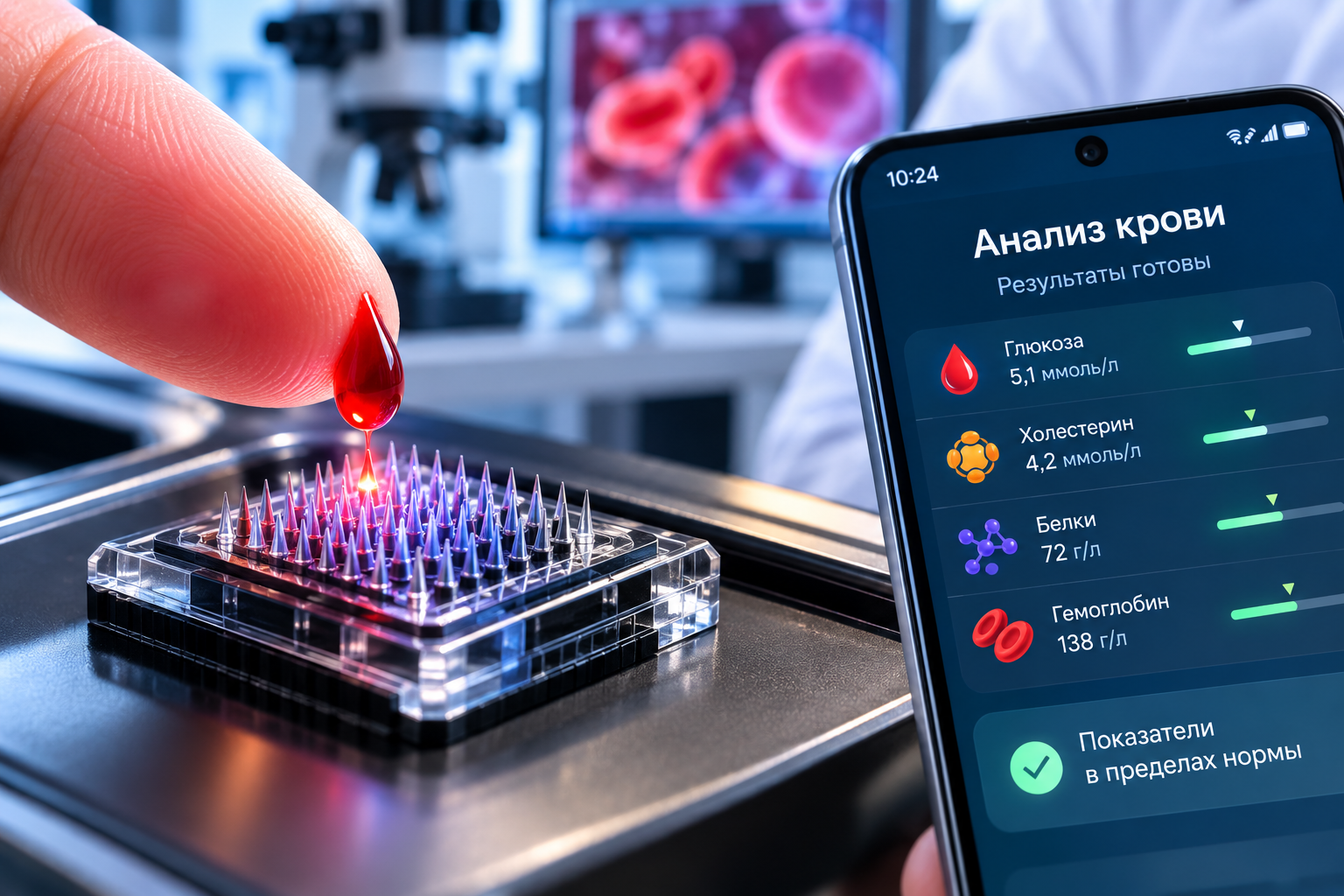
The development will be based on the method of induced photoluminescence. When exposed to light, molecules respond in a certain spectral range. Researchers obtain a kind of “passport” of such a response, the parameters of which can change depending on the biochemical composition of the blood and the presence or absence of disease.
The main problem with this approach is weak signals. Therefore, scientists use a plasma amplification system. A set of microscopic needles is created on the chip, which should amplify the optical signal. Thanks to this, small drops of blood will be sufficient for analysis.
Usually, the signals are very weak. To amplify them, a so-called plasma system is used: a set of needles is created on the chip, and each is a signal amplifier. Therefore, small drops of blood are sufficient. And such a chip can be used in a phone - this is what we are striving for.
Thus, researchers want to replace part of the equipment of a conventional laboratory with a compact sensor. It should obtain information about the composition of the sample by its optical response, using a small amount of blood.
Currently, the development is at the stage of system creation. Scientists are also exploring further possibilities for applying such technologies. In particular, the development of quantum biology may lead to the emergence of miniature robots capable of recognizing pathogens and analyzing the state of the body.
Read more on the topic:
Never miss our newsAdd this site to your preferred sources to see us more oftenAdd on Google

















