Scientists from Novosibirsk have found a way to make powerful laser light more even and stable. They discovered that as power increases, light begins to distribute almost equally among several channels within a single thin optical fiber. The experiment used a fiber with seven such channels, and fluctuations in light distribution at high power decreased to less than 5%.
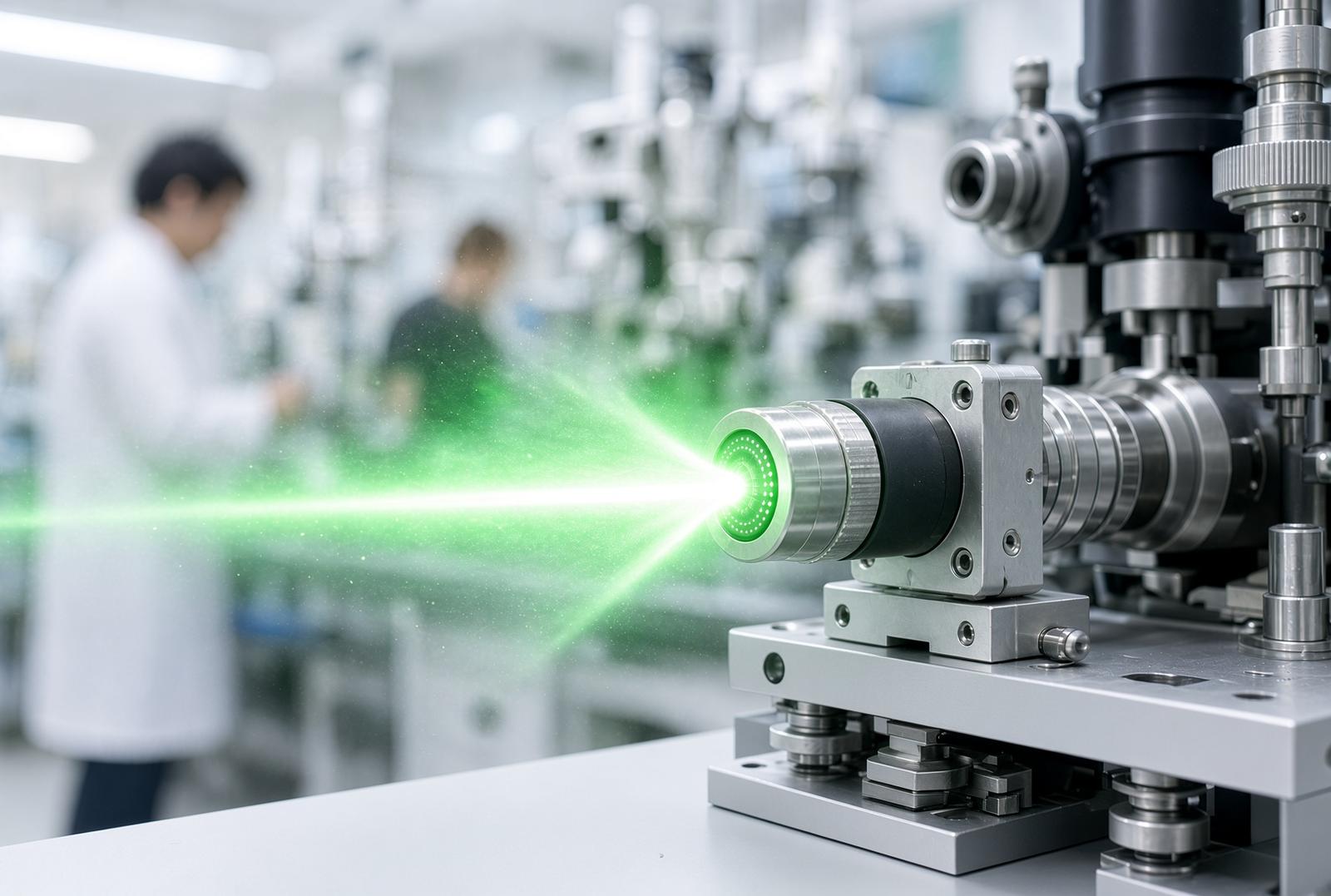
This refers to an optical fiber that has not one, but several channels for light. Imagine a very thin glass thread with several separate “paths” laid inside. In the experiment, there were seven such cores. This allows light to be transmitted simultaneously through several channels and combined into one common beam.
However, such a design has a drawback — adjacent cores begin to influence each other. At low power, energy is distributed randomly between them, so one channel may have more of it, and another less. The result is an uneven and unstable light beam.
How scientists from Novosibirsk solved the laser problem
Researchers from the Institute of Automation and Electrometry SB RAS and Novosibirsk State University first passed relatively weak laser pulses — about 130 watts — through the fiber. At low power, the distribution of output power between the cores was random and characterized by significant fluctuations — energy was constantly redistributed between them, resulting in an uneven and changing light spot.
Then the scientists significantly increased the power — to several kilowatts. And the light began to distribute much more evenly among all seven channels. Instead of a spotty and unstable image, a more even and stable light beam was obtained at the output.
The experiment was conducted with very short laser pulses in an optical fiber about 10 meters long. Moreover, the new mode proved to be stable even when the fiber was bent or twisted. The researchers also found that after about five meters, the light already begins to distribute more evenly between the channels.
Scientists explain the effect by the nonlinear properties of light
At high power, the laser begins to affect the properties of the material inside the optical fiber, which causes energy to be more actively redistributed between adjacent cores. As a result, individual fluctuations are smoothed out, and the light is ultimately distributed much more evenly among all seven cores.
The research was supported by a grant from the Russian Science Foundation. The results of the scientific research were published in the journal Opto-Electronic Advances.
The authors believe that the obtained effect can be useful in creating future optical systems for communication, laser technology, sensing, and visualization. Possible applications in medical and industrial laser equipment are also being considered.
Read more on the topic:
Never miss our newsAdd this site to your preferred sources to see us more oftenAdd on Google