Scientists from Chelyabinsk State University (ChelSU), together with colleagues from South Ural State Medical University, the Institute of Applied Mathematics of the Far Eastern Branch of the Russian Academy of Sciences, and the Pacific Oceanological Institute, have developed a device for cleaning wounds using a laser and an antiseptic.
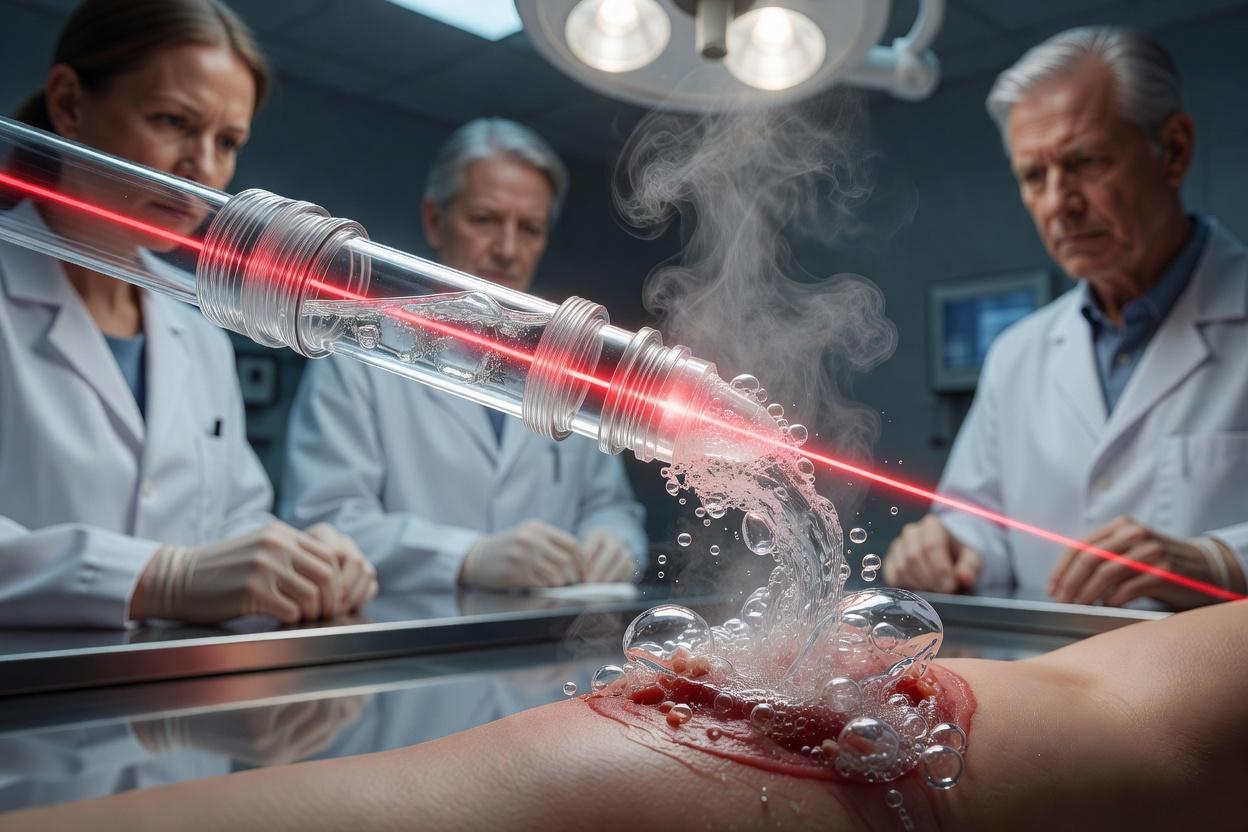
The device consists of two tubes inserted into each other with a laser fiber optic inside. Cold antiseptic is supplied through the outer tube, which instantly boils under the action of the laser at the device's outlet. The resulting steam bubbles create a vacuum of about 0.25 atmospheres, and a fluid flow occurs, drawing the wound contents into the tube.
As Anastasia Anchugova, one of the developers and a senior lecturer at the Department of General and Theoretical Physics at ChelSU, explained, this is similar to a controlled whirlpool. Bubbles and jets dislodge bacterial plaque, pus, and particles of dead tissues from the wound surface, drawing them into the tube. At the same time, healthy cells are not injured; on the contrary, they are stimulated by laser radiation for faster recovery.
The development has already been patented. Researchers have moved on to testing it on patients with phlegmons, trophic ulcers, diabetic, and infected postoperative wounds. However, ChelSU emphasized that the method does not replace surgical wound treatment but acts as an auxiliary tool that accelerates cleaning and healing. In the near future, scientists plan to expand the clinical base and conduct a comparative study with existing wound treatment methods.
Read more on the topic:
Never miss our newsAdd this site to your preferred sources to see us more oftenAdd on Google