Anatoly Kozhanov, a designer from Volgograd, has developed an unusual design for a gravitational engine. The scheme is based on a shaft with a system of weights that are supposed to move relative to its axis due to the complex mechanics of rotating brackets and cantilevers.
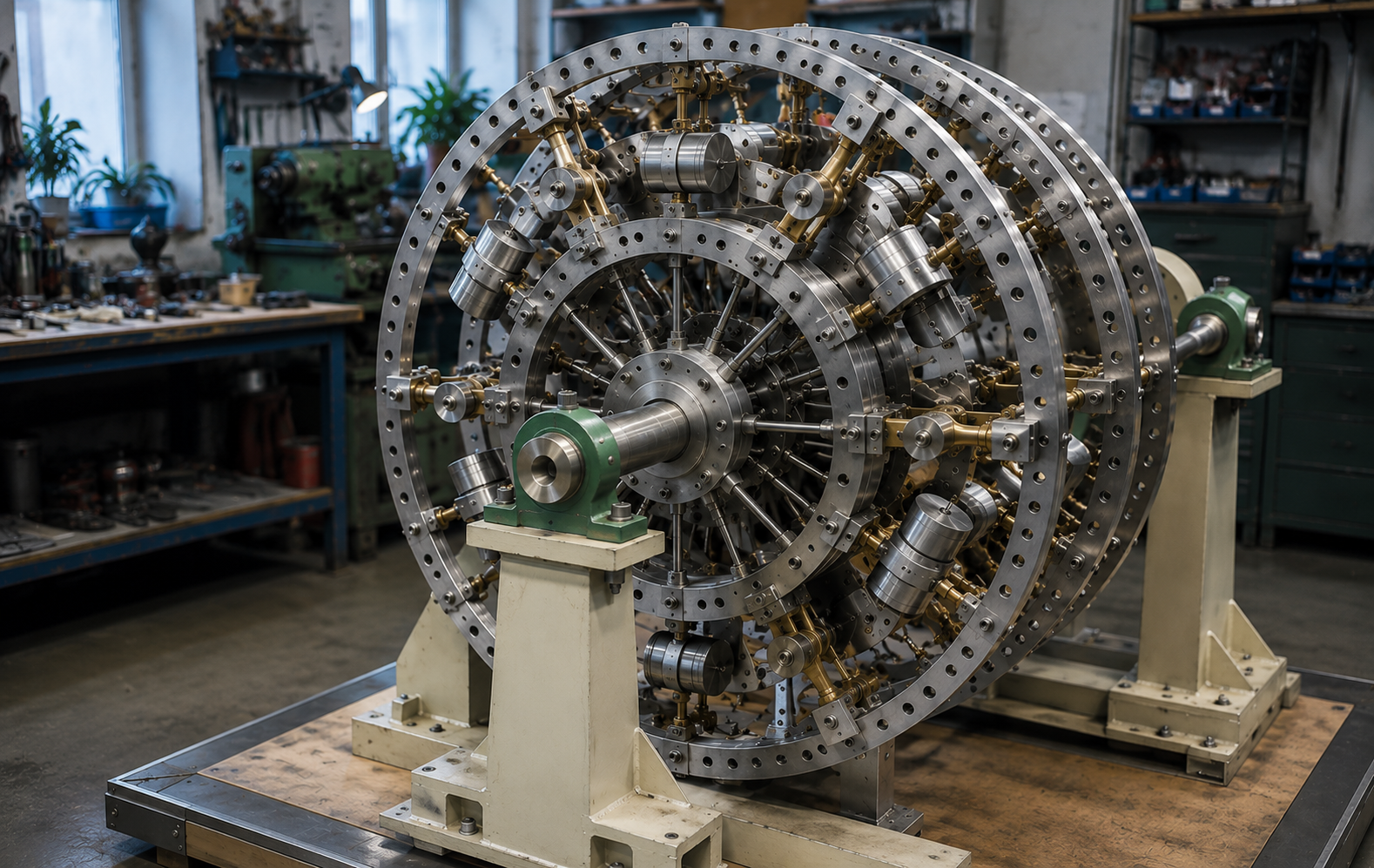
The inventor proposes to install carriers on the shaft, arranged circumferentially and along its length. Rotating brackets are attached to them, the axes of which can tilt relative to the vertical plane passing through the shaft axis.
Cantilevers with weights are attached to the brackets. They are capable of limited rotation and interaction with support elements connected to the massive base of the structure. Some of these supports, according to the patent, can move and be fixed in certain positions.
The idea of the scheme is to controllably change the position of the weights relative to the axis of rotation. Due to this, the author proposes to organize the operation of a mechanism in which the movement of masses is associated with the rotation of the shaft.
From the editors of "Pervy Tekhnichesky": Kozhanov's idea inevitably breaks against the laws of physics. The mechanics he presents with rotating brackets and shifting cantilevers can only temporarily redistribute moments of force, creating the illusion of excessive work on one side, but without an influx of external energy, rotation will inevitably cease. The described scheme is a classic "gravitational/inertial engine" with unbalanced weights on a lever; such designs are regularly patented but do not produce useful work without an external energy source – this contradicts the law of conservation of energy.
This is far from the first attempt to invent a "perpetual" engine. Recently, Viktor Bakhirev, an engineer from Nalchik, also presented his scheme for such a power plant, but "Pervy Tekhnichesky" also had serious questions about it.
Read more on the topic:
Never miss our newsAdd this site to your preferred sources to see us more oftenAdd on Google