Translated with AI from the Russian original.
Small underwater vehicles often only manage to operate for 30–40 minutes before having to return to the surface. Scientists at Perm Polytechnic have proposed a design that should work for almost an hour. The vehicle will weigh about 10 kilograms, be able to dive up to 100 meters, and its cost is planned to be reduced by approximately 2–3 times thanks to 3D printing.
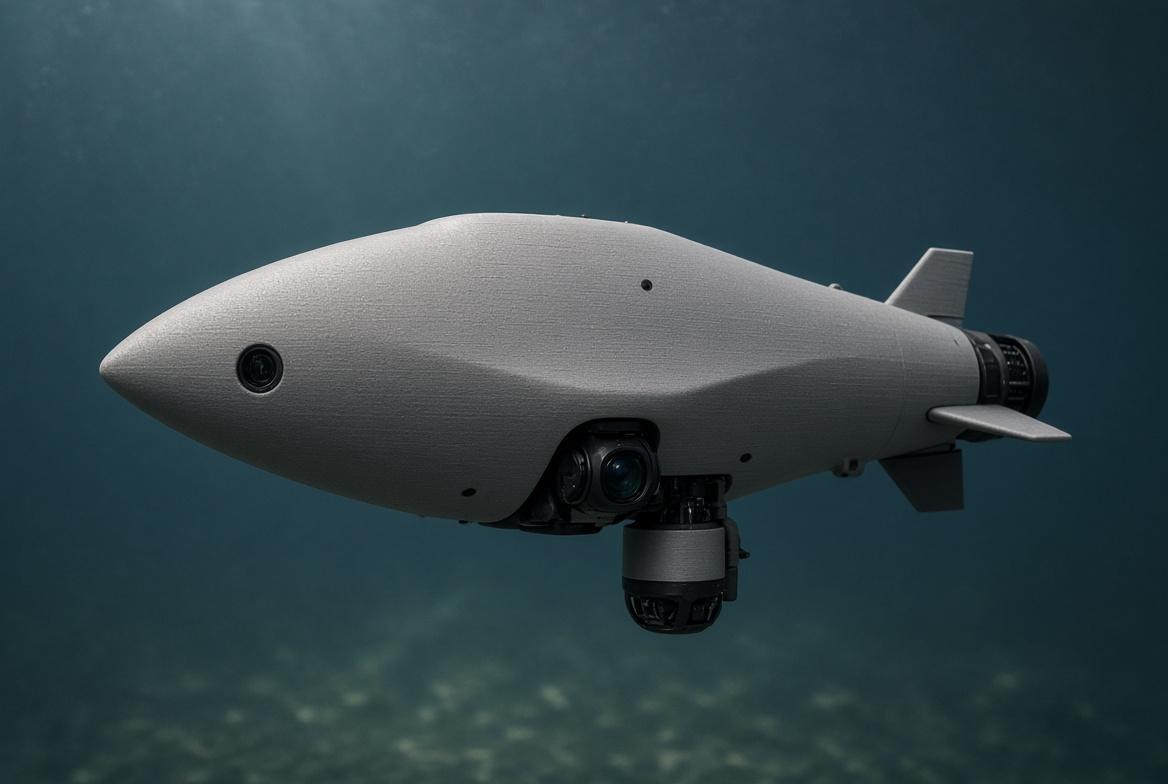
Unmanned underwater vehicles are used for seabed research, environmental monitoring, and inspection of underwater objects. They can be used to map terrain, study ecosystems, and conduct search operations. They are also needed for monitoring gas pipelines, port facilities, bridges, and communication cables.
Such devices are especially useful where it is difficult or dangerous for humans to work. The vehicle can be used under ice, in heavily polluted water, or in strong currents where diver immersion is impossible.
Most compact models are designed for depths of approximately 50–300 meters and are well-suited for coastal areas. However, their small size simultaneously creates a problem. It is difficult to place powerful engines and effective stabilization systems inside the hull. Therefore, the vehicle can be carried away even by a weak current, and constant adjustment is required to maintain the desired position.
Because of this, small devices usually operate for only 30–40 minutes. During this time, they do not always manage to fully inspect the desired area or find damage. Then the dive has to be repeated, and checking one object can take several days.
Increasing operating time or making the device more stable is also not easy. This requires complicating and weighing down the design. As a result, it loses the main advantage of small devices – compactness. According to researchers, there are currently no serial models that are simultaneously lightweight, efficient, and inexpensive.
PNIPU proposed a different design option
The vehicle will be able to operate autonomously for at least an hour, will be designed for depths up to 100 meters, and will weigh about 10 kilograms. For comparison, most existing analogues weigh 30–50 kilograms.
Scientists abandoned the usual cylindrical hull in favor of a more streamlined shape. It reduces water resistance and allows the vehicle to move more efficiently.
Instead of a conventional propeller, the developers used a waterjet. Water is sucked into the vehicle and ejected backward through a nozzle that can be rotated in different directions. Therefore, the device will not only be able to move forward but also quickly change direction. In addition, the waterjet creates less resistance and helps save battery power.
Separately, the developers created a control system that should keep the vehicle level. If the device begins to tilt forward, backward, or sideways, the system returns it to its original position. This will allow it to maintain stability at depth and stay on course even in strong currents, said Pavel Kuleshov, Associate Professor of the Department of "Information Technologies and Automated Systems" at PNIPU, Candidate of Technical Sciences.
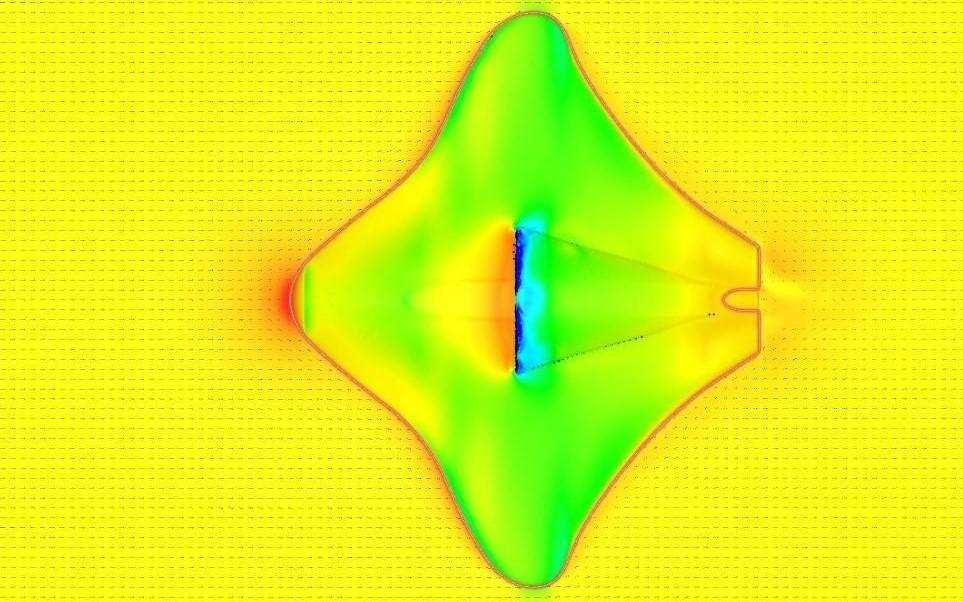
Before water tests, researchers created a three-dimensional model of the vehicle and tested it virtually. The calculations took into account current and hydrodynamic loads characteristic of the coastal zone. The depth was taken with a margin – up to 100 meters. This allowed checking whether the structure would withstand pressure, maintain tightness, and maneuverability.
Calculations showed that the vehicle maintains stability during movement
The streamlined hull reduces water resistance and evenly distributes the load, which should prevent deformation and loss of tightness.
The mass and cost of the structure are planned to be reduced through 3D printing from polymer. Usually, underwater vehicle hulls are made of steel or titanium alloys to withstand pressure. However, modern composite materials are comparable to metals in strength but significantly lighter. According to preliminary estimates, this will reduce the cost of the new vehicle by approximately 2–3 times without loss of reliability, noted Pavel Kuleshov.
In the future, the vehicle is planned to be used for inspecting underwater pipelines and port facilities, seabed mapping, and environmental monitoring. The next stage should be physical tests in reservoirs. They will allow checking the operation of all systems in real conditions and refining the design before possible launch into mass production.
Read more on the topic:
Never miss our newsAdd this site to your preferred sources to see us more oftenAdd on Google

















