Translated with AI from the Russian original.
Russian President Vladimir Putin has instructed the development of standards for autonomous civilian cargo transportation using drones in the Far East. In Yakutia, the mechanism is undergoing testing. As part of the "Air Crossing" project, drones made 270 flights across the Lena River over a distance of 12 km in 2025.
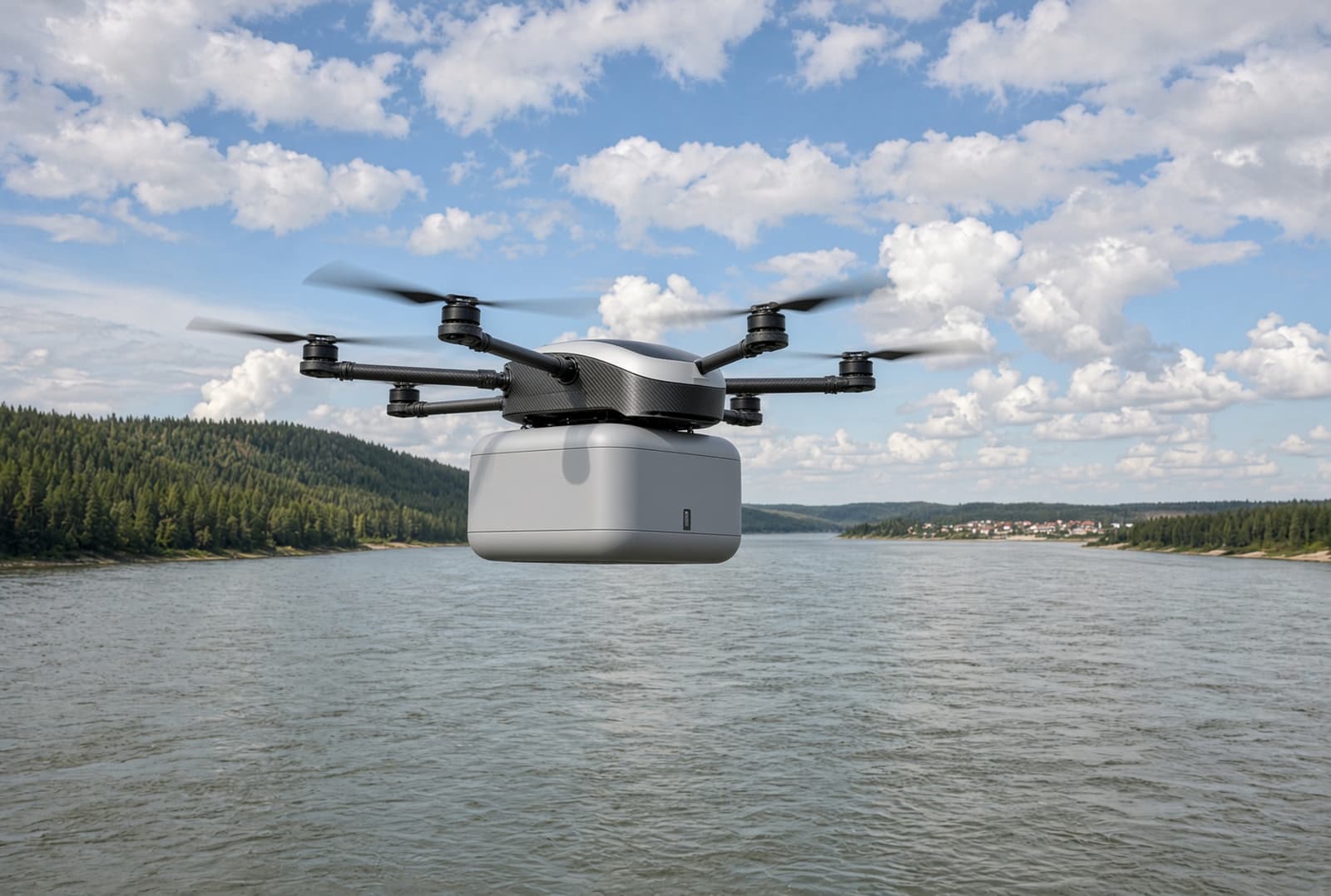
It is already necessary to set standards for autonomous transportation of civilian goods using drones.
For the region, such technology is particularly relevant due to long distances and difficult natural conditions. There can be hundreds of kilometers between settlements, and during the muddy season, movement on roads becomes difficult. A drone, however, can fly directly, without using roads and crossings.
In Yakutia, the effectiveness of this approach is already being tested in practice. The "Air Crossing" project completed 270 flights across the Lena River over a distance of 12 km in 2025.
In addition, a special regime for testing unmanned technologies is planned for the Far East. It should allow for faster testing of new solutions for civilian applications. This summer, the Federal Center for Unmanned Aircraft Systems compiled a rating of drone adoption in Russian regions. The Khanty-Mansi Autonomous Okrug and Yamal-Nenets Autonomous Okrug became the leaders.
A separate area of drone application is related to the oil and gas industry
According to Skoltech Associate Professor Dmitry Teteryukov, the world's largest oil and gas company, Saudi Aramco, is already showing interest in Russian developments.
A team led by Grigory Yashin, Director of the Robotics Department, Candidate of Physical and Mathematical Sciences, and a graduate of Skoltech's postgraduate and master's programs, created the world's first drone swarm for seismic exploration. The technology was developed in the ISR Lab and patented in the USA.
The swarm consists of 16 drones. They scan more than 160 points with geophones and record seismic wave reflection data. This allows for highly accurate prediction of oil and gas deposits.
Previously, such work was performed manually in the desert and during sandstorms, which required significant time and money. Teteryukov believes that such technologies are particularly relevant for the Russian oil and gas sector.
Drone control algorithms are also developing
FlightDiffusion technology uses diffusion models to generate a drone's flight trajectory from just one image. This work was presented at the IEEE ICRA 2026 international robotics conference in Vienna.
Another development, AgenticRL, uses a multimodal GPT agent to create a reward function for drone reinforcement learning. According to the developers, this reduced training time from two months to several hours.
Read more on the topic:
Never miss our newsAdd this site to your preferred sources to see us more oftenAdd on Google

















